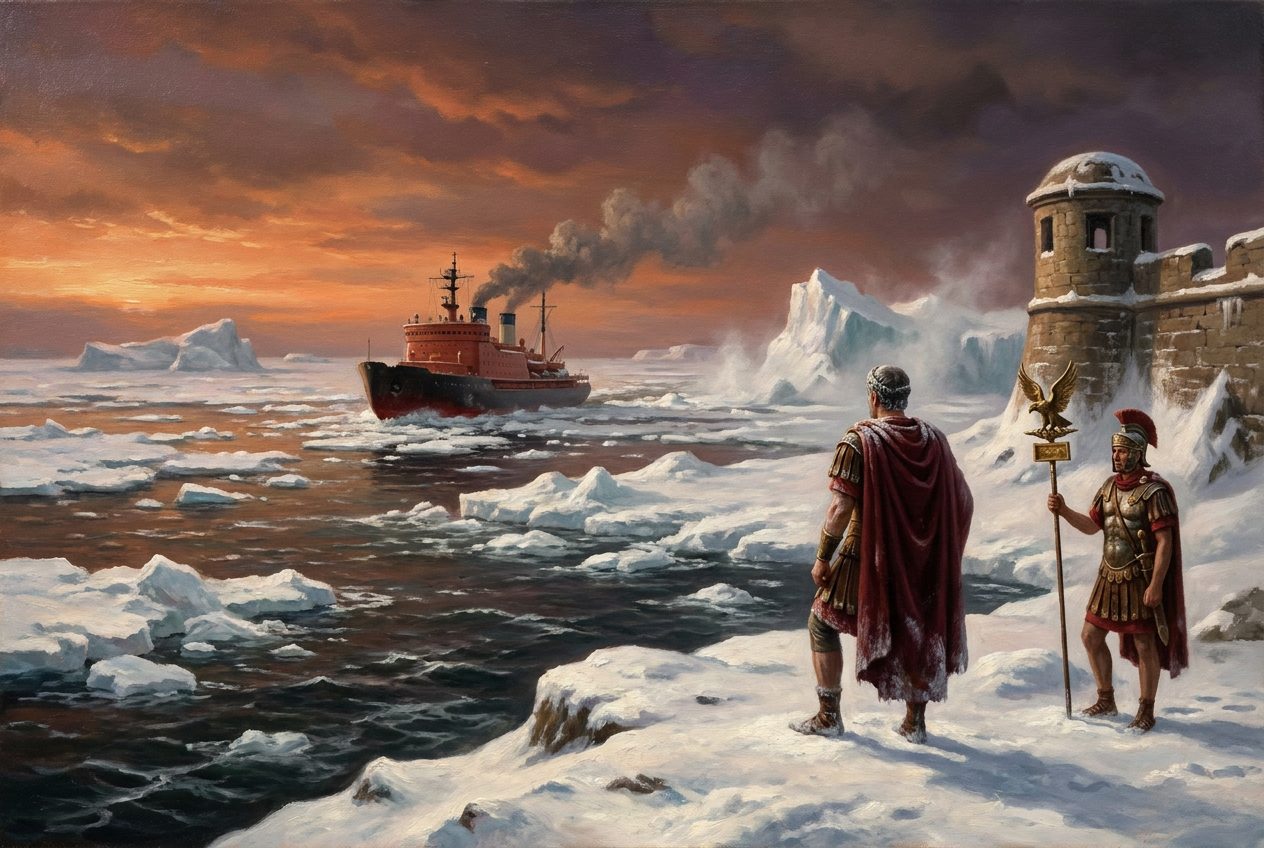
Tab. IMurus Quem Nemo Struxit, sive Limes Glacialis Solutus. Tabula Actis Mundi more veterum picta (a machina).The Wall No One Built, or The Frozen Frontier Undone. Painted for Acta Mundi in the classical manner (AI-generated).
Iter per Provincias · De glacie septentrionaliJourneys through the Provinces · On the Northern Ice
Murus quem nemo aedificavit liquescit
The Wall No One Built Is Melting
Acta quae Daily Signal inscribuntur nuntiant glaciem Arcticam per viginti annos crassitudine et spatio magis in singulas tempestates variare, ideoque duas vias maritimas patere, alteram per oras Alascae et Canadae, alteram per oram Russiae; naves glaciem frangentes et rationem quaestus requirunt. Ego censeo transitum in tabula pictum nihil esse nisi votum, donec castellis, navibus et commeatu teneatur.
The Daily Signal reports that for twenty years the Arctic ice has varied more from season to season in thickness and extent, and that two sea routes are therefore opening, one along the coasts of Alaska and Canada, the other along the coast of Russia; it calls for icebreakers and a business case. My judgment: a passage drawn on a map is nothing but a wish until forts, ships and supply hold it.
Cur hoc legimusWhy we read this Quia limes septentrionalis non verbis sed navibus ferratis muniendus est.Because the northern frontier must be fortified not with words but with iron-clad ships.
Nonis Novembribus, anno urbis conditae MMDCCLXXIX. Acta legi quae Daily Signal inscribuntur, ex illa magna re publica trans Oceanum. Nuntiant per hos viginti annos glaciem quae polum septentrionalem tegit crassitudine et spatio magis quam antea in singulas tempestates variare, et hac re vias maritimas opesque, quas uberes appellant, facilius adiri. Hoc uno fonte nititur; nemo alius in fasciculo meo idem testatur, neque mensurae ullae adiunctae sunt.
The Nones of November, in the 2779th year of the City. I have read The Daily Signal, from that great republic across the Ocean. It reports that over these twenty years the ice covering the northern pole has varied more than before, season by season, in thickness and extent, and that sea routes and resources it calls bountiful are therefore easier to reach. This rests on one source alone; no one else in my dossier says the same, and no measurements are attached.
Duas vias eminere scribunt: alteram, quam Transitum ad Septentrionem et Occidentem vocant, per oras septentrionales Alascae et Canadae; alteram, Viam Maris Septentrionalis, quae litus septentrionale Russiae praeterlegit. Utraque cursum breviorem pollicetur. Titulus ipse rem dicit: transitum illum naves glaciem frangentes requirere et rationem quaestus. Quis eas naves aedificaturus, quis pecuniam daturus, quae sint illae opes, oleum an metalla an pisces, acta non dicunt. Ego, qui castella numerare soleo antequam laudem, primum haec quaererem.
Two routes stand out, it writes: one, which they call the Northwest Passage, along the northern coasts of Alaska and Canada; the other, the Northern Sea Route, which skirts Russia's northern shore. Each promises a shorter voyage. The headline says the thing itself: the passage needs icebreakers and a business case. Who is to build those ships, who is to pay, what those resources are, oil or metals or fish, the paper does not say. I am in the habit of counting forts before I praise, and I would ask these things first.
Animadverte quid acciderit. Glacies murus erat quem nemo aedificavit, nemo custodivit, nemo stipendio aluit. Per saecula septentrionem clausit gratis, ut Oceanus Britanniam. Nunc ille murus in singulas aestates aperitur et clauditur, sicut porta cuius custos modo vigilat modo dormit. Ubi natura limitem retrahit, homines eum aut tenere debent aut amittere. Tertium non datur.
Consider what has happened. The ice was a wall no one built, no one guarded, no one kept on pay. For centuries it closed the north for nothing, as the Ocean closed Britain. Now that wall opens and shuts with each summer, like a gate whose sentry is awake one hour and asleep the next. When nature draws back a frontier, men must either hold it or lose it. There is no third choice.
Glacies murus erat quem nemo aedificavit, nemo custodivit, nemo stipendio aluit.
The ice was a wall no one built, no one guarded, no one kept on pay.
Novi quid sit finis in extremo orbe. In Britannia non in cera lineam duxi; pedibus perambulavi. Ita de me scriptum est: «murumque per octoginta milia passuum primus duxit, qui barbaros Romanosque divideret». Sed murus non lapide solo stetit: castella per singula milia passuum, turres inter ea, via militaris post vallum, cohortes quae hiemem ibi agerent, horrea quae eas alerent. Linea quae non habitatur fabula est cartographi, non limes imperii.
I know what a frontier at the edge of the world is. In Britain I did not draw a line on a wax tablet; I walked it. Thus it is written of me: "he was the first to build a wall, eighty miles long, to divide the barbarians from the Romans." But the wall did not stand by stone alone: a fort at every mile, turrets between, a military road behind the rampart, cohorts to winter there, granaries to feed them. A line no one lives on is a mapmaker's fable, not the limes of an empire.
Hoc in istis actis probo, quod rationem quaestus postulant. Recte. Castellum sine annona sepulcrum est; via quam nulla navis frequentat silvam alit, non commercium. Neque oblitus sum quid ipse fecerim cum imperium accepissem: Traiani provincias trans Euphratem reliqui, quia voluntate sola, non copiis, tenebantur. De me scriptum est me statim «tenendae per orbem terrarum paci operam» intendisse. Qui transitum glacialem sibi vindicat neque naves neque portus neque commeatum parat, Mesopotamiam meam iterum occupat, quam postea reddere cogetur.
This much I approve in the paper: it demands a business case. Rightly. A fort without its annona is a tomb; a road no ship travels feeds the forest, not trade. Nor have I forgotten what I did myself on taking power: I gave up Trajan's provinces beyond the Euphrates, because they were held by will alone, not by strength. It is written of me that I "devoted myself at once to keeping peace throughout the world." Whoever claims an ice passage and prepares neither ships nor harbors nor supply is occupying my Mesopotamia again, and will be forced to hand it back.
Duo tamen acta tacent quae imperator primum rogaret. Quot naves nunc per utramque viam vehantur non dicunt; at qui alteram viam per litus Russiae iam tenet, is non disputat sed navigat. Deinde, cuius sint aquae inter Alascam et Canadam, acta non definiunt; quod si inter socios non convenit, transitus prius iure figendus est quam navibus. Edictum meum praetoris semel in perpetuum fixi ne ius in singulos annos fluitaret; glacies fluat licet, ius ne fluat.
Yet the paper is silent on two things an emperor would ask first. It does not say how many ships now pass by either route; but whoever already holds the route along the Russian shore is not debating, he is sailing. Second, whose waters lie between Alaska and Canada the paper does not settle; and if the allies do not agree, the passage must be fixed in law before it is fixed with ships. I fixed the praetor's edict once and for all so that law should not drift from year to year; let the ice drift, the law must not.
Remedium igitur in promptu est, neque novum. Naves ferro munitas aedifica quae glaciem frangant; portus et stationes commeatus per oram dispone, ut castella per vallum; ius transitus cum socio constitue antequam alieni constituant; deinde magistratus ipse eat et videat, non ex curia per tabulas pictas imperet. Si haec facere non vult res publica, honestius est fateri viam non suam esse quam in actis eam vindicare.
The remedy, then, is ready to hand, and not new. Build iron-armored ships to break the ice; set harbors and supply stations along the coast, as forts along the rampart; settle the law of passage with your ally before strangers settle it for you; and then let the magistrate go and see for himself, not govern from the curia by painted maps. If the republic will not do these things, it is more honorable to admit the route is not its own than to claim it in the newspapers.
Glacies murum gratis praebuit; nunc murus pretio emendus est, aut alteri relinquendus.
The ice gave a wall for nothing; now the wall must be bought at a price, or left to another.
FONTES ANTIQVIANCIENT SOURCES
- SHA Hadr. 11.2murumque per octoginta milia passuum primus duxit, qui barbaros Romanosque divideret
- SHA Hadr. 5.1Adeptus imperium ad priscum se statim morem instituit et tenendae per orbem terrarum paci operam intendit
FONTES HODIERNITODAY’S SOURCES
- The Daily SignalThe Northwest Passage Needs Icebreakers and a Business Use Case
Res ex fontibus; sententia Romani.Facts from the sources; the opinion is the Roman’s.
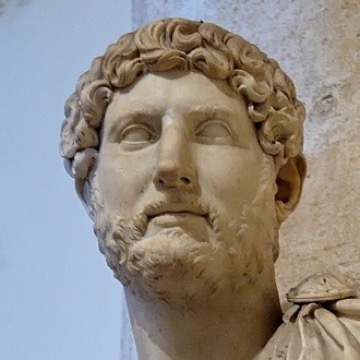
P. Aelius Hadrianus
Imperator peregrinator: omnes fere provincias obiit, fines imperii vallo in Britannia et limitibus firmavit, Pantheum restituit, Graecorum studiosus. Imperium non auxit sed servavit.The travelling emperor: he visited nearly every province, fixed the empire’s frontiers — with his Wall in Britain and fortified borders — rebuilt the Pantheon and loved all things Greek. He did not enlarge the empire; he secured it.
Haec vox restituta est ex his libris:This voice is reconstructed from:
Scribe ad Hadrian: tabellarius epistulam tuam per vias Romanas feret, et responsum post dies aliquot redibit.Write to Hadrian: the courier carries your letter along the Roman roads, and a reply comes back after a few days.
LEGE ETIAMREAD NEXT
- Limes qui non servatur non estA Frontier Unwatched Is No FrontierHadrian
- Tectum curiae ardet, annona clamat: utrumque audiendum, alterum puniendumThe council-house roof burns, the annona cries out: both must be heard, one must be punishedHadrian
- De commeatu aërio ex castris Mildenhall in Germaniam et Hispaniam translatoOn the air supply train moved from the camp at Mildenhall to Germany and SpainCaesar
- Ieiunium non est temperantiaFasting Is Not TemperanceFrontinus
- Harenam in thesaurum vertit ingenium; thesaurum unius hominis custodia tueturGenius turns sand into treasure; one man's keeping guards the treasurePliny the Elder