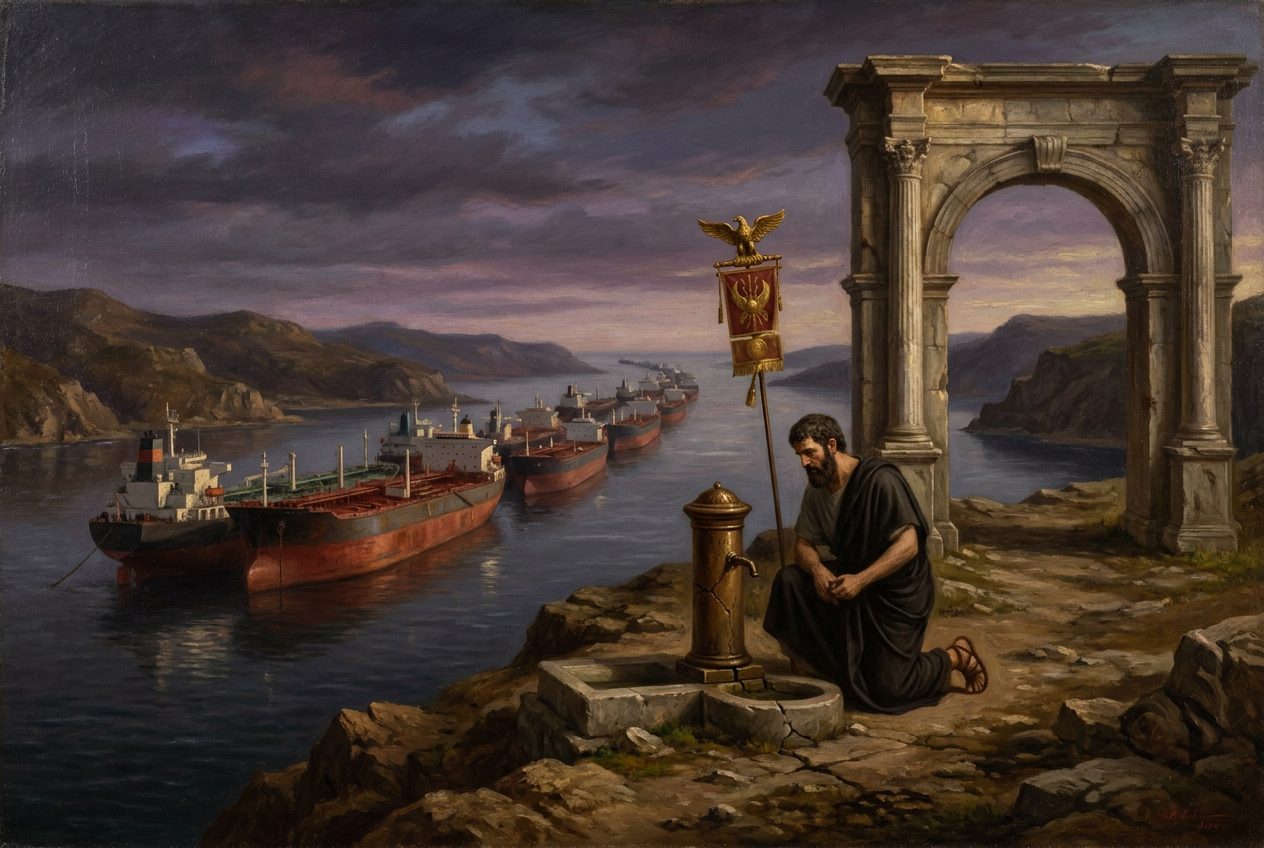
Tab. IFons Interclusus, sive Caelum Fame Purgatum. Tabula Actis Mundi more veterum picta (a machina).The Spring Cut Off, or The Sky Cleared by Hunger. Painted for Acta Mundi in the classical manner (AI-generated).
De Aquis et Strategematis · De faucibus Hormuzianis et caelo purgatoWaters and Stratagems · On the Strait of Hormuz and a cleared sky
Ieiunium non est temperantia
Fasting Is Not Temperance
Acta Gallica quae Le Figaro inscribuntur nuntiant vaporem carbonicum toto orbe hoc anno historica diminutione decrevisse, cum fauces Hormuzianae clausae inopiam olei fecissent. Curator respondit caelum non lege sed fame purgatum esse, et mensuram ante laudem postulat.
The French paper Le Figaro reports that carbon dioxide emissions fell this year across the world by a historic margin, after the closing of the Strait of Hormuz made oil scarce. The Curator answers that the sky was cleared by hunger, not by law, and asks for measurement before praise.
Cur hoc legimusWhy we read this Quia aeris puritas non legum sapientia sed angustiis commeatus et clauso freto oritur.Because the purity of the air stems not from the wisdom of laws, but from supply bottlenecks and a closed strait.
Sex. Iulius Frontinus civibus suis s. Die Martis, ante diem IV Idus Novembres, anno urbis conditae MMDCCLXXIX. Acta Gallica quae Le Figaro inscribuntur hodie nuntiant vaporem carbonicum, quem homines toto orbe ex igne et machinis emittunt, hoc anno historica diminutione decrevisse. Causam afferunt crisim olei per orbem terrarum, quam fauces Hormuzianae clausae pepererint. Ea crisis, ut aiunt, transitum ad eos fontes vis qui minus vaporis carbonici emittunt acceleravit.
Sextus Julius Frontinus to his fellow citizens, greeting. Tuesday, 10 November, in the 2779th year of the City. The French paper Le Figaro reports today that the carbon vapour which men across the world release from fire and machines has fallen this year by a historic margin. As the cause it gives the world oil crisis brought on by the closing of the Strait of Hormuz. That crisis, it says, has hastened the move towards sources of power that emit less carbon dioxide.
Rem ut curator aquarum inspexi, et primum quaesivi quod quaerere soleo: quantum? Acta nullum numerum, nullam mensuram, nullum annum ad quem comparetur dant in ea parte quae omnibus patet. Reliqua pars legentibus pretio clausa est. Neque dicunt quis fauces clauserit aut quis eas clausas teneat. Qui fistulam sine modulo laudat, aquam non metitur sed sperat. Itaque historicam istam diminutionem pro nuntio accipio, pro mensura nondum.
I inspected the matter as a curator of the waters inspects, and first asked what I always ask: how much? In the part open to all, the paper gives no number, no measure, no year for comparison. The rest is closed to readers behind a price. Nor does it say who closed the strait, or who keeps it closed. A man who praises a pipe without a gauge is not measuring water; he is hoping for it. So I accept this historic fall as news, not yet as a measurement.
Hoc tamen ex ipsis actis constat: caelum non edicto, non senatus consulto, non virtute legum purgatum est. Ostendunt eadem acta Commissionem Bruxellensem a viginti septem civitatibus postulare ut consilia ita struant quasi caelum tribus gradibus calescat, simul tamen eas finem unius gradus et dimidii retinere iubere. Haec verba sunt, et tabulae duplices. Quod edicta non effecerant, fauces clausae effecerunt. Bellum, non lex, fumum minuit.
This much, however, the paper itself establishes: the sky was not cleared by edict, by decree of a senate, or by the virtue of laws. The same paper shows the Commission in Brussels asking the twenty-seven states to draw up their plans as though the sky would warm by three degrees, while still ordering them to keep the target of one and a half. These are words, and a double set of books. What the edicts had not done, a closed strait did. War, not law, reduced the smoke.
Rationem rei e re militari peto, nam mechanismus idem est. Caesar Uxellodunum, oppidum Cadurcorum loco munitissimo situm frumentoque et armis abundans, cum expugnare non posset, aquam abstulit: cuniculis actis venas fontis unde oppidani bibebant intercepit atque avertit. Illi, cum fontem perennem subito aruisse viderent, se dediderunt. Qui fontem tenet, oppidum tenet. Provinciae hodie et regna trans Oceanum ignem per unas angustias bibunt, et mirantur cum aliquis eas angustias obstruxit.
I take the explanation from the art of war, for the mechanism is the same. When Caesar could not take Uxellodunum, a town of the Cadurci on a very strong site, for all its grain and arms, he took away its water: he drove tunnels, cut the veins of the spring from which the townsmen drank, and turned them aside. When they saw their ever-flowing spring suddenly run dry, they surrendered. Whoever holds the spring holds the town. Today the provinces, and the kingdoms across the Ocean, drink their fire through a single narrows, and are astonished when someone blocks it.
Maiores nostri aliter aedificabant. Appius Claudius aquam suam sub terra duxit, ne hostis eam facile intercipere posset. Urbs non uno ductu sed multis bibit, ut si una aqua deficeret, aliae succederent. Ego ipse aquas ita distribui ut castella non uni ductui servirent. Haec non luxuria sunt sed prudentia. Civitates quae vim suam per unum fretum alienum accipiunt unum ductum aedificaverunt et mercatum appellaverunt.
Our ancestors built otherwise. Appius Claudius carried his water underground, so that an enemy could not easily cut it. The City drinks from many conduits, not one, so that if one water fails others take its place. I myself distributed the waters so that the reservoirs did not depend on a single line. This is prudence, not luxury. States that take their power through one foreign strait have built a single conduit and called it a market.
Nunc dicam quod nemo in foro dicet. Diminutio quae ex inopia nascitur ieiunium est, non temperantia. Qui fame macrescit, eius victum nullus medicus laudat. Si quis hunc fumum minorem sibi gloriae ducit, alienum opus sibi adscribit, et quidem eius qui fauces clausit, quisquis is est. Lector quidam in actis iocatus Sinis et Hormuzio gratias egit. Iocus verior est quam multae orationes. Cui bono? Acta ipsa dicunt eos fontes vis qui minus fumi emittunt incrementum capere. Quis pretium solvat, non dicunt. Sed priora acta Gallica narraverunt multitudines per Galliam ob pretium olei et carum victum incessisse. Caelum hoc serenum in viis Gallicis pensum est.
Now I will say what no one in the Forum will say. A fall born of scarcity is fasting, not temperance. No physician praises the diet of a man who grows thin from hunger. If anyone claims this lesser smoke for his own glory, he is signing another man's work, and the work of whoever closed the strait, whoever he may be. One reader joked in the paper's columns, thanking China and Hormuz. The joke is truer than many speeches. Cui bono? The paper itself says the sources of power that emit less smoke are gaining ground. Who pays the price, it does not say. But earlier French reports told of crowds marching through Gaul over the price of oil and the cost of living. This clear sky has been paid for in the streets of Gaul.
Diminutio quae ex inopia nascitur ieiunium est, non temperantia.
A fall born of scarcity is fasting, not temperance.
Remedium in promptu est, neque novum. Primum, metire et numeros publica: nemo de historica re iudicet antequam modulum viderit. Deinde ductus multiplica, et fontes vis domi para, ne unae angustiae totam provinciam siti adfligant. In eisdem actis tabula alia memorat consilia multorum annorum quae Galliae libertatem in re vis debilitaverint. Hoc est opus restituendum, non monumentum laudis exstruendum. Postremo id cura quod delegatum est, neve ex aliorum renuntiationibus gubernes: «Cum omnis res ab imperatore delegata intentiorem exigat curam». Caelum quod inopia purgavit copia rursus obscurabit, nisi prudentia quod fames coegit ratione retineat. Valete.
The remedy is ready to hand, and not new. First, measure and publish the figures: let no one judge a thing historic before he has seen the gauge. Next, multiply the conduits and provide sources of power at home, so that one narrows cannot leave a whole province parched. In the same paper another account lists the policies of many years that weakened the independence of Gaul in matters of power. That is a work to be restored, not a monument of praise to be raised. Lastly, attend to what has been delegated to you, and do not govern by other men's reports: "Since every charge delegated by the Emperor demands more than ordinary care." A sky that scarcity has cleared, plenty will cloud again, unless prudence keeps by reason what hunger compelled. Farewell.
FONTES ANTIQVIANCIENT SOURCES
- Front. Aq. 1Cum omnis res ab imperatore delegata intentiorem exigat curam
FONTES HODIERNITODAY’S SOURCES
Res ex fontibus; sententia Romani.Facts from the sources; the opinion is the Roman’s.
Scribe ad Frontinus: tabellarius epistulam tuam per vias Romanas feret, et responsum post dies aliquot redibit.Write to Frontinus: the courier carries your letter along the Roman roads, and a reply comes back after a few days.
LEGE ETIAMREAD NEXT
- Clipeus in commentario scriptus nullum telum excipitA shield written in a ledger stops no spearFrontinus
- Quod non mensum est, nondum probatum estWhat has not been measured has not yet been provedFrontinus
- Caput fluit, ductus deficitThe source flows; the conduit failsFrontinus
- De commeatu aërio ex castris Mildenhall in Germaniam et Hispaniam translatoOn the air supply train moved from the camp at Mildenhall to Germany and SpainCaesar
- Harenam in thesaurum vertit ingenium; thesaurum unius hominis custodia tueturGenius turns sand into treasure; one man's keeping guards the treasurePliny the Elder