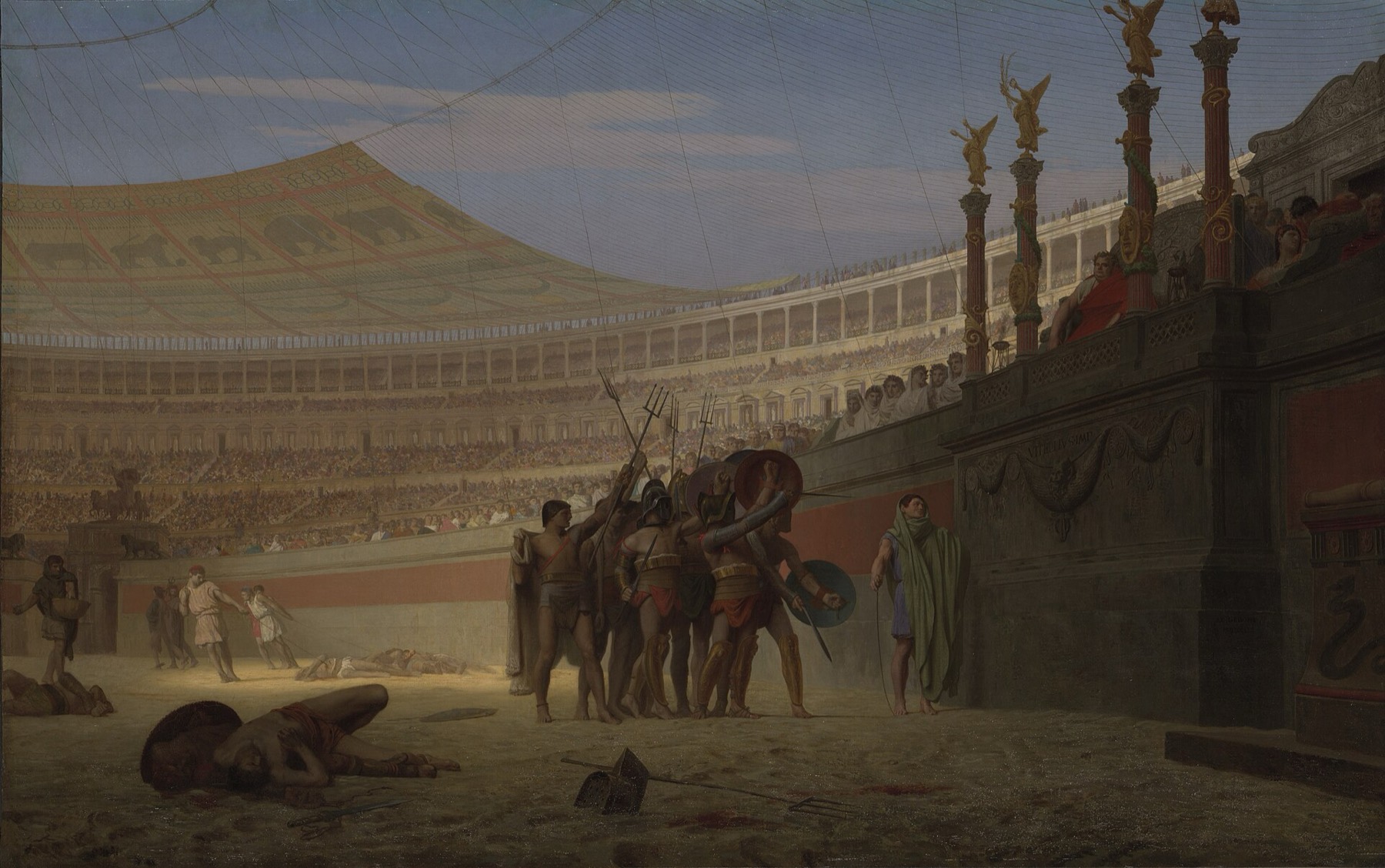
Tab. IIo. Leo Gérôme, Ave Caesar, morituri te salutant (MDCCCLIX).Jean-Léon Gérôme, Ave Caesar! Morituri te salutant (1859).
Commentarii · De impedimentis ex Britannia remotisDispatches · On the baggage withdrawn from Britain
De commeatu aërio ex castris Mildenhall in Germaniam et Hispaniam translato
On the air supply train moved from the camp at Mildenhall to Germany and Spain
Americani, ut GB News, Guardian et Daily Mail nuntiant, die Lunae naves aërias, inter eas cisternas, ex castris Mildenhall abduxerunt, cum periculum ab Irania impendere diceretur. Caesar impedimenta in tutum missa probat, sed vallum Britannicum, quod bis iam relictum est, nondum munitum esse animadvertit.
The Americans, as GB News, the Guardian and the Daily Mail report, withdrew aircraft, tankers among them, from the base at Mildenhall on Monday, a threat from Iran being said to hang over it. Caesar approves of sending the baggage to safety, but observes that the British rampart, now twice abandoned, has still not been fortified.
Cur hoc legimusWhy we read this Quia aquilas transferre propter Parthicas minas necessitas fortasse est, sed dedecus nisi celeritate et virtute compensetur.Because moving the eagles on account of Parthian threats may perhaps be a necessity, but it is a disgrace unless redeemed by speed and valor.
Britannia trans fretum Gallicum iacet et sociis Americanis sedes castrorum aëriorum praebet. In his sunt Mildenhall et Lakenheath in Suffolcia, Fairford in Glevensibus. Die Lunae, ante diem V Idus Novembres, Americani naves aërias ex castris Mildenhall abduxerunt, quod novum periculum ab Irania nuntiatum erat. Quot abductae sint, non constat. GB News septem saltem aëroplana et duas aëronaves cisternas, quae ceteras in volatu alunt, abiisse scribit, pleraque in Germaniam. Guardian, Wall Street Journal auctore, duas cisternas mane in Germaniam deflexas, alias postea eodem et in alia loca missas esse tradit. Daily Mail duas Stratotankeras et tres Ospreys in Hispaniam et Germaniam translatas esse, et, BBC auctore, novem saltem naves intra viginti quattuor horas dispersas esse refert.
Britain lies across the Gallic strait and gives the American allies sites for their air camps. Among them are Mildenhall and Lakenheath in Suffolk, and Fairford in Gloucestershire. On Monday, 9 November, the Americans withdrew aircraft from the base at Mildenhall because a new threat from Iran had been reported. How many were withdrawn is not established. GB News writes that at least seven planes and two tankers, which feed the others in flight, departed, most of them to Germany. The Guardian, citing the Wall Street Journal, says that two tankers were diverted to Germany in the morning and others sent there and to other locations later. The Daily Mail reports that two Stratotankers and three Ospreys were moved to Spain and Germany, and, citing the BBC, that at least nine aircraft dispersed within twenty-four hours.
Eodem tempore Americani in castris Mildenhall et Lakenheath custodiam ad gradum quem Charlie appellant auxerunt, qui secundus ab summo est et declaratur cum exploratorum indicia vim terroris probabilem esse significant. Quae sit ea vis, nemo exponit: rem apud magistratus Americanos adhuc deliberari omnia acta consentiunt, neque quemquam comprehensum esse. Guardian addit in ipso loco nullum certum periculum castris imminere, ut generale potius id quod Americani viderint esse videatur. Neque acta dicunt penes quem custodia valli sit; quod imperator primum quaereret.
At the same time the Americans raised the guard at Mildenhall and Lakenheath to the level they call Charlie, the second from the top, which is declared when intelligence indicates that terrorist action is likely. What that action might be, no one explains: all the reports agree that the matter is still under discussion among American officials, and that no one has been arrested. The Guardian adds that on the ground there is no specific threat against the base, so that what the Americans saw appears to be more general. Nor do the reports say who holds the guard of the rampart; which is the first thing a commander would ask.
Ministerium Defensionis Britannicum se de aliarum gentium rebus dicere non solere, naves et cetera instrumenta pro usu bellico saepe moveri respondit. Copiae aëriae Americanae naves suas inter castra multis de causis commeare, ex pactis sociorum hospitio recipi, plura propter securitatem rerum gerendarum se non dicturas esse edixerunt. Lucia Powell, ministra, se de rebus quae nunc gererentur nihil dicere posse, securitatem castrorum assidue recognosci, et ubi opus esset firme celeriterque agi affirmavit. Marcus Rubio, rebus externis Americanorum praepositus, rem ita curatam esse dixit ut homines a periculo removerentur. Donaldus Trump Americanos paratos et instructos esse, si quid in Oriente mutaretur, scripsit, sed bellum crescere vix verisimile esse.
The British Ministry of Defence replied that it does not routinely comment on the activity of other nations, and that aircraft and other assets move regularly according to operational requirements. The American air force declared that its aircraft rotate between installations for many reasons, are hosted under agreements with allies, and that for reasons of operations security it would say no more. Lucy Powell, a minister, stated that she could say nothing of live operations, that the security of the bases is constantly under review, and that firm and quick action is taken where needed. Marco Rubio, the American Secretary of State, said the matter had been addressed by moving people away from the threat. Donald Trump wrote that the Americans were ready and loaded should anything change in the East, but that an escalation was hardly likely.
Haec altera est discessio. Mense Septembri bombardarii B-1 ex Fairford abducti erant, cum prope castra homines comprehensi essent, quinque ut Guardian et Daily Mail, septem ut GB News numerat; duo postea ex lege de securitate nationali accusati sunt, quorum alter operam exploratoribus alienis, ut vigiles credunt Iraniae, dedisse insimulatur. Andreas Burnham, primus minister, valida indicia esse dixit Iraniam partem in ea re habuisse. Legatus Iraniae in Britannia culpam negat; Custodes Revolutionis autem mense Iulio Fairford et quaecumque castra ad impetus in Iraniam faciendos adhiberentur iusta proposita esse edixerant. Ex prioribus actis constat Fairford ad impetus in Iraniam ab Americanis adhibitum esse.
This is the second withdrawal. In September the B-1 bombers had been taken out of Fairford after men were arrested near the base, five by the count of the Guardian and the Daily Mail, seven by that of GB News; two were later charged under the National Security Act, one of whom is accused of assisting a foreign intelligence service, which the police believe to be Iran's. Andy Burnham, the prime minister, said there were strong indications that Iran had played a part in the affair. Iran's ambassador in Britain denies the charge; but the Revolutionary Guards had declared in July that Fairford and any base used for attacks on Iran were legitimate targets. Earlier reports establish that Fairford had been used by the Americans for attacks on Iran.
Caesar rem ita iudicat. Cisternae aëriae non acies sunt, sed commeatus; sine eis neque bombardarii neque equitatus aërius longe progredi possunt. Ricketts, olim summus securitatis consiliarius, naves magnas et necessario expositas esse dixit, et partim nimia cautione rem gestam esse coniecit. Recte. Qui impedimenta in loco relinquit ubi pauci homines cum vehiculo uno ea incendere possunt, totam expeditionem fortunae committit. Meminit Caesar Novioduni Aeduorum, ubi obsides, frumentum, pecuniam publicam, magnam impedimentorum partem collocaverat: Aeduis deficientibus, custodibus interfectis, omnia uno impetu amissa sunt. Ex eo didicit commeatum numquam ibi deponendum esse ubi custodia alieni arbitrii sit.
Caesar judges the matter thus. Tankers are not the battle line but the supply train; without them neither the bombers nor the air cavalry can go far. Ricketts, formerly national security adviser, said the aircraft were large and inevitably exposed, and guessed that the move was partly an abundance of caution. Rightly. Whoever leaves his baggage where a few men with a single vehicle can set it on fire entrusts the whole campaign to Fortune. Caesar remembers Noviodunum of the Aedui, where he had lodged his hostages, grain, public money and a great part of the baggage: when the Aedui defected and the guards were killed, all was lost at a stroke. From this he learned never to deposit supplies where the guard is at another's discretion.
Alii discessionem fugam vocant: diaria Britannica de exodo scribunt, et Gregorius Bagwell, olim in summo imperio aërio Britannico, artem salutis temporariae eam esse dicit. Fere libenter homines id quod volunt credunt. Impedimenta in tutum mittere fuga non est. Hoc tamen Caesar non neglegit: hostis, sive Irania est, ut magistratus Britannici et Americani suspicantur, sive alius, bis iam verbis et paucis hominibus effecit ut socii naves moverent, nullo telo misso. Sed fortuna, quae plurimum potest cum in reliquis rebus tum praecipue in bello, parvis momentis magnas rerum commutationes efficit; et qui semel cedere didicit, iterum cedere discit.
Others call the withdrawal flight: the British papers write of an exodus, and Greg Bagwell, once in the high command of the British air force, says it is a tactic of temporary survival. Men generally believe what they wish to believe. Sending the baggage to safety is not flight. Yet Caesar does not overlook this: the enemy, whether Iran, as British and American officials suspect, or another, has twice now made the allies move their aircraft with words and a handful of men, without loosing a single weapon. But Fortune, whose power is great in all things and above all in war, works great reversals by small moments; and he who has once learned to give way learns to give way again.
Quam ob rem remedium duplex est. Primum, qui castra in solo alieno habet, munitiones et custodiam sub uno imperio teneat, neque hospitis recognitionem assiduam exspectet; vallum enim non recognitione, sed fossa, vigiliis et exploratoribus defenditur. Deinde Britanni, qui de rebus in solo suo gestis dicere non solent, statuant palam utrum sedem belli praebeant an non; nam qui solum suum ad bellum commodat, in bello est, sive id fatetur sive tacet. Ita Caesar existimat: impedimenta in tutum mittere prudentiae est; vallum, quo redeant, non munire ignaviae.
The remedy, therefore, is twofold. First, whoever keeps camps on foreign soil should hold the works and the guard under a single command, and not wait upon his host's constant review; for a rampart is defended not by review but by ditch, sentries and scouts. Second, the British, who do not routinely comment on what is done on their own soil, should decide openly whether they offer a seat of war or not; for he who lends his soil to a war is in the war, whether he admits it or keeps silent. So Caesar holds: to send the baggage to safety is prudence; to leave unfortified the rampart it must return to is cowardice.
nam qui solum suum ad bellum commodat, in bello est, sive id fatetur sive tacet.
For he who lends his soil to a war is in the war, whether he admits it or keeps silent.
FONTES ANTIQVIANCIENT SOURCES
- Caes. BG 3.18.6fere libenter homines id quod volunt credunt
- Caes. BC 3.68.1Sed fortuna, quae plurimum potest cum in reliquis rebus tum praecipue in bello, parvis momentis magnas rerum commutationes efficit
FONTES HODIERNITODAY’S SOURCES
- GB NewsUS evacuates jets from second RAF base and moves them to Germany after Iran threats
- The GuardianUS reportedly evacuates aircraft from RAF Mildenhall over Iran threat
- Daily MailUS 'evacuates aircraft from second RAF base after Iran threat'
Res ex fontibus; sententia Romani.Facts from the sources; the opinion is the Roman’s.
C. Iulius Caesar
Galliam subegit, Rubiconem transiit, rem publicam vicit. De se ipso in tertia persona scribit, breviter, celeriter, sine ornatu. Primus omnium instituit ut acta senatus et populi publicarentur.He conquered Gaul, crossed the Rubicon, and defeated the Republic. He writes about himself in the third person — briefly, swiftly, without ornament. He was the first to order that the daily acts of Senate and people be published.
Haec vox restituta est ex his libris:This voice is reconstructed from:
Scribe ad Caesar: tabellarius epistulam tuam per vias Romanas feret, et responsum post dies aliquot redibit.Write to Caesar: the courier carries your letter along the Roman roads, and a reply comes back after a few days.
LEGE ETIAMREAD NEXT
- De legata quae ante aciem ad hostem transiit, et de duce qui eam dimiseratOf the officer who went over to the enemy before the battle, and of the general who had sent her awayCaesar
- De insula in commentario capta, in litore non captaAn Island Taken in an Op-Ed, Not on the BeachCaesar
- De scutis missis neque gladio strictoOn Shields Sent and No Sword DrawnCaesar
- Ieiunium non est temperantiaFasting Is Not TemperanceFrontinus
- Harenam in thesaurum vertit ingenium; thesaurum unius hominis custodia tueturGenius turns sand into treasure; one man's keeping guards the treasurePliny the Elder