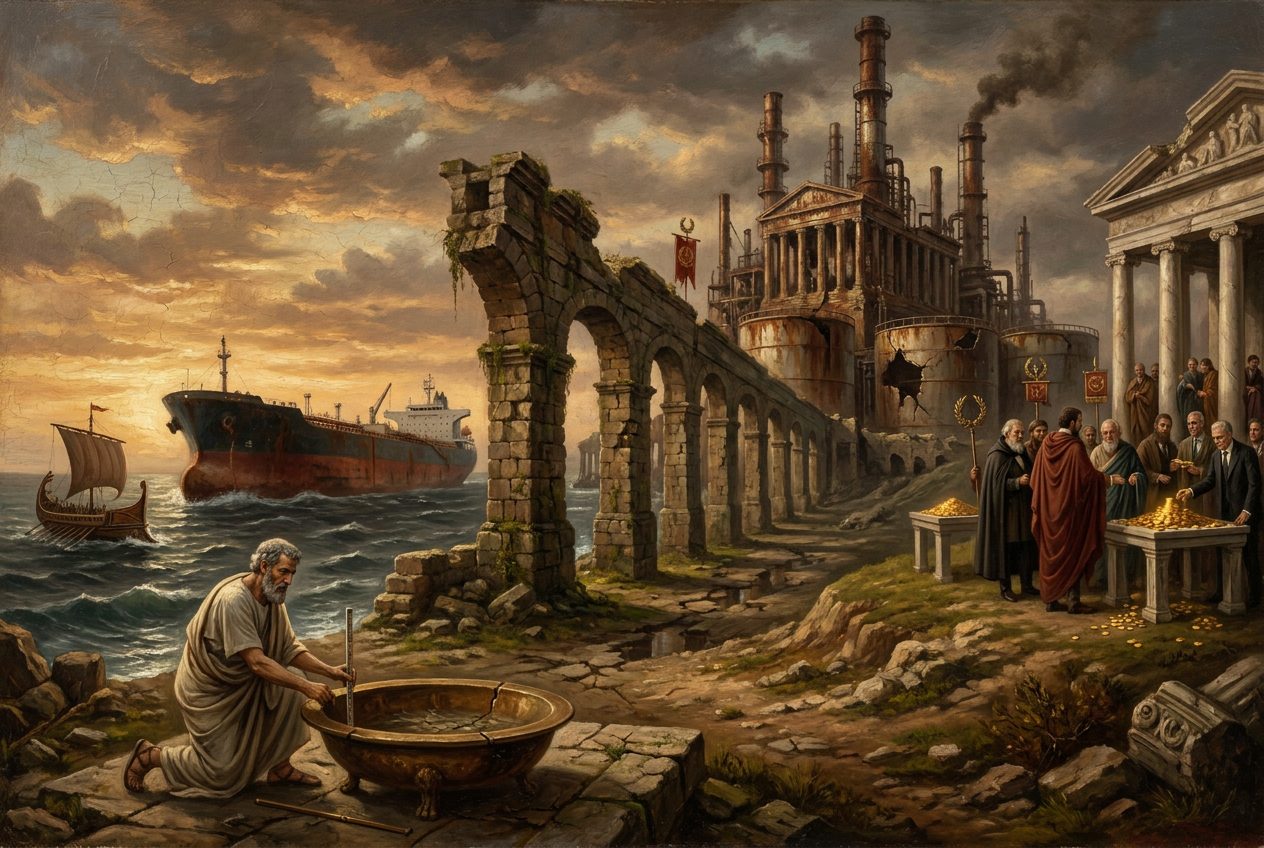
Tab. IFons Fluit, Canalis Deficit, sive Horrea Vacua. Tabula Actis Mundi more veterum picta (a machina).The Source Flows, the Conduit Fails, or The Empty Storehouses. Painted for Acta Mundi in the classical manner (AI-generated).
De Aquis et Strategematis · De oleo terrae et canalibus eiusWaters and Stratagems · On the oil of the earth and its channels
Caput fluit, ductus deficit
The source flows; the conduit fails
Ut acta La Verità nuntiant, oleo crudo supra centum dollaria in singula dolia elato, partes societatum Europaearum quae oleum effodiunt et excoquunt immodice creverunt, dum copiae publicae olei dieselici ad minimum redactae sunt. Frontinus, more curatoris, docet copiam non in fonte sed in ductibus, horreis et officinis metiendam esse.
According to La Verità, with crude oil risen above a hundred dollars a barrel, the shares of the European companies that extract and refine oil have climbed beyond all measure, while public stocks of diesel have been run down to their lowest. Frontinus, as a curator would, shows that supply is to be measured not at the source but in the conduits, the storehouses and the works.
Cur hoc legimusWhy we read this Quia vera pecunia per canales et fistulas fluit, non per vana tabularum decreta.Because real wealth flows through pipes and conduits, not through empty decrees of the registers.
I. Idibus Octobribus, anno urbis conditae MMDCCLXXIX. Commentarium de oleo terrae scribo eadem ratione qua olim de aquis urbis scripsi: primum quid fluat, deinde quid perveniat, postremo quid desit. Ut acta La Verità nuntiant, bello cum Irania dilatato et bello inter Russiam et Ucrainam perdurante, oleum crudum plus quam centum dollariis in singula dolia venit. Eadem acta tradunt exportationes ex sinu Persico per itinera quae fretui Hormuziano substituta sunt modum ante bellum servatum etiam superavisse.
I. The Ides of October, in the year 2779 from the founding of the City. I write this report on the oil of the earth on the same method by which I once wrote on the waters of the City: first, what flows; next, what arrives; last, what is lacking. According to La Verità, with the war against Iran widened and the war between Russia and Ukraine dragging on, crude oil is selling at more than a hundred dollars a barrel. The same paper reports that exports from the Persian Gulf, by routes substituted for the Strait of Hormuz, have even exceeded the levels kept before the war.
II. Salvator Gaziano, qui apud societatem SoldiExpert consiliis pecuniae collocandae praeest, dicit oleum quidem fluere, sed vehi et excoqui ingenti pretio constare: naula navium maximarum propter pericula navigandi in immensum crevisse, officinas excoquendi inter Orientem et Russiam cessare, maxime autem deesse res perfectas, praecipue oleum dieselicum, cuius copias publicas iam ad minimum redactas esse. Interea apud mensas argentariorum partes Repsol plus nonaginta et uno ex centenis ab initio anni creverunt, Eni plus sexaginta duobus, Saipem, quae cum Subsea7 coniungitur, plus nonaginta octo; ExxonMobil et Chevron Americanae circa quinquaginta. TotalEnergies, cuius partes plus quadraginta uno ex centenis auctae sunt, ut idem Gaziano refert, deliberat num primam suam inscriptionem ad mensas Novi Eboraci transferat.
II. Salvatore Gaziano, who directs investment strategy at the firm SoldiExpert, says that the oil does indeed flow, but that carrying and refining it costs a fortune: freight rates for the largest tankers have soared because of the risks at sea, refineries between the Middle East and Russia are out of service, and what is lacking above all are finished products, diesel in particular, whose strategic stocks are now at their lowest. Meanwhile, at the bankers' tables, shares in Repsol have risen more than ninety-one per cent since the start of the year, Eni more than sixty-two, Saipem, which is merging with Subsea7, more than ninety-eight; the Americans ExxonMobil and Chevron around fifty. TotalEnergies, whose shares have gained more than forty-one per cent, is considering, as the same Gaziano reports, whether to move its primary listing to the tables of New York.
III. Rem agnosco, nam eam in aquis saepe vidi. Caput non deficit; ductus deficit. Aqua quae ad fontem copiosa est urbi nihil prodest, nisi specus integer est, nisi castella plena, nisi fistulae iustae mensurae. Ita nunc: oleum ex sinu Persico abundantius quam ante bellum effunditur, et tamen oleum quo plaustra et machinae aguntur deest. Inter fontem et usum opus iacet, et opus est quod nunc claudicat: naves quae periculo non vehunt nisi magno pretio, officinae quae stant fractae, horrea quae vacua sunt.
III. I recognize the thing, for I have often seen it in the waters. The source does not fail; the conduit fails. Water abundant at the spring is of no use to the City unless the channel is sound, the distribution tanks full, the pipes of honest gauge. So it is now: oil pours out of the Persian Gulf more abundantly than before the war, and yet the oil that drives wagons and engines is lacking. Between the source and the use lies the work, and it is the work that now limps: ships that will not carry through danger except at a great price, refineries standing broken, storehouses standing empty.
IV. Gaziano narrat hoc genus negotii per annos tamquam cognatum molestum habitum esse, nimis foedum iudicatum, et ad tres tantum ex centenis totius aestimationis orbis redactum. Hoc animadverto: opinio et decreta oleum non excoquunt. Officina fracta edicto non reficitur, nec horreum sententia impletur. Appius Claudius aquam in urbem duxit priusquam populus sitiret, non postquam. De aquaeductibus olim scripsi: «Tot aquarum tam multis necessariis molibus pyramidas videlicet otiosas compares aut cetera inertia sed fama celebrata opera Graecorum». Idem de officinis excoquendi et de horreis olei dico: opera necessaria sunt, sordida videntur, et tum demum laudantur cum desunt.
IV. Gaziano relates that for years this branch of business was treated like an awkward relation, judged too foul, and reduced to a mere three per cent of the world's whole valuation. This I observe: opinion and decrees refine no oil. A broken refinery is not repaired by edict, nor is a storehouse filled by a resolution. Appius Claudius brought water into the City before the people thirsted, not after. Of the aqueducts I once wrote: "With so many indispensable structures carrying so many waters, compare, if you will, the idle pyramids or the other useless, though renowned, works of the Greeks." I say the same of refineries and oil depots: the works are necessary, they look sordid, and they are praised only when they are missing.
V. Nunc ad mensuras. Cum aquas inspicerem, aliud in commentariis scriptum, aliud in fistulis fluere inveni. Similis error nunc in foro argentariorum committitur. Partes quae nonaginta ex centenis crescunt non copiam metiuntur sed inopiam; quo vacuiora horrea, eo plenior arca possessorum. Hoc lucrum non reprehendo: societates, ut Gaziano ait, aes alienum minuerant et rationes severe rexerant, itaque parsimonia sua fruuntur. Sed magistratus qui gaudium mensarum pro salute provinciarum habet idem facit ac curator qui aquam ad caput metitur et urbem bibisse putat.
V. Now to the measures. When I inspected the waters, I found one thing written in the records and another flowing in the pipes. A like error is being made now in the bankers' forum. Shares that rise ninety per cent do not measure plenty; they measure scarcity; the emptier the storehouses, the fuller the owners' strongbox. I do not blame this profit: the companies, as Gaziano says, had cut their debt and kept strict discipline in their accounts, and so they enjoy the fruit of their own thrift. But a magistrate who takes the joy of the tables for the health of the provinces does exactly what a curator does who measures the water at the source and supposes the City has drunk.
Partes quae nonaginta ex centenis crescunt non copiam metiuntur sed inopiam; quo vacuiora horrea, eo plenior arca possessorum.
Shares that rise ninety per cent do not measure plenty; they measure scarcity; the emptier the storehouses, the fuller the owners' strongbox.
VI. Acta etiam tacent ubi curator primum interrogaret. Quanta sint copiae olei dieselici, quibus provinciis maxime desint, per quae itinera oleum ex sinu Persico vehatur et quis ea teneat, nemo scribit. Nec quisquam ex magistratibus aut consumentibus loquitur; solus argentarius. Sine numero nemo aquas regit, nec oleum.
VI. The report is also silent where a curator would ask first. How large the stocks of diesel are, in which provinces they are shortest, by what routes the oil from the Persian Gulf is carried and who holds them: no one writes it. Nor does any magistrate or consumer speak; only the banker. Without numbers no one governs the waters, nor the oil.
VII. De TotalEnergies breviter. Inscriptio trans Oceanum migrare potest; officinae, tubi, portus in Gallia manent. Si sedes lucri alio transfertur, opera autem domi remanent, magistratus quaerat quis ea curet, quis reficiat, cui pareant cum bellum premit.
VII. On TotalEnergies, briefly. A listing can migrate across the Ocean; the refineries, pipelines and ports remain in Gaul. If the seat of profit moves elsewhere while the works stay at home, let the magistrate ask who will tend them, who will repair them, and whom they will obey when war presses.
VIII. Remedium vetus est. Copiae publicae olei singulis mensibus metiantur et numeri palam proponantur; officinae excoquendi a magistratibus ipsis inspiciantur, non per conductos consiliarios, nam «nihil enim aeque indecorum tolerabili viro puto quam delegatum officium ex adiutorum agere praeceptis»; reficiatur quod fractum est priusquam novum aedificetur; horrea, sicut castella, ante bellum impleantur, non in bello. Oleum non decretis sed fistulis ducitur.
VIII. The remedy is old. Let the public stocks of oil be measured every month and the figures posted openly; let the refineries be inspected by the magistrates themselves, not through hired consultants, for "I think nothing so unbecoming to a man of any worth as to discharge a delegated duty on the instructions of his assistants"; let what is broken be repaired before anything new is built; let the storehouses, like the water tanks, be filled before the war, not during it. Oil is carried not by decrees but by pipes.
FONTES ANTIQVIANCIENT SOURCES
- Front. Aq. 16Tot aquarum tam multis necessariis molibus pyramidas videlicet otiosas compares aut cetera inertia sed fama celebrata opera Graecorum
- Front. Aq. 2nihil enim aeque indecorum tolerabili viro puto quam delegatum officium ex adiutorum agere praeceptis
FONTES HODIERNITODAY’S SOURCES
Res ex fontibus; sententia Romani.Facts from the sources; the opinion is the Roman’s.
Scribe ad Frontinus: tabellarius epistulam tuam per vias Romanas feret, et responsum post dies aliquot redibit.Write to Frontinus: the courier carries your letter along the Roman roads, and a reply comes back after a few days.
LEGE ETIAMREAD NEXT
- De civitate non ad arbitrium factionis eripiendaThat Citizenship Must Not Be Snatched Away at a Faction's PleasureCicero
- Qui petit, iam cliens est: de aerario Galliae et foedere BruxellensiHe Who Petitions Is Already a Client: On the Treasury of Gaul and the Treaty of BrusselsSymmachus
- De rege qui traiecit fretum ut saxum suum esse diceretOf a king who crossed the strait to say a rock was hisOvid