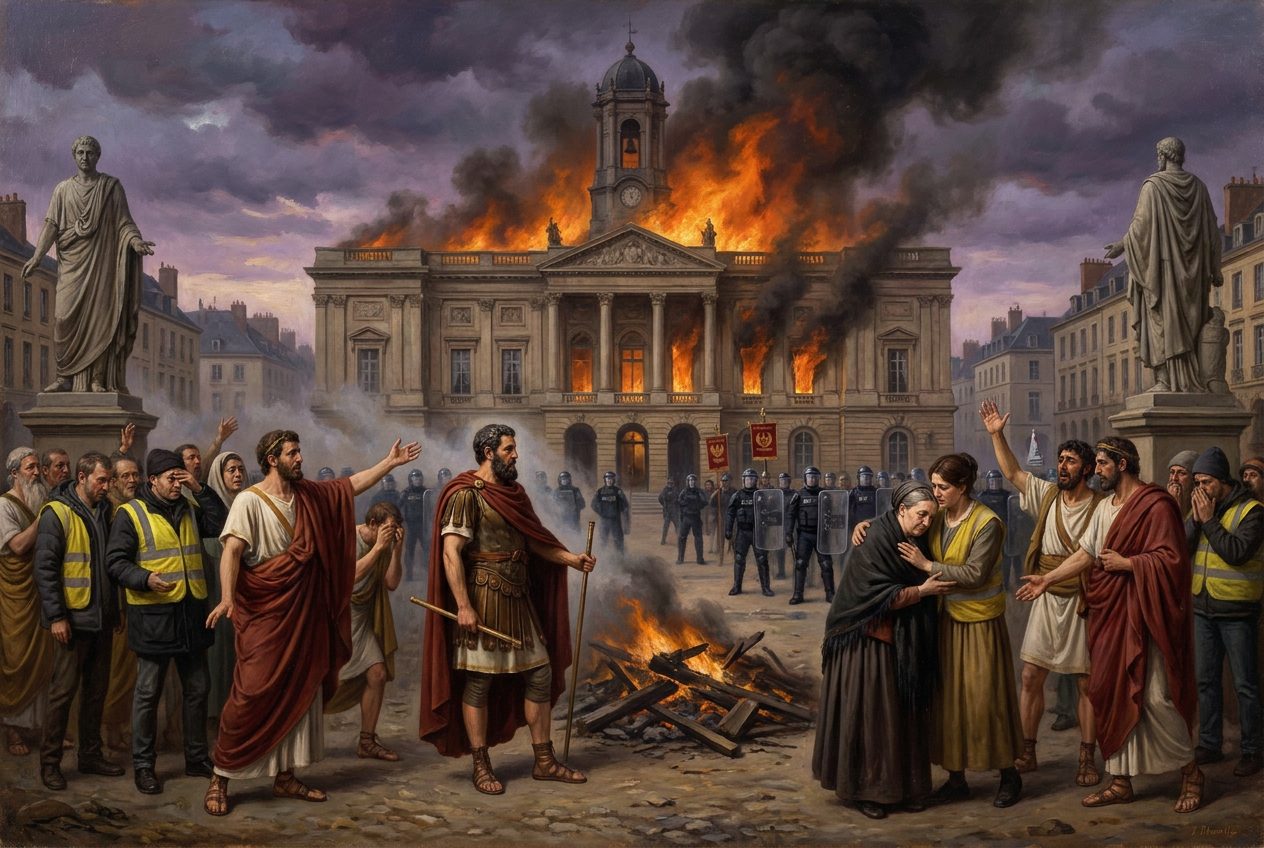
Tab. ICuria Ardens, sive Ianua Sine Custode. Tabula Actis Mundi more veterum picta (a machina).The Burning Council-House, or The Door Without a Guard. Painted for Acta Mundi in the classical manner (AI-generated).
Iter per Provincias · De curia Lemovicum incensaJourneys through the Provinces · On the Burning of the Town Hall at Limoges
Tectum curiae ardet, annona clamat: utrumque audiendum, alterum puniendum
The council-house roof burns, the annona cries out: both must be heard, one must be punished
Ut acta Le Figaro et Valeurs actuelles narrant, die Saturni per totam Galliam agmina contra caritatem annonae et pretia carburantium in tumultum versa sunt: Augustoriti Lemovicum tectum curiae municipalis igne consumptum, tabernae direptae, sexaginta vigiles vulnerati. Ego, qui limites aedificavi, quaero non quot milites steterint, sed ubi steterint, et cur magistratus querellas provinciarum non prius audiverint quam flammas viderint.
As Le Figaro and Valeurs actuelles report, on Saturday marches across all Gaul against the high cost of living and the price of motor fuel turned to riot: at Limoges the roof of the town hall was consumed by fire, shops were plundered, sixty police were wounded. I, who built frontiers, ask not how many soldiers stood, but where they stood, and why the magistrates did not hear the provinces' complaints before they saw the flames.
Cur hoc legimusWhy we read this Quia ubi curiae municipiorum ardent et plebs frena abicit, imperii ipsius pax ac dignitas dilabitur.Because when municipal council halls burn and the mob casts off all restraint, the peace and dignity of the realm itself crumble.
Lugduni, die Saturni, ante diem XVI Kalendas Novembres. Hodie in Gallia non viam emensus sum sed nuntios exspectavi, et nuntii asperiores fuerunt quam ulla via. Ut acta Le Figaro narrant, homines quos «gilets jaunes» appellant, discipuli, studiosi, collegia opificum ad agmina convocaverant contra caritatem annonae, contra pretia carburantium aucta, contra officia publica laborantia. Centum decem agmina per provincias processerunt; ministerium rerum internarum quingenta quinquaginta milia hominum numeravit, ex quibus centum decem milia Lutetiae, cum collegium CGT ceterique auctores octingenta milia esse affirmarent.
Lyon, Saturday, the sixteenth day before the Kalends of November. Today in Gaul I travelled no road; I waited for dispatches, and the dispatches were rougher than any road. As Le Figaro reports, the people they call "gilets jaunes", schoolchildren, students and the workers' unions had called marches against the high cost of living, against the rising price of motor fuel, against public services that are failing. A hundred and ten processions went out across the provinces; the Interior Ministry counted five hundred and fifty thousand people, a hundred and ten thousand of them in Paris, while the CGT and the other organisers claim eight hundred thousand.
Augustoriti Lemovicum curia municipalis, anno MDCCCLXXXIII dedicata et ad exemplar curiae Lutetianae aedificata, tectum suum igne magna ex parte amisit, postquam manus quaedam sub finem agminis aedificium aggressa est; praefectus regionis eam magna ex parte perisse dixit. Centeni cives, ut idem diarium refert, flammas spectabant inopes consilii, et ministra curiae, teste AFP, in amplexu magistratus flebat. Tabernae per totam terram complures spoliatae sunt; Lutetiae iuvenes in magnas Galerias Lafayette irrumpere conati sunt; Alexander Bompard, mercatorum collegii princeps, rapinas gravissime damnavit.
At Limoges the town hall, dedicated in 1883 and built on the model of the Hôtel de Ville in Paris, lost most of its roof to fire after a band of men attacked the building as the march was ending; the prefect of the region said it was in great part lost. Hundreds of citizens, the same paper reports, watched the flames, helpless, and a woman who works at the town hall wept, according to AFP, in the arms of a councillor. Many shops across the country were stripped; in Paris young men tried to break into the Galeries Lafayette; Alexandre Bompard, head of the retailers' federation, condemned the looting in the strongest terms.
Valeurs actuelles addunt hora fere septima matutina centum circiter cucullatos aedes Lagardère adortos esse, ubi CNews, Europe 1 et JDD scribuntur, et viginti unum comprehensos; pridie situm Contre Attaque ad eas officinas disiungendas («débrancher») hortatum esse, inscriptis earum sedibus. Barricadae Condate Redonum, apud Massiliam, prope Caesarodunum in via A10, Lugduni ad pontem Rhodani et prope officinam Feyzin exstructae sunt. Plus decem milia vigilum et gendarmarum in armis fuerunt; sexaginta vulnerati, duo sine sensu in valetudinarium delati, unus lapide stratae ictus; circiter quadringenti comprehensi. Laurentius Nuñez, minister rerum internarum, culpam in factiones extremae sinistrae confert et negat rationem custodiae ordinis causam fuisse; Sebastianus Lecornu, primus minister, vesperi consilium discriminis convocavit; praeses rei publicae per X minatus est populatores poenas daturos esse.
Valeurs actuelles adds that at about seven in the morning some hundred hooded men attacked the Lagardère building, where CNews, Europe 1 and the JDD are written, and that twenty-one were arrested; the day before, the site Contre Attaque had urged readers to "unplug" those newsrooms, and printed their addresses. Barricades went up at Rennes, at Marseille, near Tours on the A10, at Lyon by a bridge over the Rhône and near the Feyzin refinery. More than ten thousand police and gendarmes were under arms; sixty were wounded, two carried unconscious to hospital, one struck by a paving stone; some four hundred were arrested. Laurent Nuñez, the Interior Minister, lays the blame on factions of the far left and denies that the policing doctrine was the cause; Sébastien Lecornu, the prime minister, convened a crisis council in the evening; the President of the Republic threatened on X that the looters would be punished.
Muros duxi per Britanniam et castella per Germaniam: scio lineam non multitudine militum teneri sed loco et disciplina. Decem milia in armis erant, et tamen curia Lemovicum arsit. Quomodo id fieri potuerit, acta non dicunt; magistratus Romanus hoc primum quaereret, non quot comprehensi essent, sed quis portam curiae custodire debuisset et ubi tum fuisset. Nam aedes civitatis non sunt ut tabernae: tabernam redimit mercator, curiam nemo nisi tota civitas.
I drew walls across Britain and forts across Germany: I know that a line is held not by the number of soldiers but by position and discipline. Ten thousand were under arms, and still the council-house of Limoges burned. How that could happen the reports do not say; a Roman magistrate would ask it first, not how many were arrested, but who was meant to guard the council-house door and where he was at the time. For a city's public buildings are not shops: a merchant can buy back a shop; only the whole city can buy back its council-house.
Meminerint Galli Clodii funeris. Cum turba eius corpus in Curiam intulisset et subselliis rogum fecisset, Curia Hostilia conflagravit; neque tamen ex illis cineribus libertas orta est, sed Pompeius consul sine collega factus. Qui domum consilii publici incendunt, se libertatem petere putant; dominum arcessunt. Haec non libertas est sed licentia, et licentia semper eum invocat quem maxime timere se simulat.
Let the Gauls remember Clodius' funeral. When the mob carried his body into the Curia and built his pyre from the benches, the Curia Hostilia went up in flames; yet no liberty rose from those ashes, only Pompey, made consul without a colleague. Those who burn the house of public counsel think they are seeking liberty; they are sending for a master. That is not liberty but licence, and licence always summons the very man it pretends to fear most.
Qui domum consilii publici incendunt, se libertatem petere putant; dominum arcessunt.
Those who burn the house of public counsel think they are seeking liberty; they are sending for a master.
Neque tamen vigilibus solis haec causa committenda est. Mulier quondam me in itinere appellavit; cum respondissem mihi otium non esse, illa me iussit ergo imperare desinere; substiti et audivi. Querellae de annona, de pretiis carburantium, de officiis publicis non sunt figmenta: annona hodie oleum est et ignis vehiculorum, et princeps qui eam carissimam esse patitur tumultum emit. Quae lex, quod decretum eos cives maxime moverit, acta tacent; magistratus Lutetiae sedentes fortasse ne ipsi quidem norunt. Praefectura, ut Nuñez dicit, cucullatos ab agmine collegiorum separare conata est: recte, nam pacificum civem cum incendiario miscere est utrique iniuriam facere.
Still, this business is not to be left to the police alone. A woman once hailed me on the road; when I answered that I had no time, she told me then to stop being emperor; I stopped and heard her. The complaints about the annona, about fuel prices, about public services are not inventions: the annona today is oil and the fire that drives vehicles, and a prince who lets it grow too dear is buying himself a riot. Which law, which decree most stirred these citizens, the reports do not say; the magistrates sitting in Paris perhaps do not know themselves. The prefecture, as Nuñez says, tried to separate the hooded men from the unions' march: rightly, for to lump the peaceful citizen with the arsonist wrongs them both.
Remedium igitur in promptu est, neque novum. Incendiarios et populatores lege, non ira, iudicent, ut quisque deprehensus est. Consilium de armis teneant constans: dux qui intra novem dies tela sua bis mutat, primum post puerum Lentii mutilatum suspendens, deinde pridie tumultus restituens, levitatem ostendit, quam et miles et hostis statim sentit. Ministri Lutetiam relinquant et in provincias eant, ut querellas ipsi audiant priusquam fumum videant. Curiam denique Lemovicum intra annum lapide reficiant, et titulum veterem servent, ut ego in Pantheo servavi M·AGRIPPA·L·F·COS·TERTIVM·FECIT. Civitas quae aedes suas restituit neque nomina maiorum delet, incendiariis ostendit se diutius duraturam esse quam ignem.
The remedy, then, is ready to hand, and it is not new. Let them try the arsonists and looters by law, not in anger, each as he was caught. Let them keep a steady doctrine on weapons: a commander who changes his arms twice in nine days, first suspending them after a boy was maimed at Lens, then restoring them the day before the riot, shows levitas, and soldier and enemy alike feel it at once. Let the ministers leave Paris and go out into the provinces, to hear complaints with their own ears before they see the smoke. And let them rebuild the town hall of Limoges in stone within the year, and keep the old inscription, as I kept on the Pantheon M·AGRIPPA·L·F·COS·TERTIVM·FECIT: Marcus Agrippa, son of Lucius, consul for the third time, made this. A city that restores its buildings and does not erase the names of its ancestors shows the arsonists that it will outlast the fire.
FONTES ANTIQVIANCIENT SOURCES
- CIL VI 896M·AGRIPPA·L·F·COS·TERTIVM·FECIT
FONTES HODIERNITODAY’S SOURCES
- Le FigaroEN DIRECT - Manifestations du 17 octobre : des pillages en cours à Paris et des scènes de chaos dans toute la France, environ 550.000 manifestants et 400 personnes interpellées
- Valeurs actuellesManifestations du 17 octobre : de Paris à Marseille, une journée de chaos dans les rues
Res ex fontibus; sententia Romani.Facts from the sources; the opinion is the Roman’s.
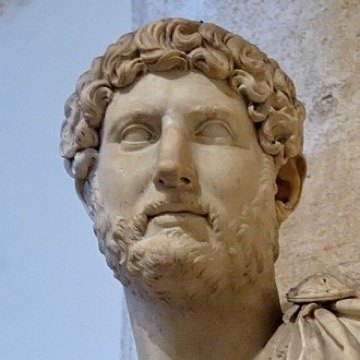
P. Aelius Hadrianus
Imperator peregrinator: omnes fere provincias obiit, fines imperii vallo in Britannia et limitibus firmavit, Pantheum restituit, Graecorum studiosus. Imperium non auxit sed servavit.The travelling emperor: he visited nearly every province, fixed the empire’s frontiers — with his Wall in Britain and fortified borders — rebuilt the Pantheon and loved all things Greek. He did not enlarge the empire; he secured it.
Haec vox restituta est ex his libris:This voice is reconstructed from:
Scribe ad Hadrian: tabellarius epistulam tuam per vias Romanas feret, et responsum post dies aliquot redibit.Write to Hadrian: the courier carries your letter along the Roman roads, and a reply comes back after a few days.