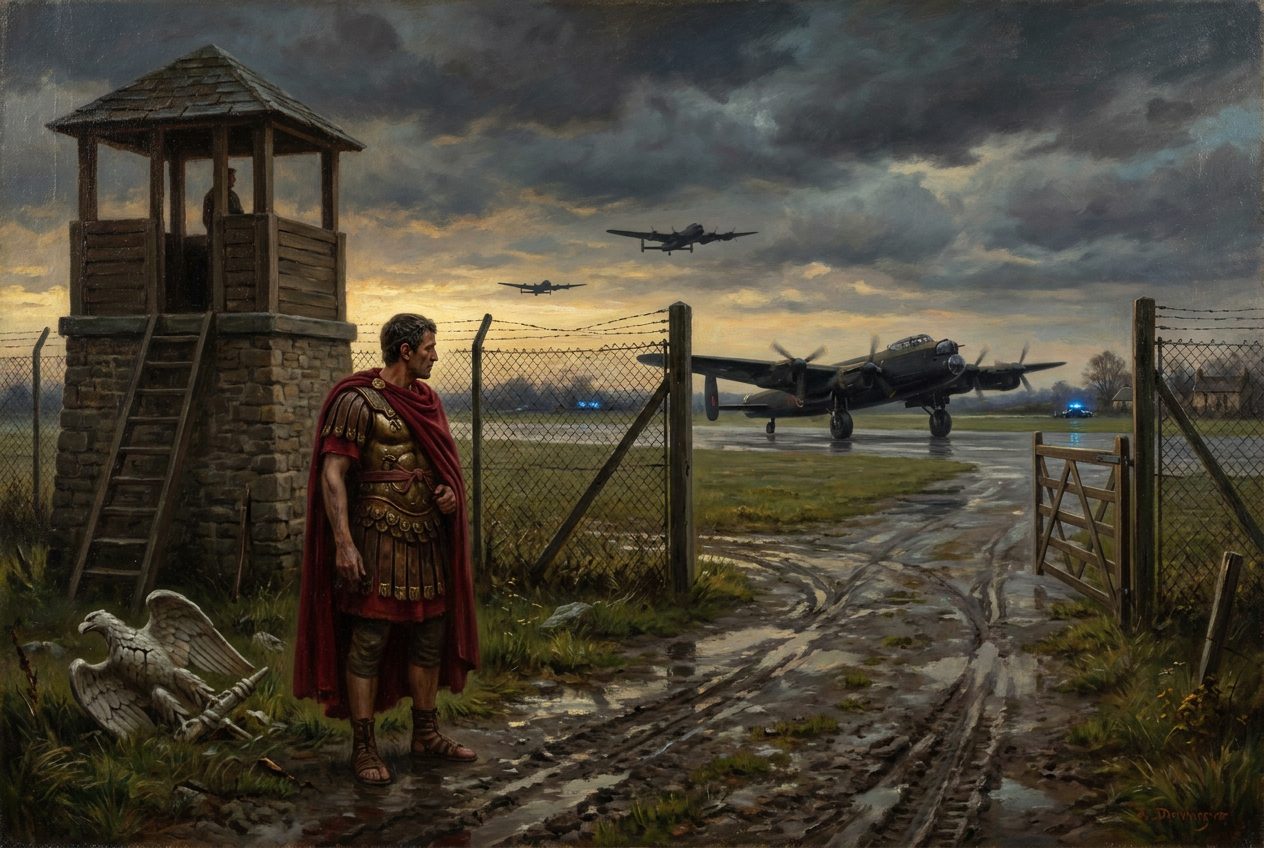
Tab. IVallum Incustoditum, sive Porta Aperta. Tabula Actis Mundi more veterum picta (a machina).The Unwatched Rampart, or The Open Gate. Painted for Acta Mundi in the classical manner (AI-generated).
Iter per Provincias · Ad castra aëria BritanniaeJourneys through the Provinces · To the air base of Britain
Limes qui non servatur non est
A Frontier Unwatched Is No Frontier
Duobus iuvenibus Londiniensibus lege de securitate nationali accusatis, aliis fideiussione dimissis, Americani duodecim fere volucres suas gravissimas ex castris quae Fairford appellant abduxerunt, cum ministri Britannorum locum tutum esse adfirmarent. Ad Glevum veni et inspexi: murus qui non vigilatur murus non est.
Two young Londoners charged under the National Security Act, others released on bail, and the Americans have withdrawn some twelve of their heaviest warplanes from the base they call Fairford, even as the British ministers insisted the place was safe. I came to Gloucester and inspected: a wall that is not watched is not a wall.
Cur hoc legimusWhy we read this Quia castra custodire prima lex legionum est, nec proditoribus porta patere debet.Because guarding the camp is the first law of legions, and the gates must not open for traitors.
Iter per Britanniam, die Martis, ante diem VI Kalendas Novembres, anno urbis conditae MMDCCLXXIX. Ad Glevum veni, unde non procul castra aëria iacent quae incolae Fairford appellant; ibi Americani, socii trans Oceanum, volucres suas onerarias stationem habere solent. Non ut moenia admirarer veni sed ut vigilias inspicerem. Nam, ut GB News nuntiat, mense Septembri tria vehicula suspiciosa prope castra visa sunt; vigiles armati accurrerunt, tumultus maximus indictus est, incolae vici cui nomen Whelford sedibus suis subducti, quinque viri comprehensi; peritique, ut alter fons, DW, tradit, ne quid exitiale in agris lateret exploraverunt.
A journey through Britain, Tuesday, the sixth day before the Kalends of November, in the year 2779 from the founding of the City. I came to Gloucester, not far from which lies the air base the locals call Fairford; there the Americans, our allies across the Ocean, keep their heavy bombers stationed. I did not come to admire the works but to inspect the watch. For, as GB News reports, in the month of September three suspicious vehicles were seen near the base; armed police rushed to the scene, a major incident was declared, the inhabitants of the village called Whelford were taken from their homes, and five men were arrested; and specialists, as the other source, DW, relates, searched the fields lest anything deadly lie hidden there.
Hodie duo iuvenes, quattuor et viginti annos nati, Londinio oriundi, Mohmed Ahmad Abdulkarim et Nouman Essghir, lege quam Britanni Actum de Securitate Nationali vocant accusati et ad iudices producti sunt. Alter, ut DW refert, arguitur ea egisse quae exploratoribus gentis externae opem ferrent — Parthiam esse suspicantur; alter locum vetitum mense Augusto in perniciem patriae intravisse dicitur. Haec crimina sunt, nondum probata: ita accusatores ferunt, ita iudicium decernet.
Today two young men, twenty-four years of age, born in London, Mohmed Ahmad Abdulkarim and Nouman Essghir, were charged under the law the British call the National Security Act and brought before the judges. One, as DW reports, is accused of conduct that would give aid to the spies of a foreign power — they suspect Parthia; the other is said to have entered a prohibited place in August to the harm of his country. These are charges, not yet proven: so the prosecutors allege, and so the court will decide.
Interea septem viri, qui in hanc rem comprehensi esse feruntur, fideiussione dimissi sunt, antequam alii caperentur. Quod factum praeses Americanus Donaldus Trump palam vituperavit: mirari se ait eos dimissos esse, numquam se ipsum tale quid facturum fuisse. Contra Laurentius Taylor, qui cohortibus contra perduelles praepositus est, consilium suum defendit: decreta sua foris nonnumquam sine ratione videri, sed causam semper subesse; tempus opus esse ut indicium in probationem vertatur; hac via celeriorem progressum, meliora testimonia, denique crimina ipsa parta esse; Parthiae denique civitatis manum in his rebus versari valde veri simile esse.
Meanwhile seven men said to have been arrested in this affair were released on bail, before others were seized. The American president Donald Trump openly condemned this: he says he is surprised they were released, and that he himself would never have done such a thing. Against him, Laurence Taylor, who commands the cohorts set against traitors, defended his plan: his decisions, he said, can at times appear senseless to those outside, but there is always a reason behind them; time is needed to turn intelligence into evidence; by this road came swifter progress, better evidence, and at last the charges themselves; and the hand of the Parthian state in these matters is, he says, highly likely.
Utrique audiantur. Scio quid mora possit: «unus homo nobis cunctando restituit rem». Sed cunctatio Fabiana telum est in tempus reconditum, non ignavia praefecti; et quaestio quam praefectus castrorum primam ponit haec est: dum illi dimissi vagantur, quis eos observabat? Hoc acta non dicunt. Gravius aliud vulnus est: introitum in locum vetitum mense Augusto factum esse accusatio dicit, tumultus vero non nisi mense Septembri motus. Murus non ab ultimo qui transcendit, sed a primo iudicatur.
Let both be heard. I know what delay can do: "one man, by delaying, restored the state to us." But Fabian delay is a weapon stored up for its moment, not a prefect's idleness; and the question a camp prefect asks first is this: while those released men wandered free, who was watching them? The reports do not say. There is a graver wound: the charge says the prohibited place was entered in August, yet the alarm was not raised until September. A wall is judged not by the last man who crosses it, but by the first.
Nec satis. Duodecim fere volucres illas quas B-1 Lancer vocant, quae plus oneris exitialis quam ulla ballistarum cohors ferunt, Americani ex his castris propter minas quasdam, ut praeses eorum ait, abduxerunt; cum tamen aedes illae Decimae, unde primus minister Britanniae loqui solet, locum tutum esse adfirmarent. Duo domini, duae voces. Socius qui aquilas suas subducit suffragium verius fert quam ulla epistula obsignata. Cui bono? Si vera est suspicio cohortium, Parthia — quae castra, ex quibus in terram suam tela iaciantur, iusta sibi impetendi loca esse praedicat — sine proelio campo potita est; negat tamen illa se quicquam egisse, nec acta ullam adhuc probationem ostendunt quae accusatos cum mandatoribus externis coniungat. Fama nondum probatio est. Diu in tribunali sedi ne quem suspicionibus praefectorum damnarem; diu in limite steti ne portam, dum litigamus, apertam relinquerem.
Nor is that all. Some twelve of those planes they call B-1 Lancers, which carry more deadly weight than any cohort of ballistae, the Americans withdrew from this base because of "some threats", as their president says; and this while the house they call Number Ten, from which the British prime minister usually speaks, was insisting the place was safe. Two masters, two voices. An ally who pulls back his eagles casts a truer vote than any letter sealed with oaths. Cui bono? If the cohorts' suspicion is true, Parthia — which declares the bases from which missiles are hurled at its own land to be legitimate targets — has gained the field without a battle; yet Parthia denies it did anything, and the reports so far show no proof linking the accused to their foreign taskmasters. Report is not yet proof. I sat long on the tribunal lest I condemn any man on a prefect's suspicions; I stood long on the frontier lest the gate be left open while we argue.
Causam vero, non casum, quaerere oportet: ex his castris, ut ambo fontes tradunt, in Parthiam tela iacta sunt. Provincia quae solum suum alieno bello praebet bellum ipsum in limen suum advocat. Augustus monuit imperium intra terminos continendum esse; ego Mesopotamiam, quam Traianus ceperat, reddidi, quia quod tenere non potes ne occupare quidem debes. Non meum est de Americanorum bello iudicare; magistratus autem qui exercitum hospitem in solo suo accipit geminatam vigiliam civibus debet, nec acta ostendunt eam geminatam fuisse.
But one must seek the cause, not the chance: from this base, as both sources relate, missiles were hurled at Parthia. A province that lends its soil to another's war invites that war onto its own threshold. Augustus warned that the empire be kept within its boundaries; I gave back Mesopotamia, which Trajan had taken, because what you cannot hold you should not even occupy. It is not mine to judge the Americans' war; but a magistrate who receives a foreign army on his soil owes his citizens a doubled watch, and the reports do not show that it was doubled.
Remedium in promptu est, neque novum. Vallum circum castra ducatur, sicut in extremo Britanniae murum duxi «qui barbaros Romanosque divideret»; stationes inspiciantur, milites in pace exerceantur, vigiles qui dormierint puniantur, qui nuntiaverint praemium ferant; de tutela loci una vox exeat, et sociorum dicta factis congruant. Limes non in tabula pingitur sed in vigilia constat; ubi custodes dormiunt, murus sepulcrum est.
The remedy is at hand, and it is not new. Let a rampart be drawn around the base, as I drew a wall at the far edge of Britain "to divide the barbarians from the Romans"; let the posts be inspected, the soldiers drilled in peace, the watchmen who slept punished, and those who gave warning rewarded; let there be one voice on the safety of the place, and let the allies' words agree with their deeds. A frontier is not drawn on a map but stands in vigilance; where the guards sleep, the wall is a tomb.
Limes non in tabula pingitur sed in vigilia constat; ubi custodes dormiunt, murus sepulcrum est.
A frontier is not drawn on a map but stands in vigilance; where the guards sleep, the wall is a tomb.
FONTES ANTIQVIANCIENT SOURCES
- Ennius, Ann. 363 Sk.unus homo nobis cunctando restituit rem
- SHA Hadr. 11.2murumque per octoginta milia passuum primus duxit, qui barbaros Romanosque divideret
FONTES HODIERNITODAY’S SOURCES
- GB NewsPolice defend decision to release RAF Fairford suspects on bail as two men charged with National Security Act offences
- DWTwo men face UK national security charges following an incident near RAF Fairford, with police suspecting Iranian state involvement
Res ex fontibus; sententia Romani.Facts from the sources; the opinion is the Roman’s.
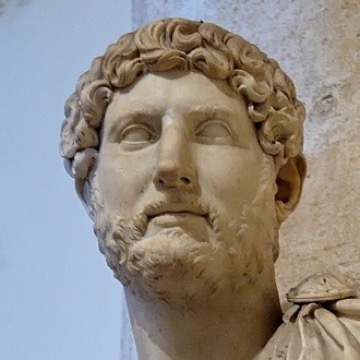
P. Aelius Hadrianus
Imperator peregrinator: omnes fere provincias obiit, fines imperii vallo in Britannia et limitibus firmavit, Pantheum restituit, Graecorum studiosus. Imperium non auxit sed servavit.The travelling emperor: he visited nearly every province, fixed the empire’s frontiers — with his Wall in Britain and fortified borders — rebuilt the Pantheon and loved all things Greek. He did not enlarge the empire; he secured it.
Haec vox restituta est ex his libris:This voice is reconstructed from:
Scribe ad Hadrian: tabellarius epistulam tuam per vias Romanas feret, et responsum post dies aliquot redibit.Write to Hadrian: the courier carries your letter along the Roman roads, and a reply comes back after a few days.
LEGE ETIAMREAD NEXT
- Murus quem nemo aedificavit liquescitThe Wall No One Built Is MeltingHadrian
- Tectum curiae ardet, annona clamat: utrumque audiendum, alterum puniendumThe council-house roof burns, the annona cries out: both must be heard, one must be punishedHadrian
- De commeatu aërio ex castris Mildenhall in Germaniam et Hispaniam translatoOn the air supply train moved from the camp at Mildenhall to Germany and SpainCaesar
- Ieiunium non est temperantiaFasting Is Not TemperanceFrontinus
- Harenam in thesaurum vertit ingenium; thesaurum unius hominis custodia tueturGenius turns sand into treasure; one man's keeping guards the treasurePliny the Elder