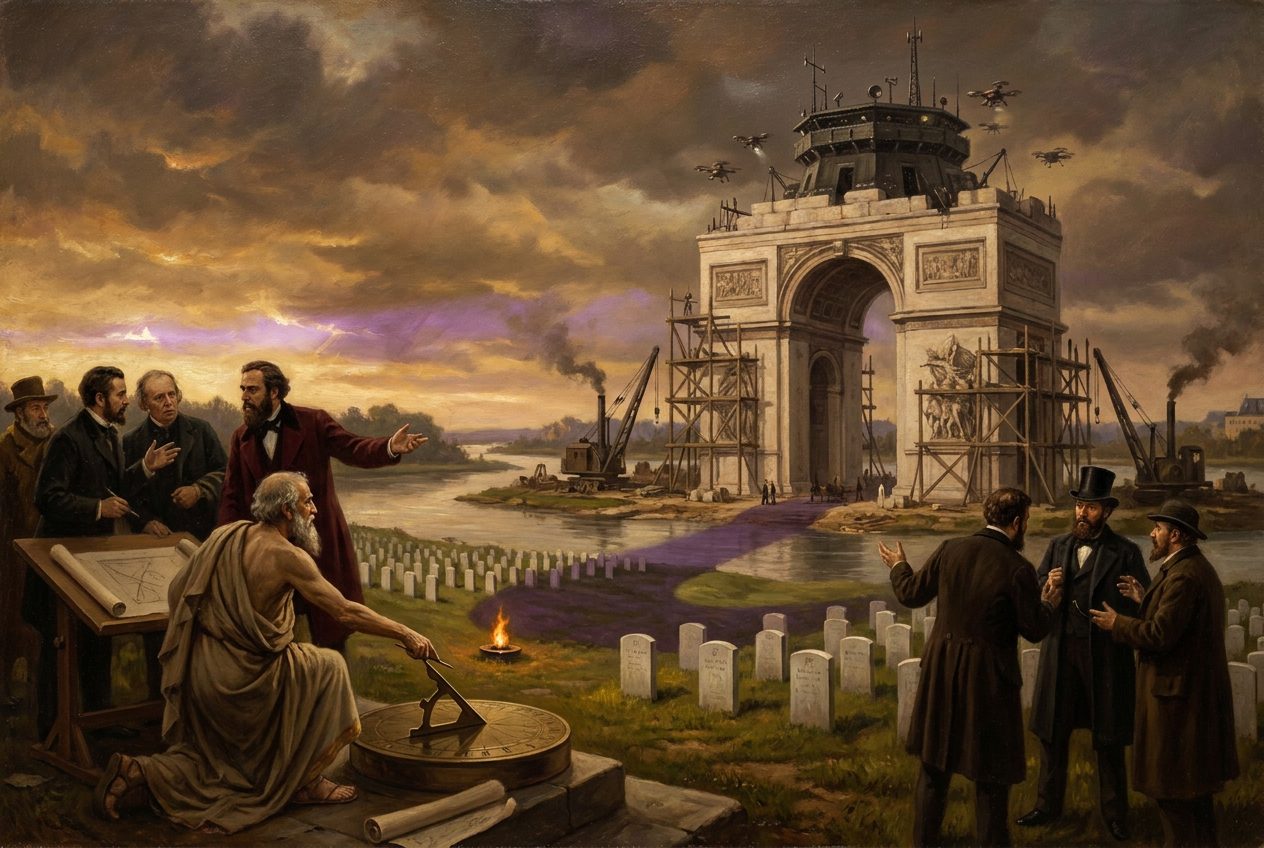
Tab. IUmbra Arcus, sive Gnomon Neglectus. Tabula Actis Mundi more veterum picta (a machina).The Shadow of the Arch, or The Neglected Gnomon. Painted for Acta Mundi in the classical manner (AI-generated).
De Architectura · De arcu triumphali ad insulam ColumbiaeOn Architecture · The triumphal arch on Columbia Island
De arcu cuius umbra in sepulcra cadit, et cuius pretium nemo professus est
On an arch whose shadow falls on graves, and whose price no one has declared
Ut RedState nuntiat, Districtus Columbiae et Virginia lite apud iudicium foederale intenta prohibere conantur ne arcus triumphalis ducentorum quinquaginta pedum, quem praeses Donaldus Trump in Memorial Circle ponere vult, aedificetur. Ego opus non lite sed regula metior: firmitate, utilitate, venustate, situ, et pretio vere professo.
As RedState reports, the District of Columbia and Virginia have brought suit in federal court to stop construction of the 250-foot triumphal arch that President Donald Trump wants to set up at Memorial Circle. I measure the work not by lawsuit but by rule: soundness, usefulness, beauty, site, and an honestly declared price.
Cur hoc legimusWhy we read this Quia fornix triumphalis non solum opus marmoreum sed civitatis dominatus et memoria est.Because a triumphal arch is not merely marble work, but the assertion and memory of a state's dominion.
Dinocrates architectus, cogitationibus et sollertia fretus, cum Alexander rerum potiretur, ad exercitum regis profectus est commendationis cupidus. Is, cum aditum non haberet, corpus oleo perunxit, caput populea fronde coronavit, pelle leonina umerum texit, clavam manu tenuit, atque ita Herculis habitu in conspectum regis processit. Promisit deinde se montem Athonem in statuae virilis formam conformaturum, cuius laeva manu moenia amplissimae civitatis continerentur, dextra patera quae omnium fluminum aquam exciperet. Delectatus rex statim quaesivit num agri circa essent qui ei civitati frumentum praestarent; et cum intellexisset non esse, formam laudavit, situm improbavit. Itaque ego quoque, Imperator, in omni opere magnifico primum quaero quo loco et cui usui ponatur; magnitudinem postea.
Dinocrates the architect, trusting in his ideas and his skill, set out for the king's army when Alexander was master of the world, eager to be noticed. Having no introduction, he oiled his body, crowned his head with poplar leaves, threw a lion's skin over his shoulder, took a club in his hand, and so, in the dress of Hercules, walked into the king's sight. He then promised to shape Mount Athos into the figure of a man, whose left hand should hold the walls of a great city and whose right a bowl to receive the water of every river. The king, delighted, asked at once whether there were fields round about to supply that city with grain; and when he learned there were none, he praised the design and condemned the site. So I too, Imperator, ask first of every magnificent work where it is placed and what it is for; its size comes afterwards.
Ut RedState nuntiat, administratio praesidis Donaldi Trump pronuntiavit se intra duas hebdomadas fossionem incepturam esse fundamentorum operis quod Magnum Arcum Triumphalem et Speculam Militarem appellat, ducentorum quinquaginta pedum altitudine, in Memorial Circle insulae Columbiae, inter monumentum Lincolnii et sepulcreta Arlingtoniensia. Id opus futurum esse dicit peregrinantibus spectaculum, praesidio urbis sedem iaculatorum ex occulto et fucorum volantium, monumentum denique caput potentissimae civitatis decens. Pridie Kalendas Novembres autem Districtus Columbiae et Virginia iudicium foederale rogaverunt uti opus inhiberetur: arcum contra leges altiorem esse, viarum commeatum per annos impediturum, totum opus flagranter non legitimum. Acta Washingtoniensia, simulacro trium dimensionum facto, invenisse dicuntur umbram arcus in multa sepulcra et monumenta cadere, quibusdam diebus etiam in sepulcrum Iohannis Kennedy et ignem eius perpetuum; administratio contra affirmat plerasque umbras mane fieri, priusquam sepulcreta aperiantur. Ante diem III Kalendas Novembres Tanya Chutkan, iudex, in alia lite, cuius actores RedState non nominat, significavit se opus fortasse ad tempus inhibituram, et quaesivit num praeses urbem tantum praestringere vellet.
As RedState reports, President Donald Trump's administration has announced that within two weeks it will begin excavating the foundations of the work it calls the Great Triumphal Arch and Military Observation Deck, 250 feet high, at Memorial Circle on Columbia Island, between the Lincoln Memorial and Arlington National Cemetery. It says the work will be a spectacle for visitors, a post for snipers and drones to guard the city, and, finally, a monument befitting the capital of the most powerful state. On 31 October, however, the District of Columbia and Virginia asked a federal court to halt the work: the arch, they say, is unlawfully tall, will snarl traffic for years, and the whole project is flagrantly unlawful. The Washington Post, having built a three-dimensional model, is said to have found that the arch's shadow falls on many graves and monuments, and on some days even on the grave of John F. Kennedy and its eternal flame; the administration answers that most of the shadows fall in the early morning, before the cemetery opens. On 30 October Judge Tanya Chutkan, in a separate suit whose plaintiffs RedState does not name, indicated that she might halt the work at least for a time, and asked whether the president simply wished to dazzle the city.
«Haec autem ita fieri debent, ut habeatur ratio firmitatis, utilitatis, venustatis.» De firmitate nihil omnino in actis legitur: neque de fundamentis in insula fluminis iactis, neque de materia, neque de architecto. Quod de utilitate dicitur, id me, qui ballistas et scorpiones Caesari paravi, non offendit: speculam enim in loco edito ponere res militaris est et honesta. Sed decor operis postulat ut forma ex usu nascatur. Arcus est porta honoris, per quam victor cum exercitu transit; specula est turris ex qua custodes prospiciunt. Qui utrumque in uno opere coniungit, neque portam integram facit neque turrem; et iaculatores in fornice triumphali collocare idem est atque in templo armamentarium aedificare.
"All these must be built with due regard to soundness, usefulness and beauty." Of soundness the reports say nothing at all: nothing of foundations laid on an island in a river, nothing of materials, nothing of the architect. What is said of usefulness does not offend me, who prepared ballistae and scorpions for Caesar: to set a lookout on a high place is a military matter, and an honourable one. But propriety requires that a building's form arise from its use. An arch is a gate of honour, through which the victor passes with his army; a watchtower is a tower from which sentries look out. Whoever joins the two in one work makes neither a whole gate nor a whole tower; and to station marksmen in a triumphal vault is like building an armoury inside a temple.
De situ gravius dicendum est. Architectum astrologiae peritum esse oportet, uti sciat quemadmodum sol per menses currat et quo umbrae cadant. Scriptor RedState lepide monet solem moveri. Verum est solem moveri; sed architectus ideo gnomonem habet, uti sciat quo moveatur. Haec res non in foro neque apud iudicem disputanda erat, sed in tabula, antequam primum rutrum terram tangeret. Sepulcreta autem Arlingtoniensia sunt sedes militum qui pro patria ceciderunt; monumentum quod eos honorare se dicit non debet eos opprimere, sed modestia proportionis cum vicinis operibus convenire, uti membra corporis inter se respondent.
Of the site I must speak more gravely. An architect ought to know astronomy, so that he understands how the sun runs through the months and where shadows fall. The RedState writer wittily reminds us that the sun moves. True, the sun moves; but that is why the architect has a gnomon, to know where it moves. This question belonged not in the forum or before a judge, but on the drawing board, before the first spade touched the earth. And Arlington is the resting place of soldiers who fell for their country; a monument that claims to honour them ought not to overbear them, but to agree in modest proportion with the works around it, as the members of a body answer to one another.
Verum est solem moveri; sed architectus ideo gnomonem habet, uti sciat quo moveatur.
True, the sun moves; but that is why the architect has a gnomon, to know where it moves.
Districtum autem et Virginiam, magistratus finitimos, sero litigare video, paucis diebus ante fossionem; atque ea mora pro armis forensibus uti, non pro regula artis. Concedo: sua quisque civitas lege uti debet, et Augustus noster altitudines aedificiorum in urbe publice finivit, qua lege etiam princeps tenebatur. Sed si lex altitudinis exstat, ante annos proferenda erat, non pridie Kalendas; et si non exstat, iniquum est arcum lite pro lege prohibere. Utraque pars igitur in eodem vitio est: opus magnum sine consilio publico perfecto incipere, et contra id sine ratione perfecta pugnare.
As for the District and Virginia, neighbouring magistracies, I see that they go to law late, a few days before the digging, and use that delay as a courtroom weapon, not as a rule of the craft. I grant it: every community should use its own laws, and our Augustus fixed by public law the heights of buildings in the city, a law that bound even the princeps. But if a height law exists, it should have been produced years ago, not on the eve of the Kalends; and if none exists, it is unjust to forbid an arch by lawsuit in place of law. Both sides, then, share one fault: to begin a great work without a finished public plan, and to fight it without a finished argument.
Restat quod maximum est, quodque acta prorsus tacent: quanti constet, quis solvat, quis aedificet. «Nobili Graecorum et ampla civitate Ephesi lex vetusta dicitur a maioribus dura condicione sed iure non iniquo constituta»: architectus, cum opus publicum susciperet, pretium ante profitebatur et bona sua obligabat; si quarta parte amplius consumpsisset, de suo solvebat. Remedium igitur in promptu est: nominetur architectus, profiteatur pretium, obliget bona; umbrae per totum annum gnomone dimensae publice proponantur; tum aut aedificetur in saecula ex lapide, aut omnino ne aedificetur. Qui umbram operis sui metiri non potest, ne arcum statuat.
There remains the greatest matter, on which the reports are wholly silent: what it costs, who pays, who builds. "In the famous and great Greek city of Ephesus an ancient law is said to have been laid down by the ancestors, harsh in its terms but not unjust in principle": an architect who took on a public work declared its price in advance and pledged his property; if he spent more than a quarter over, he paid it from his own purse. The remedy is ready to hand: let the architect be named, let him declare the price, let him pledge his goods; let the shadows, measured by gnomon through the whole year, be publicly posted; then let it either be built of stone for the ages, or not be built at all. He who cannot measure the shadow of his own work should not raise an arch.
FONTES ANTIQVIANCIENT SOURCES
- Vitr. 1.3.2Haec autem ita fieri debent, ut habeatur ratio firmitatis, utilitatis, venustatis
- Vitr. 10 praef. 1Nobili Graecorum et ampla civitate Ephesi lex vetusta dicitur a maioribus dura condicione sed iure non iniquo constituta
FONTES HODIERNITODAY’S SOURCES
- RedStateHere We Go Again: VA, DC Sue to Kill Trump's Arch Just Days Before Construction Scheduled to Begin
- BreitbartGeorgia Police: Teen Strangled His Mom with Intent to Kill Before Stealing Her Car and Leading Cops on 100 mph Chase
Res ex fontibus; sententia Romani.Facts from the sources; the opinion is the Roman’s.
Scribe ad Vitruvius: tabellarius epistulam tuam per vias Romanas feret, et responsum post dies aliquot redibit.Write to Vitruvius: the courier carries your letter along the Roman roads, and a reply comes back after a few days.
LEGE ETIAMREAD NEXT
- Membrum maius corpore: de vico Barnham et castris sine symmetriaA limb larger than the body: the village of Barnham and a camp without symmetryVitruvius
- Saxa Oceano obiecta non sunt fundamentaRocks Thrown Against the Ocean Are Not FoundationsVitruvius
- Firmitas, Utilitas — Ubi Venustas?Strength, Utility — and Where Is Beauty?Vitruvius
- De commeatu aërio ex castris Mildenhall in Germaniam et Hispaniam translatoOn the air supply train moved from the camp at Mildenhall to Germany and SpainCaesar
- Ieiunium non est temperantiaFasting Is Not TemperanceFrontinus