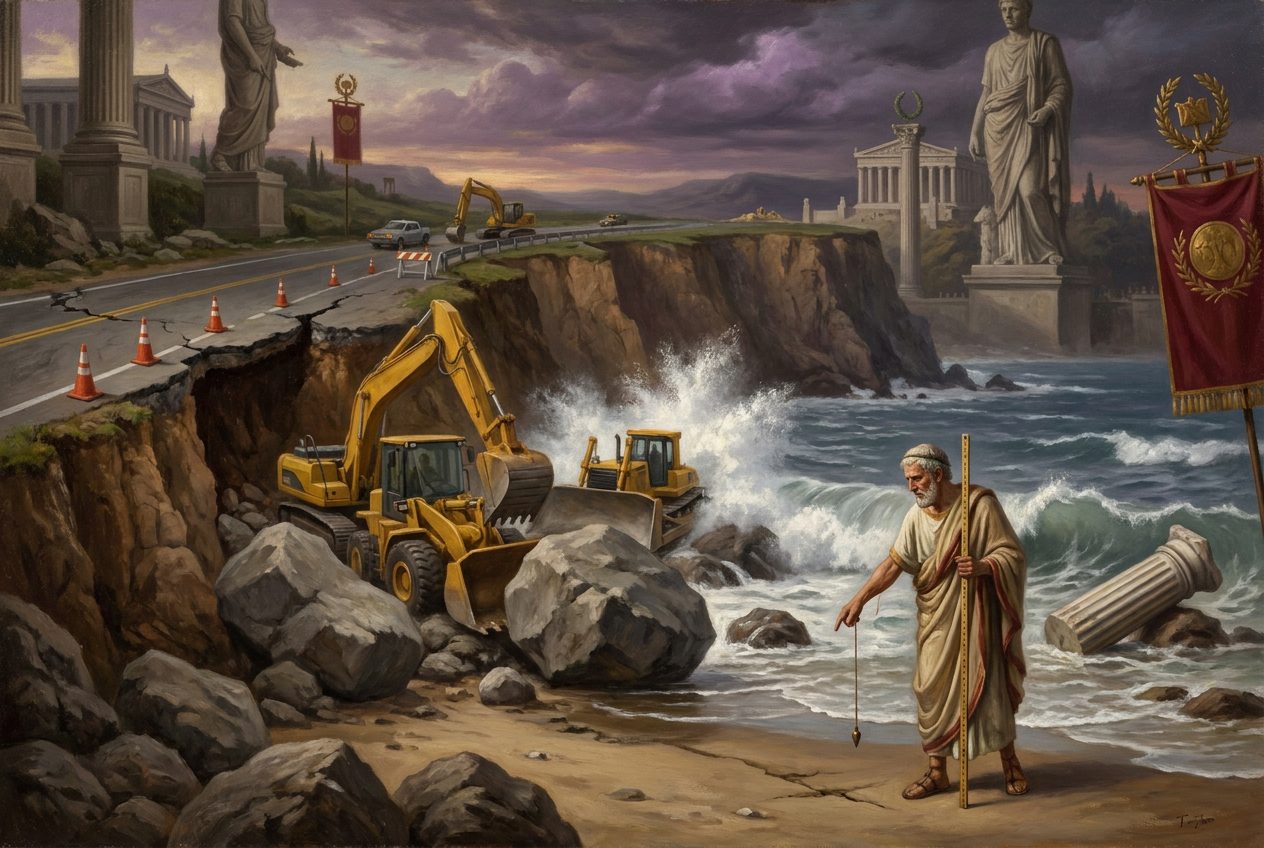
Tab. ISaxa Contra Oceanum, sive Via Sine Fundamento. Tabula Actis Mundi more veterum picta (a machina).Rocks Against the Ocean, or The Road Without Foundation. Painted for Acta Mundi in the classical manner (AI-generated).
De Architectura · De via litorali CaliforniaeOn Architecture · On the coast road of California
Saxa Oceano obiecta non sunt fundamenta
Rocks Thrown Against the Ocean Are Not Foundations
Ut New York Post nuntiat, Caltrans viam litoralem Oceani Pacifici apud Malibu, tempestatibus abruptam, saxis congestis munire contendit, et alibi rupes sub eadem via fissa est. Ego censeo opus quod non in solido fundatur aut in solidum transferri debere aut a mari recedere.
As the New York Post reports, Caltrans is hurrying to shore up the Pacific coast highway at Malibu, torn away by storms, with heaped rocks, and elsewhere the cliff beneath the same road has split. My judgment is that a work not founded on solid ground must either be carried down to the solid or draw back from the sea.
Cur hoc legimusWhy we read this Quia viae litorales, quamvis magna arte structae, naturae tempestatibus cedunt nisi fundamenta in ipsa saxa defixa sint.Because coastal highways, however skillfully engineered, succumb to the tempests of nature unless their foundations are anchored in living rock.
Praefatio. Salpia vetus, Apuliae oppidum, in paludibus posita erat, et cives eius quotannis morbis laborabant. Marcus Hostilius autem non aggeribus neque fossis paludem vincere conatus est, sed a senatu populoque Romano impetravit uti oppidum transferre liceret; itaque locum salubriorem quattuor milibus passuum procul ad mare elegit, moenia fundavit, areas divisit, et Salpini, vetere oppido relicto, in novum migraverunt. Hoc ideo memoro, uti intellegatur architectum non semper naturam corrigere debere, sed interdum cedere et locum mutare.
Preface. Old Salpia, a town of Apulia, was set among marshes, and its citizens fell sick year after year. Marcus Hostilius, however, did not try to defeat the marsh with embankments or ditches; he obtained leave from the senate and people of Rome to move the town. So he chose a healthier site four miles off, by the sea, laid the walls, divided the building plots, and the Salpians abandoned the old town and moved into the new. I record this so that it may be understood that an architect need not always correct nature; sometimes he must yield and change the site.
Nunc ad rem. Ut New York Post nuntiat, curatores viarum Californiae, quos Caltrans appellant, die Veneris, ante diem XVII Kalendas Novembres, ediderunt operarios apud litus Thornhill Broome in agro Malibu, ad septentriones a Sycamore Canyon Road, saxa ingentia congerere, ubi pars viae, quae Via Prima dicitur, proxima tempestate abrupta erat; machinis fodientibus et trudentibus terram et saxa moveri. Item custodes viarum monuerunt aestus altos iter in eodem loco impedire, et cursus vehiculorum mutatos esse. Praeterea in Orange County, prope El Morro supra Laguna Beach, rupes sub via fissura magna hiare dicitur; quam ob rem Caltrans unam semitam meridiem versus inter Irvine Cove et Reef Point Drive clausit. Christianne Smith, curatorum interpres, ut acta LA Times referunt, viatores signa sequi iussit propter salutem viatorum et operariorum. Civitas autem California, hiemem El Niño appellatam timens, statum necessitatis ante tempestates indixit; quando via apud Malibu restituatur, magistratus nondum dixerunt.
Now to the matter. As the New York Post reports, the California road commissioners, whom they call Caltrans, announced on Friday, the seventeenth day before the Kalends of November, that workers at Thornhill Broome Beach in the district of Malibu, north of Sycamore Canyon Road, are piling up huge rocks where part of the road known as Highway 1 was torn away in the latest storm; earth and boulders are being moved by digging and pushing machines. The road patrol likewise warned that high tides are hindering travel at the same spot, and that traffic patterns have been changed. Further, in Orange County, near El Morro above Laguna Beach, the cliff beneath the road is said to gape with a great crack; for this reason Caltrans has closed one southbound lane between Irvine Cove and Reef Point Drive. Christianne Smith, the commissioners' spokeswoman, as the LA Times reports, told travellers to follow the signs for the safety of travellers and workers. And the state of California, fearing the winter they call El Niño, has declared a state of emergency before the storms; when the road at Malibu will be restored, the officials have not yet said.
Primum igitur considerandum est quod in omni opere praecepi: «Haec autem ita fieri debent, ut habeatur ratio firmitatis, utilitatis, venustatis». Firmitas autem non in pavimento est neque in saxis superpositis, sed in fundamento. Fundamenta enim, si fieri potest, ad solidum et in solido fodienda sunt; si solidum non invenitur, sublicis et carbonibus et structura certa locus firmandus est. Caltrans id genus munitionis praesidium diuturnum vocat; acta tamen non narrant utrum haec saxa in viva petra posita sint an in harena litoris tantum acervata. Hoc primum quaereret architectus, nam saxum quod non tenetur ipsum mare movet, et quod mare movet, mox in viam reicit.
First, then, we must consider what I have laid down for every work: "These things must be so done that account is taken of soundness, usefulness and beauty." Soundness, however, lies not in the road surface, nor in rocks laid on top, but in the foundation. Foundations, where it can be done, must be dug down to the solid and into the solid; where the solid is not found, the site must be made firm with piles, charcoal and sure masonry. Caltrans calls this kind of defence long-term protection; yet the reports do not say whether these rocks are set on living bedrock or merely heaped on the sand of the beach. An architect would ask this first, for a rock that is not held fast the sea itself moves, and what the sea moves it soon flings back onto the road.
Deinde rupes apud Laguna Beach docet ubi vitium sit. Via non ipsa cedit, sed terra quae viam portat; fluctus enim pedem rupis edunt, et cum pes exesus est, totum supra pendet. Qui igitur viam reficit et rupem neglegit, tectum reficit et parietem non inspicit. Neque Oceanus hostis est novus aut improvisus: civitas ipsa, cum ante hiemem statum necessitatis indixerit, confitetur se periculum ante scire. Quod autem quotannis scitur, non est necessitas, sed neglegentia diligenter repetita.
Next, the cliff at Laguna Beach shows where the fault lies. It is not the road that gives way, but the earth that carries the road; the waves eat at the foot of the cliff, and once the foot is eaten away, all above it hangs. Whoever repairs the road and neglects the cliff repairs the roof and never looks at the wall. Nor is the Ocean a new or unforeseen enemy: the state itself, by declaring an emergency before winter, confesses that it knew the danger in advance. What is known every year is not an emergency; it is negligence, diligently repeated.
Quod autem quotannis scitur, non est necessitas, sed neglegentia diligenter repetita.
What is known every year is not an emergency; it is negligence, diligently repeated.
De utilitate et sumptu item dicendum est. Acta neque sumptum operis neque finem temporis indicant. Memini legem Ephesiam: «Nobili Graecorum et ampla civitate Ephesi lex vetusta dicitur a maioribus dura condicione sed iure non iniquo constituta». Architectus ibi sumptum ante pronuntiabat et bona sua obligabat; si plus quarta parte excesserat, ipse de suo solvebat. Hic autem, ubi operi nullus sumptus, nullus dies propositus est, cives quod mare quotannis rapuerit, quotannis repetent, et nemo pro aestimatione spondebit.
Of usefulness and cost something must also be said. The reports give neither the cost of the work nor a date for its end. I remember the Ephesian law: "In the noble and great Greek city of Ephesus an ancient law is said to have been established by the ancestors, harsh in its terms but not unjust." There the architect declared the cost in advance and pledged his property; if he exceeded it by more than a quarter, he paid from his own purse. Here, where no cost and no day has been set for the work, the citizens will reclaim every year what the sea seizes every year, and no one will stand surety for the estimate.
Remedium itaque duplex est, neque novum. Aut opera in vivam petram descendant, uti pilae portuum nostrorum, quae arcis immissis et pulvere Puteolano structae sub aqua durescunt et fluctibus resistunt; aut via, ubi petra deest, a margine recedat, quemadmodum Hostilius Salpiam a palude transtulit. Tertia via, saxa in litore acervare et hiemem exspectare, non architecti est sed votum Neptuno factum. Mare enim non vincitur congerie, sed aut fundamento aut recessu.
The remedy, therefore, is twofold, and not new. Either the works go down to living rock, like the piers of our harbours, built with sunken caissons and Puteolan dust that hardens under water and withstands the waves; or, where rock is wanting, the road draws back from the edge, as Hostilius moved Salpia from the marsh. The third course, to heap rocks on the beach and wait for winter, is not an architect's work but a vow made to Neptune. For the sea is not beaten by a heap, but by a foundation or by retreat.
FONTES ANTIQVIANCIENT SOURCES
- Vitr. 1.3.2Haec autem ita fieri debent, ut habeatur ratio firmitatis, utilitatis, venustatis
- Vitr. 10 praef. 1Nobili Graecorum et ampla civitate Ephesi lex vetusta dicitur a maioribus dura condicione sed iure non iniquo constituta
FONTES HODIERNITODAY’S SOURCES
Res ex fontibus; sententia Romani.Facts from the sources; the opinion is the Roman’s.
Scribe ad Vitruvius: tabellarius epistulam tuam per vias Romanas feret, et responsum post dies aliquot redibit.Write to Vitruvius: the courier carries your letter along the Roman roads, and a reply comes back after a few days.
LEGE ETIAMREAD NEXT
- Firmitas, Utilitas — Ubi Venustas?Strength, Utility — and Where Is Beauty?Vitruvius
- Tectum curiae ardet, annona clamat: utrumque audiendum, alterum puniendumThe council-house roof burns, the annona cries out: both must be heard, one must be punishedHadrian
- Umbra circuli non doletThe Shadow of a Circle Feels No PainHypatia
- Suffragium hereditas est, non praedaThe Vote Is an Inheritance, Not PlunderCornelia