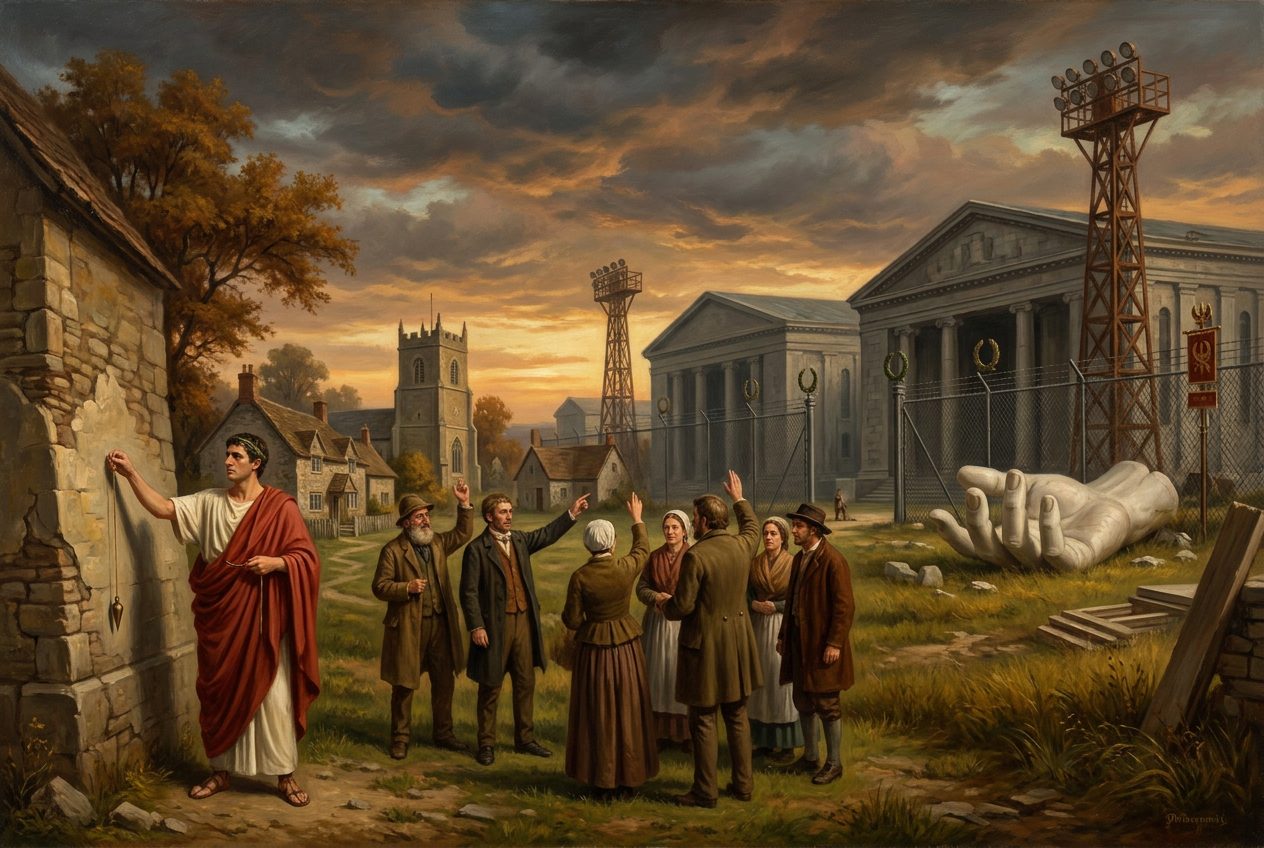
Tab. IMembrum Maius Corpore, sive Castra sine Symmetria. Tabula Actis Mundi more veterum picta (a machina).A Limb Larger than the Body, or The Camp without Symmetry. Painted for Acta Mundi in the classical manner (AI-generated).
De Architectura · De castris iuxta vicum positisOn Architecture · On a camp set beside a village
Membrum maius corpore: de vico Barnham et castris sine symmetria
A limb larger than the body: the village of Barnham and a camp without symmetry
Ut GB News nuntiat, vicani Barnhamenses in Britannia, cum Home Office in castris aëriis vicinis advenas asylum petentes primo MCCL, nunc DCCCCXIII collocare statuisset, in contione suffragium de discessu a Regno Unito habendum decreverunt. Ego hoc dico: opus quod ipso oppido cui adiungitur maius est nullam symmetriam habet, et rogatio vicanorum nihil aliud est quam perpendiculum quod murum non rectum esse ostendit.
GB News reports that the villagers of Barnham in Britain, after the Home Office resolved to lodge asylum seekers at a nearby air base, first 1,250 of them and now 913, decided at a public meeting to hold a vote on leaving the United Kingdom. My verdict is this: a work larger than the town it is attached to has no symmetry, and the villagers' motion is a plumb line that shows the wall is not true.
Cur hoc legimusWhy we read this Quia castra sine modo inter pagos structa civitatis concordiam atque fines violant.Because barracks planted without measure among townships violate civic harmony and the boundaries of the commonwealth.
Dinocrates architectus, cogitationibus suis confisus, Alexandro regi se obtulit Herculis habitu, et formam proposuit montis Athonis in statuam viri conversi, cuius laeva manu moenia urbis amplissimae continerentur, dextra patera flumina omnia montis exciperet. Delectatus est rex inventione; sed statim quaesivit, essentne circa agri qui eam civitatem frumento alerent. Cum Dinocrates responderet non posse nisi transmarinis subvectionibus, rex consilium reiecit, quod, quemadmodum infans sine nutricis lacte ali non potest, item civitas sine agris et copia frequentiam suam tueri non potest. Hoc primum architecto praeceptum est: non quid in tabula pulchrum sit, sed quid loco conveniat, quaerendum.
Dinocrates the architect, trusting in his own designs, presented himself to King Alexander dressed as Hercules, and proposed to shape Mount Athos into the statue of a man, whose left hand should hold the walls of a great city and whose right a bowl to catch all the streams of the mountain. The king was delighted with the invention; but he asked at once whether there were fields round about to feed such a city with grain. When Dinocrates answered that it could be fed only by shipments from overseas, the king rejected the plan: for just as an infant cannot be nourished without its nurse's milk, so a city cannot sustain its numbers without fields and supplies. This is the first precept for an architect: he must ask not what looks handsome on the drawing board, but what suits the site.
Ut GB News refert, auctore Local Democracy Reporting Service, die Saturni, ante diem IX Kalendas Novembres, in vico Suffolciae qui Barnham appellatur contio frequens habita est; ex octoginta qui aderant septem tantum contra rogationem suffragati sunt, ceteri decreverunt suffragium populi de discessu a Regno Unito esse habendum, exemplo vici Piddington, qui talem rogationem iam per speciem tulerat. Consilium Home Office erat in castris aëriis vicinis advenas asylum petentes, omnes viros iuvenes et caelibes, ut dicitur, collocare, primo MCCL; die autem Veneris palam factum est numerum ad DCCCCXIII esse redactum. Vicus ipse circiter sescentos incolas habet. Iohannes Bauer, consilii paroecialis praeses, dixit vicanos voluisse ostendere quanto dolore ferrent rem publicam nemine consulto id statuisse quod naturam vici mutaret. Legatus Home Office respondit se aequiorem distributionem per totam terram quaerere, deversoria omnia claudere, in castra militaria vetera advenas transferre, quae per se clausa, custodibus die noctuque et speculis electricis munita, minus vicinis nocerent.
As GB News reports, on the authority of the Local Democracy Reporting Service, a crowded meeting was held on Saturday, 24 October, in the Suffolk village called Barnham. Of the eighty present only seven voted against the motion; the rest decided that a popular vote on leaving the United Kingdom should be held, following the example of the village of Piddington, which had already held such a vote as a symbolic gesture. The Home Office's plan was to lodge asylum seekers at the nearby air base, all of them, it is said, young single men, at first 1,250; but on Friday it was made public that the number had been cut to 913. The village itself has about six hundred inhabitants. John Bauer, chairman of the parish council, said the villagers wished to show how deeply they resented the government deciding, without consulting anyone, a matter that would change the nature of the village. A Home Office spokesman replied that it was seeking a fairer distribution across the whole country, closing all the hotels, and moving the asylum seekers to former military sites, which, being self-contained and guarded day and night by security and electronic cameras, would do less harm to their neighbours.
Iudicemus igitur hoc opus ad regulam quam in primo libro posui: «Haec autem ita fieri debent, ut habeatur ratio firmitatis, utilitatis, venustatis». Symmetria autem est ex membris operis conveniens consensus, et ex partibus ad universae figurae speciem ratae partis responsus. Si statuarius manum faceret capite maiorem, ridiculus esset; hic vero membrum maius corpore adiungitur, nam DCCCCXIII viri sescentis animis, in quibus matres, senes, pueri numerantur, apponuntur. Oppidum quod unius aetatis et unius sexus hominibus constat oppidum non est, castra sunt; atque ipse legatus castra describit, cum custodias et clausuram praedicat. Castra vero sine imperatore, sine opere, sine termino, quid sunt nisi deversorium armatum ad portam alieni vici positum?
Let us judge this work, then, by the rule I laid down in my first book: "All these must be built with due regard to soundness, usefulness and beauty." Symmetry, moreover, is the fitting agreement of a work's members with one another, and the correspondence of each part to the form of the whole. If a sculptor made a hand larger than the head, he would be laughed at; yet here a limb larger than the body is being attached, for 913 men are set beside six hundred souls, among whom are counted mothers, old men and children. A town made up of men of one age and one sex is not a town; it is a camp. And the spokesman himself describes a camp, when he boasts of guards and enclosure. But a camp without a commander, without work, without an end date: what is that but an armed lodging-house planted at the gate of another man's village?
Si statuarius manum faceret capite maiorem, ridiculus esset; hic vero membrum maius corpore adiungitur, nam DCCCCXIII viri sescentis animis, in quibus matres, senes, pueri numerantur, apponuntur.
If a sculptor made a hand larger than the head, he would be laughed at; yet here a limb larger than the body is being attached, for 913 men are set beside six hundred souls, among whom are counted mothers, old men and children.
Neque praetereundum est quod acta tacent. Quomodo hi homines examinati sint, unde veniant, quamdiu mansuri, quis commeatum, aquam, medicos, opera praestiturus sit, nihil reperio. Architectus qui de aedificio interrogatus de aqua et de agris tacet, Dinocrati similis est. Maiores nostri colonias non clam deducebant, sed lege lata, triumviris creatis, agro mensura diviso; et oppidani sciebant qui venturi essent et quibus legibus victuri. Hic consilium mutatum est, nuntiatum postea; ita fit ut dominus aedium a fabro discat parietem suum alio loco positum esse.
Nor should I pass over what the reports leave unsaid. How these men were vetted, where they come from, how long they will stay, who is to provide their provisions, water, doctors and work: on all this I find nothing. An architect who, questioned about a building, says nothing of water and fields is another Dinocrates. Our ancestors did not found colonies in secret, but by passing a law, appointing three commissioners and dividing the land by survey; and the townsmen knew who was coming and under what laws they would live. Here the plan was changed and announced afterwards; so it is that the master of a house learns from the builder that his wall has been put up somewhere else.
Rogationem vicanorum non ita accipio quasi paroecia regno discedere possit; qua lege id fieri possit, acta non dicunt, neque ullam esse credo. Est tamen perpendiculum: murum non rectum esse ostendit, etiamsi ipsum murum non erigit. Laudo item Bauer, qui suffragium per totum comitatum, quod consilium comitatus a factione Reform UK ductum postulavit, reiecit, quia, ut ait, multis milibus librarum constaret neque pecunia publica bene uteretur; ille enim, ut lex Ephesia iubebat, sumptum prius quam opus computavit. Sed vicani, cum fines suos suffragio describunt, id agunt quod nos agrimensores facimus: terminos ponunt, quos res publica neglexit.
I do not take the villagers' motion to mean that a parish can secede from a kingdom; by what law that could be done the reports do not say, nor do I believe there is any. It is, however, a plumb line: it shows that the wall is not true, even if it does not set the wall upright. I commend Bauer, too, for rejecting the county-wide vote demanded by the Reform UK-led county council, because, as he says, it would cost many thousands of pounds and would be no good use of public money; for he, as the Ephesian law required, reckoned the cost before the work. But when the villagers mark out their bounds by ballot, they are doing what we surveyors do: they are setting boundary stones that the state has neglected.
Remedium autem vetus est neque difficile. Primum, nullum hospitium publicum maius fiat oppido cui adiungitur. Deinde, antequam fundamenta iaciantur, oppidani consulantur, numerus palam edatur, ager, aqua, viae, custodia ratione computentur. Postremo magistratus qui locum eligit nomen suum operi inscribat et rationem reddat, si numerus aut sumptus excesserit. Nam locus qui hominem non alit, nec advenam servat nec civem.
The remedy is old and not difficult. First, let no public lodging be built larger than the town to which it is attached. Next, before the foundations are laid, let the townsfolk be consulted, the number published openly, and the land, water, roads and guard properly reckoned. Lastly, let the magistrate who chooses the site inscribe his name on the work and render account if the number or the cost runs over. For a place that cannot nourish a man preserves neither the stranger nor the citizen.
FONTES ANTIQVIANCIENT SOURCES
- Vitr. 1.3.2Haec autem ita fieri debent, ut habeatur ratio firmitatis, utilitatis, venustatis
FONTES HODIERNITODAY’S SOURCES
- GB NewsBarnham residents vote to hold Piddington-inspired 'independence' referendum over migrant camp plans
Res ex fontibus; sententia Romani.Facts from the sources; the opinion is the Roman’s.
Scribe ad Vitruvius: tabellarius epistulam tuam per vias Romanas feret, et responsum post dies aliquot redibit.Write to Vitruvius: the courier carries your letter along the Roman roads, and a reply comes back after a few days.
LEGE ETIAMREAD NEXT
- De arcu cuius umbra in sepulcra cadit, et cuius pretium nemo professus estOn an arch whose shadow falls on graves, and whose price no one has declaredVitruvius
- Saxa Oceano obiecta non sunt fundamentaRocks Thrown Against the Ocean Are Not FoundationsVitruvius
- Firmitas, Utilitas — Ubi Venustas?Strength, Utility — and Where Is Beauty?Vitruvius
- De commeatu aërio ex castris Mildenhall in Germaniam et Hispaniam translatoOn the air supply train moved from the camp at Mildenhall to Germany and SpainCaesar
- Ieiunium non est temperantiaFasting Is Not TemperanceFrontinus