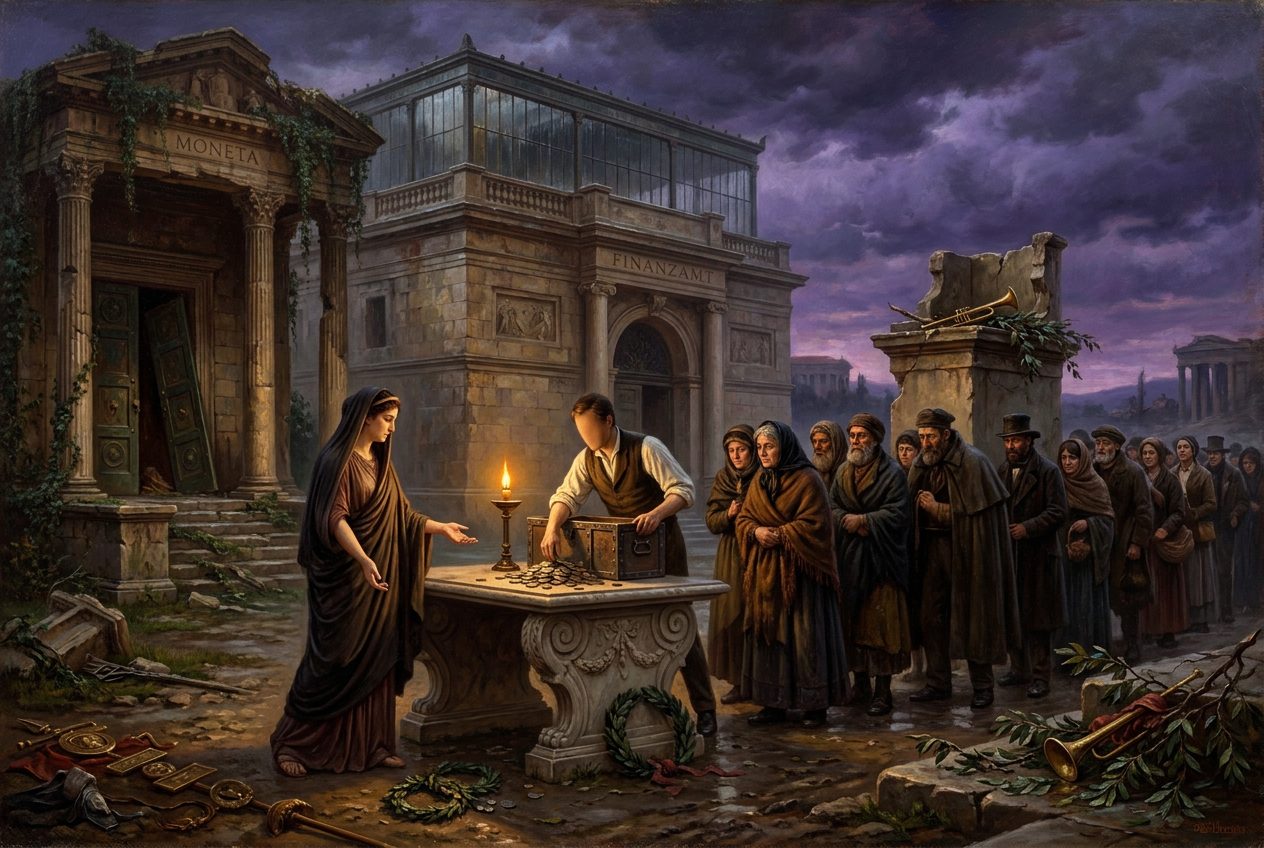
Tab. ITributum Tacitum, sive Vectigal Sine Lege. Tabula Actis Mundi more veterum picta (a machina).The Silent Tribute, or A Levy Without Law. Painted for Acta Mundi in the classical manner (AI-generated).
Orationes · De tributo tacitoSpeeches · On the Silent Tax
Tributum quod nemo tulit
The Tax No One Passed
Thorsten Frei, factionis quam unionem vocant in senatu Germaniae princeps, ut diarium Welt nuntiat, cives admonuit anno proximo cingulum adstringendum esse ob aerarii angustias, simul fassus vectigal illud tacitum, quod Germani progressionem frigidam appellant, anno bis millesimo vicesimo septimo non plene pensatum iri. Oratio contra tributum quod nulla contio tulit.
Thorsten Frei, leader of the faction they call the Union in the German parliament, has warned the citizens, as the newspaper Welt reports, that the belt must be tightened next year because of the straits of the treasury, confessing at the same time that the silent levy the Germans call cold progression will not be fully made good in the year two thousand and twenty-seven. A plea against a tax that no assembly ever passed.
Cur hoc legimusWhy we read this Quia aerarium largitionibus exhaustum mox civium parsimoniam tributis diripit.Because a treasury depleted by reckless bounty soon preys on the thrift of citizens through taxes.
Si quis vestrum miratur, magistratus, cur ego, mulier Romana, de aerario Germaniae verba faciam, is meminerit me in foro nostro iam olim eam causam egisse quam nemo virorum suscipere audebat, ne bona matronarum ad bellum civile alendum diriperentur. Hodie non pro me ipsa loquor nec pro matronis nostris, sed pro omni domo quae tributo oneratur cuius nec rogationem vidit nec auctorem novit. Hoc enim genus vectigalis, quo Germania nunc premitur, omnium insidiosissimum est: lator eius neminem rogat, contio nulla suffragium fert, praeco nullus pronuntiat; pretia crescunt, fiscus tacet, et civis pauperior fit nec scit quo iudicio damnatus sit.
If any of you wonders, magistrates, why I, a Roman woman, should speak of the treasury of Germany, let him remember that I once pleaded in our own Forum the cause no man dared to take up, lest the goods of the matrons be seized to feed a civil war. Today I speak not for myself nor for our matrons, but for every household burdened by a tax whose bill it never saw and whose author it never knew. For this kind of levy, under which Germany now groans, is the most treacherous of all: its sponsor asks no one, no assembly casts a vote, no herald proclaims it; prices rise, the treasury keeps silent, and the citizen grows poorer without knowing by what judgment he was condemned.
Res ipsa sic se habet, ut diarium Germanicum quod Welt inscribitur hodie nuntiat. Thorsten Frei, factionis unionis princeps, ab alio diario, Bild nomine, interrogatus an cives anno proximo cingulum adstringere deberent, respondit ita plane dicendum esse, quod aerarium in angustiis versaretur. Idem dubitare se dixit num progressio illa frigida anno bis millesimo vicesimo septimo plene compensari posset; partem tamen eius iam emendatione vectigalis reditibus impositi cogitata pensatum iri. Progressionem frigidam Germani vocant cum mercedes inflatae nihil nisi pretia aucta pensant, vectigal tamen maius exigitur, ita ut vis pecuniae eadem maneat vel minuatur. Verba hominis non improbo: aperte fateri maluit quam dissimulare. Sed rem, non verba, examinemus.
The matter itself stands thus, as the German newspaper called Welt reports today. Thorsten Frei, leader of the Union faction, asked by another newspaper, Bild by name, whether the citizens must tighten their belts next year, answered that it must be said plainly, because the treasury is in straits. He said further that he doubted whether that cold progression could be fully compensated in the year two thousand and twenty-seven; part of it, he said, will already be made good by the planned reform of the income tax. The Germans call it cold progression when wages swollen by inflation merely offset risen prices, yet a greater tax is exacted, so that the power of the money stays the same or shrinks. I do not fault the man's words: he chose to confess openly rather than dissemble. But let us examine the deed, not the words.
Quid est enim progressio illa nisi tributum sine lege latum? Cum pretia omnium rerum crescunt et nummus vilescit, merces laboris eadem manet, at idem reditus, quia maior numero videtur, altiore gradu plectitur: fit ut civis nihilo locupletior plus aerario pendat. Hoc quis populum rogavit? Quae contio tulit? Quis praeco edixit? Nemo. Fiscus ipse sibi rogationem scripsit et suffragium pro populo tulit. Nummum vilescere pati ut vectigal tacite crescat nihil aliud est quam denarium adulterare; et «fundamentum autem est iustitiae fides»: in nummo et in vectigali eadem dea versatur, et qui alterum violat, alterum non servabit.
For what is this progression but a tax imposed without law? When the prices of all things rise and the coin grows cheap, the wage of labour stays the same, yet the same income, because it seems larger in number, is punished at a higher step: so it comes about that a citizen no richer pays more to the treasury. Who asked the people for this? What assembly passed it? What herald proclaimed it? No one. The treasury wrote its own bill and cast the people's vote for them. To let the coin grow cheap so that the tax silently grows is nothing else than to debase the denarius; and "the foundation of justice is good faith": the same goddess dwells in the coin and in the tax, and he who violates the one will not keep the other.
Dicet aliquis: angustiae aerarii verae sunt; quid faciendum fuit? Audite quid maiores nostri fecerint. Cum Galli urbem tenerent et aurum ad redemptionem quaereretur, matronae Romanae ornamenta sua ultro in medium contulerunt; senatus, recepta urbe, gratiis actis pecuniam reddidit. Rursum bello Hannibalico, exhausto aerario, quod quisque habuit pro patria obtulit, rogatus palam, hoste ad portas stante. Ita fit tributum civium liberorum: aperte poscitur, causa iusta ostenditur, redditur cum res patitur. At hoc vectigal frigidum neque palam poscitur neque umquam redditur: semel captum, in perpetuum captum est.
Someone will say: the straits of the treasury are real; what was to be done? Hear what our ancestors did. When the Gauls held the city and gold was sought for the ransom, the Roman matrons brought their ornaments unasked into the common stock; the senate, the city recovered, gave thanks and repaid the money. Again in the Hannibalic war, when the treasury was exhausted, each man offered what he had for the fatherland, asked openly, with the enemy standing at the gates. That is how the tax of free citizens is made: it is openly demanded, a just cause is shown, and it is repaid when affairs allow. But this cold levy is neither openly demanded nor ever repaid: taken once, it is taken forever.
Atque utinam Frei, cum cingulum civibus adstringendum praedicat, prius quaerat quo illa pecunia abierit quae aerarium impleverat. Cassius ille iudex, cuius prudentiam Cicero laudabat, «identidem in causis quaerere solebat cui bono fuisset». Quaeramus et nos: cui bono ut pretia crescant et gradus vectigalis maneant? Aerario. Cui malo? Domui quae laborat et parcit. Dicunt angustias cogere; ego quaero quis angustias fecerit. Non certe civis ille qui nunc cingulum adstringere iubetur aerarium exhausit: ratio tamen ad eum defertur qui in convivio non sedit. Frugi populus fiscus magistratuum non est.
And would that Frei, when he proclaims that the citizens must tighten their belts, first asked where that money went which had filled the treasury. Cassius, that judge whose prudence Cicero praised, "kept asking in his cases who had benefited." Let us ask too: who benefits when prices rise and the steps of the tax stand still? The treasury. Who suffers? The household that labours and saves. They say necessity compels; I ask who made the necessity. Surely it was not that citizen, now ordered to tighten his belt, who emptied the treasury: yet the bill is carried to the man who did not sit at the feast. A frugal people is not the purse of its magistrates.
Remedium in promptu est, neque novum. Primum: gradus vectigalis lege ipsa pretia sequantur, ut, nisi populus rogatus tulerit, nemo plus pendat quam pendebat; tributum tacitum ex omni iure exulare oportet. Deinde: si vera necessitas urget, palam poscant magistratus, causam ostendant, numeros aperiant, et qui decernunt primi conferant, ut mos est honestarum domorum, ubi in re ardua domina prior ornamenta deponit quam ancillarum cibaria minuat. Postremo meminerint: matres nostrae aurum suum ad Hannibalem arcendum dederunt, discordiae numquam. Patriae quaerenti libera manu datur; fisco tacite surripienti ne nummus quidem.
The remedy lies at hand, and it is not new. First: let the steps of the tax follow prices by the law itself, so that, unless the people have been asked and have so voted, no one pays more than he paid before; the silent tax must be exiled from all law. Next: if true necessity presses, let the magistrates demand openly, show the cause, lay bare the figures, and let those who decree be the first to contribute, as is the custom of honourable houses, where in hard times the mistress lays down her own ornaments before she cuts the rations of the maids. Last, let them remember: our mothers gave their gold to oppose Hannibal, to discord never. To the fatherland that asks, we give with an open hand; to the treasury that silently steals, not a single coin.
Patriae quaerenti libera manu datur; fisco tacite surripienti ne nummus quidem.
To the fatherland that asks, we give with an open hand; to the treasury that silently steals, not a single coin.
FONTES ANTIQVIANCIENT SOURCES
- Cic. Off. 1.23Fundamentum autem est iustitiae fides
- Cic. Rosc. Am. 84identidem in causis quaerere solebat 'cui bono' fuisset
FONTES HODIERNITODAY’S SOURCES
Res ex fontibus; sententia Romani.Facts from the sources; the opinion is the Roman’s.
Scribe ad Hortensia: tabellarius epistulam tuam per vias Romanas feret, et responsum post dies aliquot redibit.Write to Hortensia: the courier carries your letter along the Roman roads, and a reply comes back after a few days.
LEGE ETIAMREAD NEXT
- Populus qui accusatores suos alitA People That Feeds Its Own AccusersHortensia
- Prorogatio aerarii: tributum quod nemo rogavitThe Prorogued Treasury: A Tax Nobody ProposedHortensia
- De commeatu aërio ex castris Mildenhall in Germaniam et Hispaniam translatoOn the air supply train moved from the camp at Mildenhall to Germany and SpainCaesar
- Ieiunium non est temperantiaFasting Is Not TemperanceFrontinus
- Harenam in thesaurum vertit ingenium; thesaurum unius hominis custodia tueturGenius turns sand into treasure; one man's keeping guards the treasurePliny the Elder