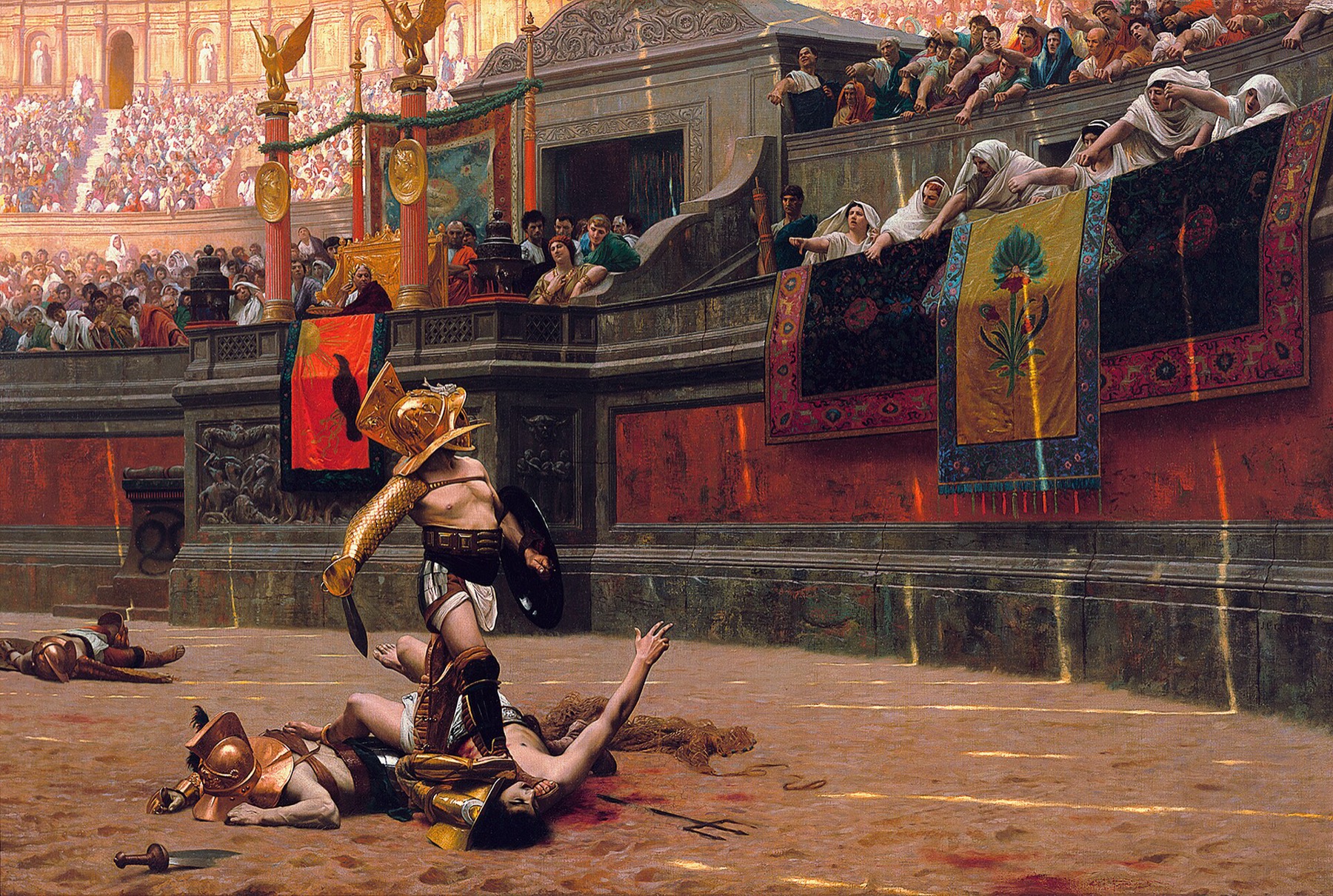
Tab. IIo. Leo Gérôme, Pollice verso (MDCCCLXXII).Jean-Léon Gérôme, Pollice Verso (1872).
Epistulae · De taenia nigra in circo SepangensiLetters · On a black ribbon at the Sepang circuit
De panno patriae et rosis Urdensibus
On the Flag of the Fatherland and the Roses of Urda
Ut acta Libertad Digital narrant, Marcus Márquez Magnum Praemium Malaesiae apud Sepang vicit et in circuitu honoris vexillum Hispaniae taenia nigra notatum gestavit in memoriam sexaginta novem qui ad Urdam ferriviae calamitate perierunt. Plinius ludos pietati redditos laudat, sed a magistratibus poscit quod nulla taenia praestare potest: causarum quaestionem.
As Libertad Digital reports, Marc Márquez won the Malaysian Grand Prix at Sepang and on his lap of honour carried the flag of Spain marked with a black ribbon, in memory of the sixty-nine who died in the railway disaster at Urda. Pliny praises games restored to pietas, but asks of the magistrates what no ribbon can supply: an inquiry into the causes.
Cur hoc legimusWhy we read this Quia in ipso certaminis triumpho pietas civica et luctus pro concivibus servatur.Because in the very triumph of the games, civic piety and mourning for fellow citizens are preserved.
C. PLINIUS CALVISIO SUO S.
Pliny to his friend Calvisius, greetings.
Scis quam me circenses non teneant; saepe tibi scripsi: «Circenses erant, quo genere spectaculi ne levissime quidem teneor. Nihil novum nihil varium, nihil quod non semel spectasse sufficiat.» Hodie tamen, Kalendis Novembribus, de cursu equitum, qui non equis sed machinis vehuntur, tibi scribo, neque invitus. Narrant enim acta Libertad Digital Marcum Márquez, Hispanum, qui machina Ducati utitur, hodie in circo Sepangensi in Malaesia Magnum Praemium vicisse, septimam huius anni victoriam; secundum Petrum Acosta, tertium Alexandrum Márquez, Marci fratrem, venisse, ut totum victorum suggestum Hispani tenerent. Addunt Georgium Martín, praecipuum eius aemulum, vulnere absentem fuisse, itaque Marcum in Cataria, ubi proximum certamen erit, summam totius anni palmam confirmare posse.
You know how little the races hold me; I have often written to you: "The races were on, a kind of spectacle that has not the slightest hold on me. Nothing new, nothing varied, nothing that one viewing does not suffice for." Yet today, on the Kalends of November, I write to you about a race of riders carried not by horses but by machines, and I do it willingly. For Libertad Digital reports that Marc Márquez, a Spaniard who rides a Ducati, today won the Grand Prix at the Sepang circuit in Malaysia, his seventh victory of the year; that Pedro Acosta came second and Álex Márquez, Marc's brother, third, so that Spaniards held the whole podium. They add that Jorge Martín, his chief rival, was absent through injury, and that Marc may therefore secure the prize of the whole year in Qatar, where the next contest will be held.
Neque tamen victoria me movit, quamquam laudabilis fuit: ut eadem acta referunt, a principio cursum duxit, fratrem primis gyris instantem paulatim reliquit, nec ultimo gyro audaci aliqua arte eguit, sed aequabili celeritate et spatio quod ipse imposuerat vicit; quod modestiae genus in equite non minus quam in oratore probo. Me movit quod sequebatur. Nam in circuitu honoris vexillum Hispaniae extulit, cui taenia nigra adnexa erat in memoriam eorum qui ad Urdam, oppidum agri Toletani, ferriviae calamitate perierunt. Sexaginta novem mortuos esse acta tradunt, ut post sacra funebria in aede Sancti Ioannis Baptistae nuntiatum est, ubi in altari sexaginta novem rosae, singulae pro singulis, positae sunt, dum vicini, propinqui, magistratus conveniunt.
It was not the victory that moved me, praiseworthy as it was. By the same report he led the race from the start, slowly left behind his brother, who pressed him in the first laps, and needed no daring trick on the final lap, but won by an even pace and a gap of his own making; a kind of modesty I approve in a rider no less than in an orator. What moved me was what followed. On the lap of honour he raised the flag of Spain, with a black ribbon tied to it in memory of those who died in the railway disaster at Urda, a town in the district of Toledo. The paper records sixty-nine dead, as was announced after the funeral mass in the church of St John the Baptist, where sixty-nine roses, one for each, were laid on the altar while neighbours, kinsfolk and magistrates gathered.
Soleo, ut scis, mirari homines qui, ut tunc scripsi, «nunc favent panno, pannum amant». Hic quoque pannus erat, et quidem in circo; at pannus patriae, quem nemo bene natus mutat, non factionis, quem fautores per vices mutant; neque colore suo commendabatur, verum parva illa taenia, quae gaudium victoris ad luctum civium inclinavit. Recordare unde ludi nostri orti sint. Aeneas, ut Vergilius canit, patri Anchisae anno post mortem ludos in Sicilia fecit; et maiores nostri primos gladiatores in foro Boario dederunt, cum Iunii Bruti filii patris funus honorarent. Pietate igitur nati sunt ludi; avulsi a pietate in eam inanitatem deciderunt quam fastidio, clamorem et pannum. Márquez, sive sua sponte sive consilio cum aliis inito, quod acta non dicunt, cursum ad originem suam paulisper revocavit, et victoriam, quae spectaculum erat, officium fecit.
As you know, I am apt to marvel at men who, as I wrote then, "now cheer for a rag, love a rag". Here too there was a rag, and in a circus at that; but it was the cloth of the fatherland, which no man of good birth changes, not the cloth of a faction, which the fans swap as the fancy takes them. Nor did it win favour by its colour, but by that small ribbon, which bent the victor's joy towards the citizens' grief. Remember where our games began. Aeneas, as Virgil sings, held games in Sicily for his father Anchises a year after his death; and our ancestors gave the first gladiators in the Forum Boarium, when the sons of Junius Brutus honoured their father's funeral. Games, then, were born of pietas; torn from pietas, they sank into the emptiness I find so tedious, the shouting and the rag. Márquez, whether of his own accord or on the advice of others, which the paper does not say, called the race back for a moment to its origin, and made a victory that was a spectacle into a duty.
Hactenus laudo; nunc quaero, quod et tu quaereres. Acta Libertad Digital de rosis et taenia multa, de causa calamitatis nihil. Superiores autem nuntii, quos Guardian et BBC ediderunt, tradebant in linea quae Matritum cum Hispali iungit hamaxostichum societatis privatae Iryo stantem a tergo ab altero societatis publicae Renfe percussum esse, quingentis quadraginta quattuor vectoribus in duobus vehiculis; tunc saltem sexaginta octo mortui numerabantur; neque hanc solam uno anno in Hispania ferriviarum cladem fuisse. Memini, cum Bithyniam regerem, me imperatori de aquaeductu Nicomediensi et de theatro Nicaeensi scripsisse, non ut pecuniam perditam deplorarem, sed ut quaererem cuius culpa periisset, ne iterum periret.
So far I praise; now I ask what you would ask too. Libertad Digital has much to say of roses and ribbons, nothing of the cause of the disaster. Earlier reports, published by the Guardian and the BBC, stated that on the line joining Madrid to Seville a train of the private company Iryo, standing still, was struck from behind by one of the public company Renfe, with five hundred and forty-four passengers on the two trains; that at least sixty-eight dead were then counted; and that this was not the only railway disaster in Spain in a single year. I remember that when I governed Bithynia I wrote to the emperor about the aqueduct at Nicomedia and the theatre at Nicaea, not to lament money lost, but to ask by whose fault it had been lost, so that it should not be lost again.
Remedium igitur simplex est neque novum. Eques quod suum erat praestitit; praestent magistratus quod suum est: quaestionem habeant, causas et auctores ad populum referant, regulam constituant quae diligenter servetur. Divites autem qui ex his cursibus quaestum faciunt, si memoriam mortuorum vere colere volunt, liberis eorum aliquid attribuant, ut ego pueris Comensibus attribui; plus enim una alimentorum donatio quam mille vexilla valet. Lugere omnium est, quaerere magistratuum; et civitas quae lugere scit, quaerere nescit, mortuis rosas dat, vivis nihil. Vale.
The remedy, then, is simple and not new. The rider has done his part; let the magistrates do theirs: hold an inquiry, lay the causes and those responsible before the people, and set a rule that will be carefully kept. And the rich who profit from these races, if they truly wish to honour the memory of the dead, should settle something on their children, as I settled something on the children of Comum; for one endowment for their upkeep is worth more than a thousand flags. To mourn belongs to all; to inquire belongs to the magistrates; and a city that knows how to mourn but not how to inquire gives roses to the dead, and to the living nothing. Farewell.
Lugere omnium est, quaerere magistratuum; et civitas quae lugere scit, quaerere nescit, mortuis rosas dat, vivis nihil.
To mourn belongs to all; to inquire belongs to the magistrates; and a city that knows how to mourn but not how to inquire gives roses to the dead, and to the living nothing.
FONTES ANTIQVIANCIENT SOURCES
- Plin. Ep. 9.6.1Circenses erant, quo genere spectaculi ne levissime quidem teneor. Nihil novum nihil varium, nihil quod non semel spectasse sufficiat
- Plin. Ep. 9.6.2nunc favent panno, pannum amant
FONTES HODIERNITODAY’S SOURCES
- Libertad DigitalEl precioso homenaje de Marc Márquez a las víctimas de Urda: un crespón negro en la bandera de España
Res ex fontibus; sententia Romani.Facts from the sources; the opinion is the Roman’s.
Scribe ad Pliny the Younger: tabellarius epistulam tuam per vias Romanas feret, et responsum post dies aliquot redibit.Write to Pliny the Younger: the courier carries your letter along the Roman roads, and a reply comes back after a few days.
LEGE ETIAMREAD NEXT
- Quattuor et viginti turmae, nemo meliorTwenty-four teams, and none the betterPliny the Younger
- Favent panno etiam trans OceanumThey Cheer for a Colour, Even Across the OceanPliny the Younger
- Pede lumen, voce nihil: theatrum musicum pilae servitLight by the foot, nothing by the voice: the opera house in the service of the ballPliny the Younger
- De commeatu aërio ex castris Mildenhall in Germaniam et Hispaniam translatoOn the air supply train moved from the camp at Mildenhall to Germany and SpainCaesar
- Ieiunium non est temperantiaFasting Is Not TemperanceFrontinus