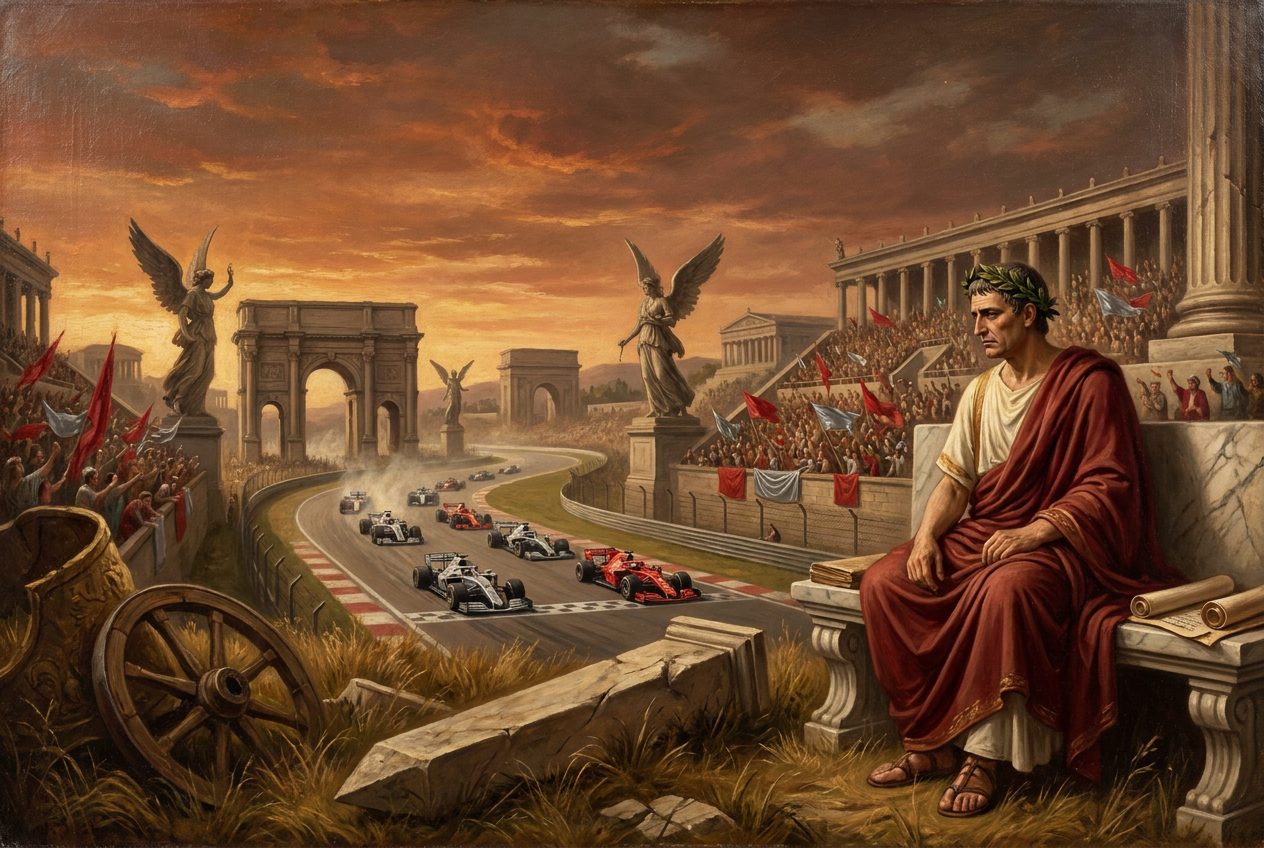
Tab. IPannus, non Homo, sive Circus Trans Oceanum. Tabula Actis Mundi more veterum picta (a machina).The Cloth, Not the Man, or The Circus Across the Ocean. Painted for Acta Mundi in the classical manner (AI-generated).
Epistulae · De curribus AustinensibusLetters · On the Chariots of Austin
Favent panno etiam trans Oceanum
They Cheer for a Colour, Even Across the Ocean
Ut Frankfurter Allgemeine nuntiat, Kimi Antonelli apud Austinum primum in carceribus locum occupavit et hodie vesperi orbis victor iunior omnibus fieri potest. Plinius colorem spectari, non virum, iterum queritur, sed duas res laudat: domini modestiam et aemuli humanitatem.
As the Frankfurter Allgemeine reports, Kimi Antonelli has taken the first place at the starting gates in Austin and this evening may become the youngest champion of the world. Pliny complains once more that men watch the colour, not the man, but he praises two things: an owner's modesty and a rival's humanity.
Cur hoc legimusWhy we read this Quia curruum certamina et iuvenum aurigarum furor plebem hodie non minus quam olim occupant.Because chariot races and the frenzy for young drivers captivate the public today no less than in ancient times.
C. PLINIUS CALVISIO SUO S.
Pliny to his friend Calvisius, greetings.
Quaeris quid his diebus egerim. Omne hoc tempus inter pugillares et libellos iucundissimo otio transegi, cum interim trans Oceanum, apud Austinum in Texia, tota fere orbis pars de curribus sine equis disputaret. Nam, ut Frankfurter Allgemeine nuntiat, Kimi Antonelli, iuvenis Italus qui currum Mercedis regit, die Saturni, ante diem IX Kalendas Novembres, in eo certamine quo ordo carcerum constituitur, primum locum duabus secundi decimis occupavit. Eadem acta tradunt eum a medio mense Iulio in prima acie non stetisse. Si hodie vicerit, ac George Russell, collega eius, non melior nono, Lewis Hamilton non melior quinto pervenerit, iuniorem eum fore omnibus qui umquam hanc palmam tulerint.
You ask what I have been doing these last days. I have spent the whole of the time among my notebooks and my little books, in the pleasantest leisure, while across the Ocean, at Austin in Texas, nearly a whole quarter of the world was arguing about chariots without horses. For, as the Frankfurter Allgemeine reports, Kimi Antonelli, a young Italian who drives the Mercedes car, took first place on Saturday, the ninth day before the Kalends of November, in the contest that settles the order of the starting gates, and by two tenths of a second. The same paper tells us he had not stood in the front rank since the middle of July. If he wins today, and George Russell, his teammate, finishes no better than ninth and Lewis Hamilton no better than fifth, he will be younger than anyone who has ever carried off this palm.
Ceteri ita ordinati sunt: Isack Hadjar, qui alterum currum Red Bull regit, ante Carolum Leclerc constitit, qui quartus fuit; Hamilton quintus, Russell sextus, in agmine, ut scribunt, mirum in modum confertissimo. Ferrarienses autem, qui die Veneris praecipui visi erant, die Saturni more suo deciderunt; pneumata eorum in ipso discrimine defecisse dicuntur. Hamilton rem simpliciter explicavit: currum suum optime se habuisse, ceteros igitur velociores esse. Leclerc mutationem caloris timet; paucis gradibus ardoris in via plus minusve interiectis tantum, ait, interesse quantum inter diem et noctem; meminit tamen se, cum proxime Austini quartus profectus esset, vicisse. Sex et quinquaginta spatia hodie vesperi in via inaequali currentur, et plurimum, ut aiunt, in ipso initio primoque flexu post arduum clivum positum erit.
The rest were arranged thus: Isack Hadjar, who drives the second Red Bull car, placed ahead of Charles Leclerc, who was fourth; Hamilton fifth, Russell sixth, in a field, as they write, remarkably tightly packed. The Ferrari men, who had looked the favourites on Friday, fell away on Saturday after their custom; their tyres are said to have failed them at the decisive moment. Hamilton explained the matter simply: his car had felt very good, so the others must simply be faster. Leclerc fears the changes of temperature; a few degrees more or less of heat on the track, he says, make as much difference as between day and night; yet he remembers that the last time he started fourth at Austin, he won. Fifty-six laps will be run this evening on an uneven track, and most, they say, will depend on the start itself and the first bend after the steep climb.
Haec cum legerem, epistulae meae veteris recordatus sum, quam tibi olim de Circensibus scripsi. Mutata sunt omnia, machinae pro equis, Texia pro Circo Maximo, nihil tamen in animis spectantium mutatum. Nam rubros currus Ferrarienses eodem studio sequuntur quo nostri Russatam; neque ego dubito quin verum etiamnunc sit quod tum scripsi: «nunc favent panno, pannum amant, et si in ipso cursu medioque certamine hic color illuc ille huc transferatur, studium favorque transibit». Quod si apud imperitos tantum fieret, minus mirarer; sed apud quosdam graves homines fit, qui de pneumatum calore gravius quam de re publica disserunt.
As I read this I remembered the old letter I once wrote you about the races in the Circus. Everything has changed, machines for horses, Texas for the Circus Maximus, and yet nothing has changed in the minds of the spectators. They follow the red Ferrari cars with the same passion our people gave the Reds; and I have no doubt that what I wrote then is still true: "now they cheer for a cloth, they love a cloth, and if in the very running, in the middle of the contest, this colour were carried over there and that one here, their zeal and their favour would cross over with it." If this happened only among the ignorant, I should wonder less; but it happens among certain serious men, who discourse more gravely on the heat of tyres than on the affairs of the state.
Duas tamen res in his actis inveni quas libenter laudem. Primum Toto Wolff, factionis Mercedis praefectus, interrogatus quo modo sui ex nihilo ad primum locum venissent, ingenue respondit se, si id sciret, dicturum; nunc nihil se dicere posse nisi eum singularem esse aurigam. Rara modestia domini qui fatetur se causam victoriae suae ignorare; plerique enim, quod fortuna dedit, consilio suo tribuunt. Deinde Max Verstappen, qui aemulus est, iucundum sibi esse dixit cum eo certare, et eum successum huius anni mereri, et merito orbis victorem fore. Hoc ego pluris aestimo quam duas illas secundi decimas; nam velocitatem machina praestat, humanitatem nemo nisi homo. Avunculus quidem meus, si viveret, non risum adulescentis notasset, sed causam celeritatis quaesivisset; quam tamen acta tacent, et ipse dominus tacet.
Still, I found two things in this report that I am glad to praise. First, Toto Wolff, the head of the Mercedes stable, asked how his people had come from nowhere to first place, answered candidly that if he knew, he would say; for now he could say only that the driver was a special one. Rare modesty in an owner, to admit he does not know the cause of his own victory; most men credit to their own judgment what Fortune has given them. Second, Max Verstappen, who is his rival, said that it was a pleasure to fight him, that he deserved this year's success and would be a deserving champion of the world. I value this more than those two tenths of a second; for a machine can supply speed, but only a man can supply humanity. My uncle, were he alive, would not have noted down the young man's grin, but would have inquired into the cause of his speed; on that, however, the report is silent, and so is the owner himself.
velocitatem machina praestat, humanitatem nemo nisi homo.
for a machine can supply speed, but only a man can supply humanity.
Ego hodie vesperi, dum alii clamant, legam; et si quis mihi postea nuntiaverit quis primus flexum superaverit, gratias agam, neque amplius requiram. Adulescenti illi omnia bona opto, et hoc praecipue, ne tanta gloria tam mature parta animum eius corrumpat; nam celerius currus quam mores reguntur. Ego autem, ut tum dixi, «capio aliquam voluptatem, quod hac voluptate non capior». Vale.
This evening, while others shout, I shall read; and if someone afterwards tells me who took the first bend first, I shall thank him and ask no more. I wish that young man well, and this above all: that so much glory won so early may not spoil his character; for a chariot is steered more quickly than a man's conduct. As for me, as I said then, "I take some pleasure in the fact that this pleasure does not take me." Farewell.
FONTES ANTIQVIANCIENT SOURCES
- Plin. Ep. 9.6.2nunc favent panno, pannum amant, et si in ipso cursu medioque certamine hic color illuc ille huc transferatur, studium favorque transibit
- Plin. Ep. 9.6.3capio aliquam voluptatem, quod hac voluptate non capior
- Plin. Ep. 9.6.2nunc favent panno, pannum amant, et si in ipso cursu medioque certamine hic color illuc ille huc transferatur, studium favorque transibit
FONTES HODIERNITODAY’S SOURCES
- Frankfurter AllgemeineFormel 1: Wird Antonelli in Austin zum jüngsten Weltmeister der Geschichte?
Res ex fontibus; sententia Romani.Facts from the sources; the opinion is the Roman’s.
Scribe ad Pliny the Younger: tabellarius epistulam tuam per vias Romanas feret, et responsum post dies aliquot redibit.Write to Pliny the Younger: the courier carries your letter along the Roman roads, and a reply comes back after a few days.
LEGE ETIAMREAD NEXT
- Quattuor et viginti turmae, nemo meliorTwenty-four teams, and none the betterPliny the Younger
- De panno patriae et rosis UrdensibusOn the Flag of the Fatherland and the Roses of UrdaPliny the Younger
- Pede lumen, voce nihil: theatrum musicum pilae servitLight by the foot, nothing by the voice: the opera house in the service of the ballPliny the Younger
- De commeatu aërio ex castris Mildenhall in Germaniam et Hispaniam translatoOn the air supply train moved from the camp at Mildenhall to Germany and SpainCaesar
- Ieiunium non est temperantiaFasting Is Not TemperanceFrontinus