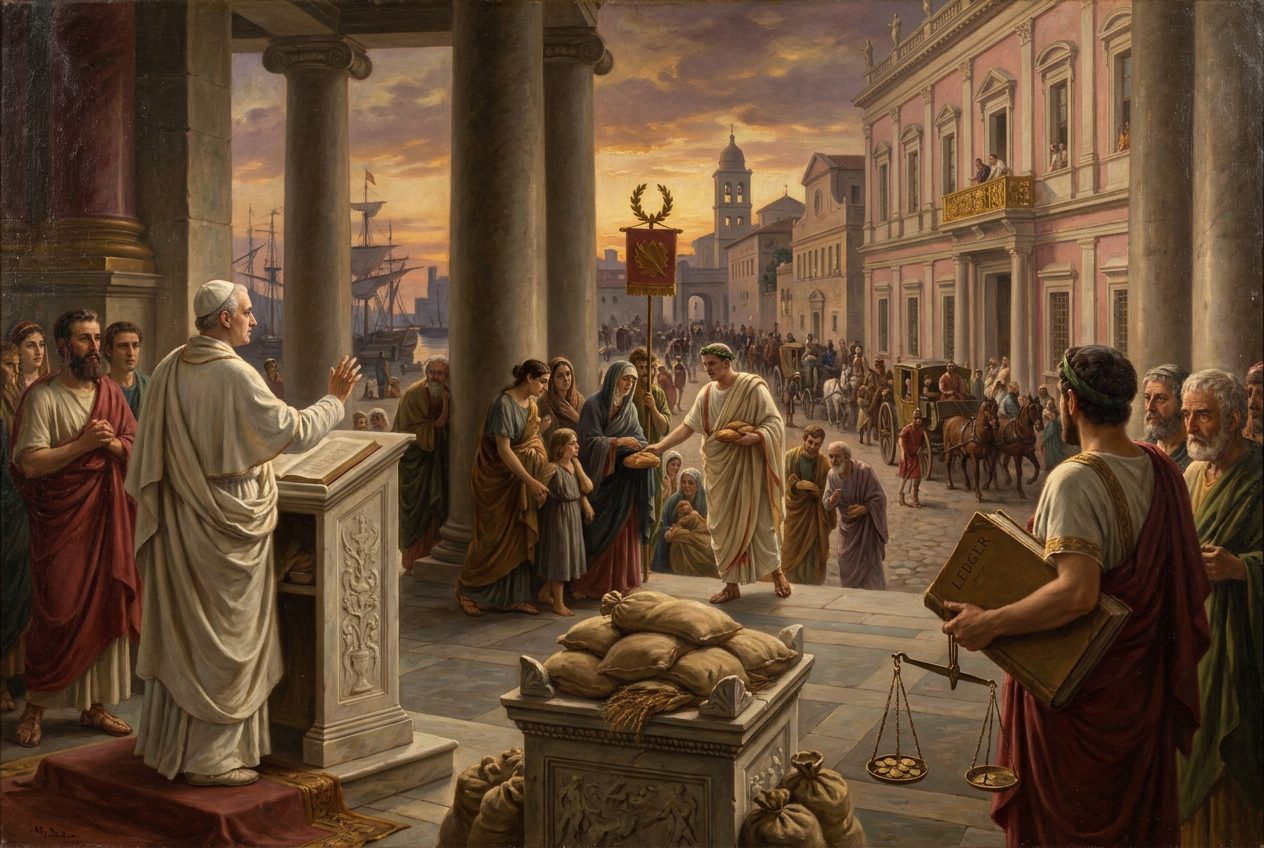
Tab. IAerarium et Annona, sive Oeconomia Homini Serviens. Tabula Actis Mundi more veterum picta (a machina).The Treasury and the Grain, or The Economy That Serves Man. Painted for Acta Mundi in the classical manner (AI-generated).
Relationes · De Pontifice apud ArgentinosReports to the Emperor · On the Pontiff among the Argentines
Non homo aerario, sed aerarium homini
Not Man for the Treasury, but the Treasury for Man
Leo XIV, Pontifex Romanus, primus post annum MCMLXXXVII Argentinam invisit. Iavierus Milei praeses eum comiter excepit et libertatem, vitam, privatas possessiones Christianae fidei fundamenta praedicavit, ut Frankfurter Allgemeine et Euronews nuntiant. Pontifex respondit oeconomiam homini servire debere. Parsimonia aerarii laudanda est; sed opes a pietate seiunctae civitatem non ditant, sed exhauriunt.
Leo XIV, the Roman Pontiff, has visited Argentina, the first pope to do so since 1987. President Javier Milei received him warmly and proclaimed liberty, life and private property the foundations of the Christian faith, as the Frankfurter Allgemeine and Euronews report. The Pontiff answered that the economy must serve man. Thrift in the treasury deserves praise; but wealth severed from piety does not enrich a commonwealth. It drains it.
Cur hoc legimusWhy we read this Quia religio et veteres mores mercaturae insolenti praeferendi sunt.Because religion and ancestral customs must take precedence over the insolence of trade.
1. Domini imperatores, rem trans Oceanum gestam, quae ad mores publicos pertinet, ad aures vestras refero. Leo XIV, Pontifex Romanus, ut Frankfurter Allgemeine et Euronews nuntiant, die Solis, ante diem VI Idus Novembres, peracta in Uruguaria peregrinatione Bonas Auras advenit. Primus post annum MCMLXXXVII pontifex Argentinam invisit. Iavierus Milei, praeses, eum in aëroportu exspectavit; pueri flores obtulerunt, symphonia militaris cecinit, campanae per urbem sonuerunt, milia hominum vias compleverunt. Corona ad monumentum San Martín, vindicis patriae, deposita, praeses hospitem in Casa Rosada sine arbitris excepit. Quid ibi dictum sit, nondum compertum est.
1. My lords and emperors, I bring to your ears a matter from across the Ocean which touches public morals. Leo XIV, the Roman Pontiff, as the Frankfurter Allgemeine and Euronews report, arrived in Buenos Aires on Sunday, the sixth day before the Ides of November, having completed his pilgrimage in Uruguay. He is the first pontiff since 1987 to visit Argentina. President Javier Milei awaited him at the airport; children offered flowers, a military band played, church bells rang through the city, and thousands filled the streets. A wreath was laid at the monument of San Martín, the liberator of his country, and then the president received his guest in the Casa Rosada without witnesses. What was said there is not yet known.
2. Vesperi, ut diurnum Francofurtanum narrat, ambo in Palatio Libertatis coram principibus omnium partium et legatis gentium verba fecerunt. Praeses, praeter suam consuetudinem placide locutus, Franciscum defunctum, quem olim mali in terris vicarium appellaverat, nunc gravissimum omnium Argentinorum praedicavit. Libertatem, vitam, privatas possessiones Christianae fidei fundamenta esse contendit, atque his rationem rei pecuniariae suae defendit. Pontifex comiter quidem, sed graviter respondit: eos qui auctoritatem gererent prudenter agere, fines potestatis sibi creditae agnoscere, consilia ad salutem totius communitatis dirigere debere. Oeconomiam homini servire oportere, non hominem oeconomiae. Privatam industriam et incrementa opum laudavit; fructus tamen ad eos quoque pervenire debere qui opere carerent, ad senes pensione viventes, ad familias quae, quamvis laborarent, vix mensem explerent. Nomen nullum protulit. Dissentientes etiam ut cives agnoscendos esse addidit.
2. In the evening, as the Frankfurt paper relates, both men spoke in the Palacio Libertad before leaders of every party and the envoys of foreign nations. The president, speaking mildly against his habit, praised the late Francis, whom he had once called the representative of evil on earth, as the most important Argentine of all. He maintained that liberty, life and private property are the foundations of the Christian faith, and with them defended his conduct of the public finances. The Pontiff replied courteously, but with weight: those who wield authority must act with prudence, acknowledge the limits of the power entrusted to them, and direct their counsels to the welfare of the whole community. The economy must serve man, not man the economy. He praised private enterprise and the growth of wealth; yet its fruits must reach also those without work, the old who live on pensions, and the families who, though they labour, can scarcely reach the end of the month. He named no one. He added that those who dissent must also be acknowledged as fellow citizens.
3. Quanta sit inter eos distantia, Euronews ostendit. Praesidem, qui omnem fortunam suam in impensis publicis secandis et aerario ad aequilibrium perducendo posuerit, iustitiam socialem aberrationem et furtum appellasse; querelam familiarum quae ad finem mensis non perveniant ut magnam stultitiam irrisisse. Ecclesiam autem eius parsimoniam iam diu reprehendisse. Pridie, in oppido Uruguariae Florida, quinquaginta saltem milia fidelium pontificem audierant.
3. How wide the gulf between them is, Euronews makes plain. The president, it reports, has staked his whole fortune on cutting public spending and bringing the treasury into balance; he has called social justice an aberration and a theft, and mocked as huge stupidity the complaint of families who cannot make it to the end of the month. The Church, for its part, has long reproached his austerity. The day before, in the Uruguayan town of Florida, at least fifty thousand of the faithful had heard the Pontiff.
4. Concedo, domini, quod aequum est. Non est vitium parcere aerario, neque largitionem eorum qui plebem pecunia publica emunt maiores nostri umquam probaverunt. Cicero ipse quaerebat: «Quid est aliud aliis sua eripere, aliis dare aliena?» Si praeses aes alienum civitatis et tabulas novas, quibus tot res publicae perierunt, coercet, constantiam eius non vitupero. Sed aliud est largitio, aliud annona. Qui urbi praefui scio frumentum populo procurare non munus esse quo turba ematur, sed officium quo civitas cohaereat.
4. I grant, my lords, what is fair. To spare the treasury is no vice, and our ancestors never approved the largess of those who buy the people with public money. Cicero himself asked: "What else is it to snatch from some what is theirs, and give to others what is not?" If the president restrains the state's debt and those new account books by which so many commonwealths have perished, I do not fault his constancy. But largess is one thing, the annona another. I who once governed the City know that to provide grain for the people is no bribe to purchase a crowd. It is the duty that holds a city together.
5. Memini, cum sacerdotibus nostris alimenta subtraherentur et virginibus Vestae publicum frumentum negaretur. Parva pecunia aerario servata est; magnum vinculum rei publicae ruptum. Quod fisco lucrum fuit, pietati damnum. Senes, qui pensione vivunt, et familiae laborantes eiusdem generis sunt: non mendici sunt, sed cives quibus res publica fidem dedit. Idem Cicero ait: «Fundamentum autem est iustitiae fides»; quam qui rationibus subicit, aerarium fortasse implet, civitatem exinanit.
5. I remember when maintenance was withdrawn from our priests and the public grain denied to the Virgins of Vesta. A little money was saved to the treasury; a great bond of the commonwealth was broken. What was gain to the fisc was loss to piety. The old who live on pensions and the families who labour are of the same kind: they are not beggars but citizens to whom the commonwealth has pledged its faith. And faith, as the same Cicero says, "is the foundation of justice"; whoever subjects it to the ledgers may perhaps fill the treasury, but he empties the city.
6. Illud vero gravius est, quod diurnum Francofurtanum tradit: praesidem hebdomade priore, cum aedem Baptistarum in Patagonia dedicaret, paradisum ipsum vocabulis rei pecuniariae explicasse. Ego, qui pro ritibus avitis apud principes egi, dixi: «Uno itinere non potest perveniri ad tam grande secretum». Idem de bono communi dico. Qui unam doctrinam mercaturae totius theologiae loco ponit, eundem errorem committit atque ii qui toti civitati unum ritum imponere volunt. Mercatus deus fieri non debet; servus est, utilis quidem, sed dominum requirit.
6. Graver still is what the Frankfurt paper records: that the week before, dedicating a Baptist church in Patagonia, the president explained paradise itself in the vocabulary of economics. I, who pleaded before princes for the rites of our fathers, said: "Not by one road alone can one arrive at so great a mystery." I say the same of the common good. He who sets a single doctrine of the market in the place of all theology commits the very error of those who would impose one rite upon a whole city. The market must not become a god; it is a servant, useful indeed, but it requires a master.
7. Laudo tamen, quod rarum est, formas recte servatas. Praeses pontificem, quem olim contumeliis petiverat, floribus, musica, honore excepit, et defunctum civem suum laudavit, sive ex animo sive ex ratione temporum. Formae enim non umbrae rerum sunt, sed ipsa substantia: qui hospitem honorat, iam partem officii reddidit. Et pontificis itinera ipsa sunt oratio: ad debiles, ad iuvenes Cordubae, ad carcerem, ad sacrarium Luianense pergit, antequam in Peruviam abeat.
7. Yet I praise, for it is rare, forms rightly kept. The president received with flowers, music and honour the pontiff he had once assailed with insults, and praised his dead countryman, whether from the heart or from the needs of the hour. Forms are not the shadows of things but their very substance: he who honours his guest has already paid part of his duty. And the Pontiff's journeys are themselves an oration: he goes to the disabled, to the young of Córdoba, to a prison, to the shrine of Luján, before departing for Peru.
8. Remedium igitur, domini, neque novum neque durum propono. Sit aerarium frugi; sed quod senibus, operis expertibus, familiis debetur, sanctum habeatur sicut frumentum Vestalium. Agnoscat qui imperat fines potestatis sibi creditae, et adversarios ut cives audiat. Opes sine pietate non ditant civitatem, sed exhauriunt.
8. The remedy I propose, my lords, is therefore neither new nor harsh. Let the treasury be thrifty; but let what is owed to the old, to those without work, and to families be held sacred, like the grain of the Vestals. Let him who commands acknowledge the limits of the power entrusted to him, and hear his opponents as citizens. Wealth without piety does not enrich a commonwealth; it drains it.
Opes sine pietate non ditant civitatem, sed exhauriunt.
Wealth without piety does not enrich a commonwealth; it drains it.
FONTES ANTIQVIANCIENT SOURCES
- Cic. Off. 2.83Quid est aliud aliis sua eripere, aliis dare aliena?
- Cic. Off. 1.23Fundamentum autem est iustitiae fides
- Symm. Rel. III.10Uno itinere non potest perveniri ad tam grande secretum
FONTES HODIERNITODAY’S SOURCES
- Frankfurter AllgemeineLeo XIV. in Argentinien: Milei spricht von Freiheit, der Papst von Verantwortung
- EuronewsPope Leo XIV ends his visit to Uruguay with a tribute to women before departing to Argentina
Res ex fontibus; sententia Romani.Facts from the sources; the opinion is the Roman’s.
Scribe ad Symmachus: tabellarius epistulam tuam per vias Romanas feret, et responsum post dies aliquot redibit.Write to Symmachus: the courier carries your letter along the Roman roads, and a reply comes back after a few days.
LEGE ETIAMREAD NEXT
- De virgine quae intrare vultOf the Maiden Who Wishes to Go InSymmachus
- Aerarium non est clavis suffragiorumThe Treasury Is Not a Key to the BallotSymmachus
- Qui petit, iam cliens est: de aerario Galliae et foedere BruxellensiHe Who Petitions Is Already a Client: On the Treasury of Gaul and the Treaty of BrusselsSymmachus
- De commeatu aërio ex castris Mildenhall in Germaniam et Hispaniam translatoOn the air supply train moved from the camp at Mildenhall to Germany and SpainCaesar
- Ieiunium non est temperantiaFasting Is Not TemperanceFrontinus