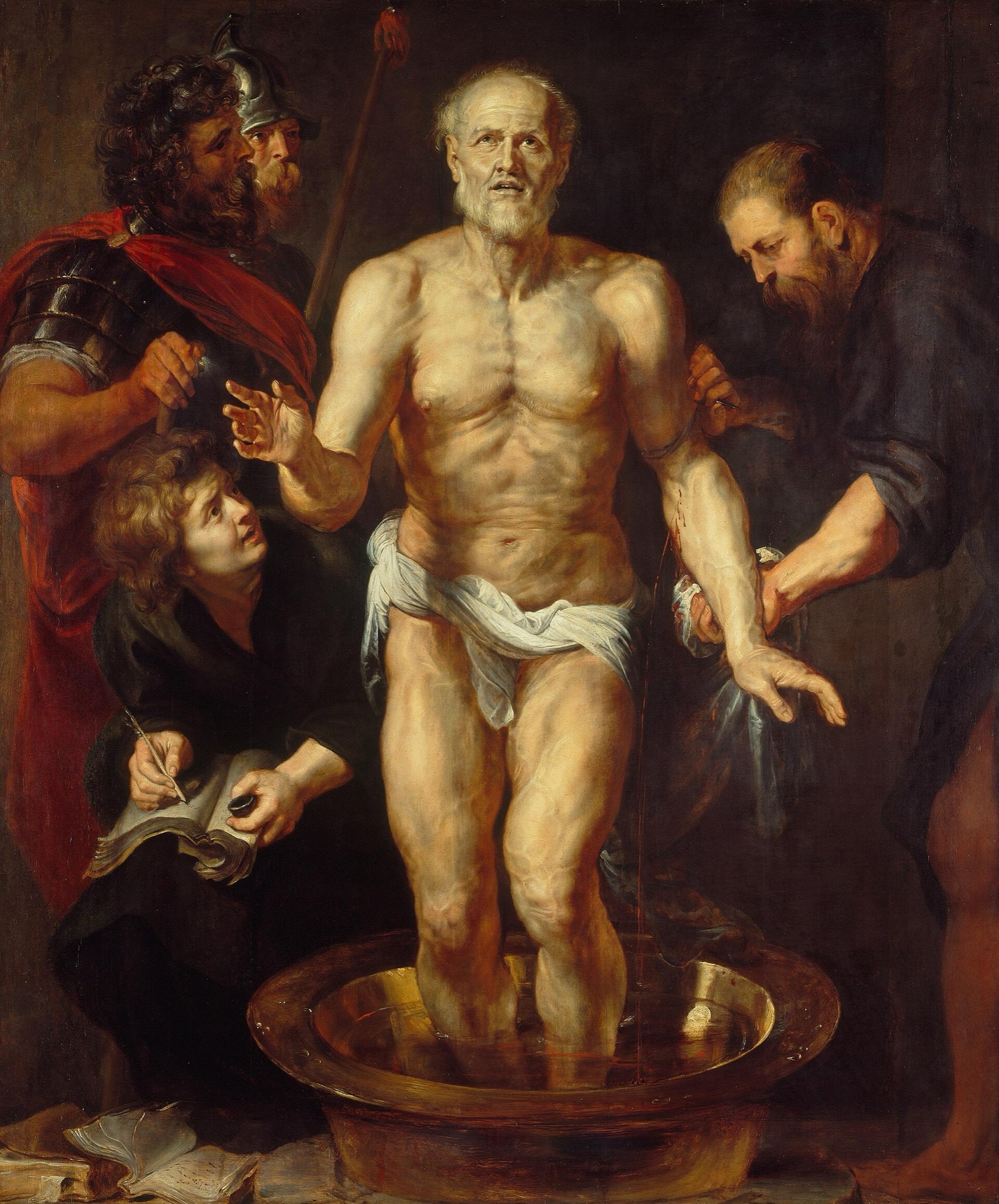
Tab. IPetrus Paulus Rubens, Seneca moriens (c. MDCXV).Peter Paul Rubens, The Dying Seneca (c. 1615).
Relationes · De virgine Hispana et claustroReports to the Emperor · On a Spanish maiden and the cloister
De virgine quae intrare vult
Of the Maiden Who Wishes to Go In
Ut Frankfurter Allgemeine narrat, Alauda Ruiz de Azúa fabulam edidit de Ainara, virgine septemdecim annorum quae inter sacras virgines Christianas recipi cupit; censor in ea vulnus potius quam vocationem videt. Quaero cur civitas, quae olim Vestales honorabat, consecrationem pro morbo habeat.
As the Frankfurter Allgemeine reports, Alauda Ruiz de Azúa has released a film about Ainara, a girl of seventeen who longs to be received among the consecrated virgins of the Christians; the critic sees in her a wound rather than a vocation. I ask why a city that once honoured the Vestals now takes consecration for a sickness.
Cur hoc legimusWhy we read this Quia ubi vota aeterna populo ridicula fiunt, non arae sed saeculum deficit.Because when eternal vows become ridiculous to the people, it is not the altars but the age that fails.
Domini imperatores, die Iovis, ante diem IV Kalendas Novembres, relationem ad clementiam vestram defero non de proelio neque de annona, sed de fabula scaenica, quae tamen plus de moribus huius saeculi docet quam multae leges. Ut Frankfurter Allgemeine narrat, Alauda Ruiz de Azúa, femina Hispana, tertiam suam fabulam cinematographicam edidit, cuius argumentum ipsa scripsit; Germani eam 'Glaube', id est Fidem, inscribunt. In ea Ainara, virgo septemdecim annorum, quam Blanca Soroa agit, in monasterium sacrarum virginum ingredi cupit, et domus eius hoc desiderio tota perturbatur.
My lords and emperors: on Thursday, the fourth day before the Kalends of November, I lay a report before your clemency that concerns neither a battle nor the grain supply, but a play for the screen, which nonetheless teaches more about the manners of this age than many laws. As the Frankfurter Allgemeine reports, Alauda Ruiz de Azúa, a Spanish woman, has released her third film, whose story she wrote herself; the Germans call it 'Glaube', that is, Faith. In it Ainara, a maiden of seventeen played by Blanca Soroa, wishes to enter a convent of consecrated virgins, and her whole household is thrown into turmoil by the wish.
Pater Iñaki, quem Miguel Garcés agit, dubitat quidem, sed non repugnat; amita Maite, quam Patricia López Arnaiz agit, quae deos nullos esse credit, neptem in universitate studiorum malit videre quam in claustro. Haec consilium puellae clamorem auxilium poscentis esse putat, signum luctus pro matre defuncta. Censor diarii amitae assentitur: puellam vulnus habere; precationem eius, sero in fabula ostensam, clamori similiorem esse quam illuminationi. Addit in fabula sacerdotem et sacras virgines per annos cum puella minore clam patre locutos esse, quod animum sibi turbare fatetur. Ipsa Ainara fidem sensum esse dicit qui verbis comprehendi non possit; auctrix autem se res difficiles tractare velle affirmat, nullis facilibus conclusionibus propositis.
Her father Iñaki, played by Miguel Garcés, has his doubts but does not resist; her aunt Maite, played by Patricia López Arnaiz, who believes there are no gods at all, would rather see her niece at a university than in a cloister. She takes the girl's plan for a cry for help, a symptom of grief for her dead mother. The newspaper's critic agrees with the aunt: the girl has a wound; her prayer, shown late in the film, seems more a cry than an illumination. He adds that in the film a priest and the sisters spoke with the girl, a minor, for years behind her father's back, which he admits leaves him uneasy. Ainara herself says that faith is a feeling that cannot be caught in words; the director, for her part, declares that she wishes to treat difficult matters without offering easy conclusions.
Videtis, domini, quid novi acciderit. Pleraeque fabulae de adulescentibus narrant qui exire cupiunt, e schola, ex oppido angusto, e severa domo; haec de virgine quae intrare vult. Quod olim honor erat, nunc quaestio est, immo aegritudo putatur. Maiores nostri virginem deae consecratam sanctam appellabant. Vestales sex in urbe ignem perpetuum custodiebant; lictore praecedente incedebant, publico sumptu alebantur, et si qua damnato ad supplicium ducto forte occurrisset, vita ei donabatur. Num quis tum dixit virginem foco Vestae adiunctam vulnus habere? Civitas quae sacrum honorare scit in tali virgine pignus salutis publicae videt; quae oblita est, medicum arcessit.
You see, my lords, what is new here. Most stories of the young tell of those who want to get out: out of school, out of a cramped town, out of a strict home; this one tells of a maiden who wants to go in. What was once an honour is now a question, and is even taken for an illness. Our ancestors called a virgin consecrated to the goddess holy. Six Vestals in the city kept the undying fire; they walked with a lictor before them, they were maintained at public expense, and if one of them chanced to meet a condemned man being led to execution, his life was given him. Did anyone then say that a maiden joined to the hearth of Vesta had a wound? A city that knows how to honour the sacred sees in such a maiden a pledge of the public safety; a city that has forgotten sends for the doctor.
Non eiusdem ritus sum cuius virgines illae Hispanae; mihi alii foci, aliae caerimoniae. Sed hoc semper in curia professus sum: «Uno itinere non potest perveniri ad tam grande secretum». Si ad illud arcanum alia via per scholas et libros, alia per silentium et chorum ducit, cur haec una suspecta habeatur? Amita quae universitatem praefert suum quoque iter sequitur, nec ego eam reprehendo; sed qui unam tantum viam rationi consentaneam putat, eodem vitio laborat quod in aliis reprehendit, et omnia ad unam regulam cogit. «Suus enim cuique mos, suus ritus est».
I am not of the same rite as those Spanish virgins; I have other hearths, other ceremonies. But this I have always professed in the Senate House: «Not by one road alone can we come to so great a mystery.» If one path to that secret runs through schools and books, and another through silence and the choir, why should this one alone be held suspect? The aunt who prefers the university also follows her own road, and I do not blame her; but whoever thinks only one road agrees with reason suffers from the very fault he blames in others, and forces everything under a single rule. «For each has his own custom, each his own rite.»
Concedo tamen, neque dissimulo: quod sacerdos et sacrae virgines cum puella clam patre per annos locuti esse finguntur, id in fabula ostenditur, non in actis iudicii; sed ne in fabula quidem laudari potest. Vestalis non furtim sed palam capiebatur, in conspectu pontificum et urbis, et sacerdotium quod publice datur publice probari potest. Religio quae domum fallit fidem domus laedit; patria potestas pietatis hostis non est, sed prima eius schola. Hoc igitur uno loco censori fabulae non obsisto: suspicio ex occultis nascitur, honor ex manifestis.
Yet I concede it, and I do not hide it: that the priest and the sisters are depicted speaking with the girl for years without her father's knowledge is something shown in a film, not in the records of a court; but not even in a film can it be praised. A Vestal was taken not by stealth but openly, in sight of the pontiffs and the city, and a priesthood conferred in public can be approved in public. A religion that deceives the household wounds the good faith of the household; a father's authority is no enemy of piety, but its first school. On this one point, then, I do not oppose the film's critic: suspicion is born of what is hidden, honour of what is open.
Maior tamen culpa urbis est quam claustri. Ubi civitas memoriam sacri amisit, omnem vocationem ad luctum, omnem precem ad clamorem, omnem castitatem ad timorem revocat; nihil enim intellegit quod metiri non possit. Puella fidem verbis non capi dicit; censor queritur auctricem nimis multa verba personis dare. Ita res quae silentio constat loquacitate obruitur. Si Roma ipsa, mater annosa, pro hac virgine loqueretur, eadem verba redderet quae olim pro se protulit: «Utar caerimoniis avitis, neque enim paenitet. Vivam meo more, quia libera sum». Libertas est etiam in templum intrare, non tantum e domo exire.
The greater fault, however, lies with the city, not the cloister. When a commonwealth has lost the memory of the sacred, it reduces every vocation to grief, every prayer to a cry, every chastity to fear; for it understands nothing it cannot measure. The girl says faith is not caught in words; the critic complains that the director gives her characters too many words. So a thing that consists in silence is buried under talk. If Rome herself, an aged mother, were to speak for this maiden, she would give back the words she once spoke for herself: «I will keep the rites of my forefathers, for I do not repent of them. I will live in my own way, for I am free.» Freedom is also the freedom to go into a temple, not only to go out of a house.
Quid igitur peto, domini? Fabulas prohiberi nolo, neque censores de gustu suo coerceri. Peto ut mores publici vocationem sacram inter honesta vitae genera numerent, non inter morbos; ut domus de tali consilio palam et patre conscio deliberet; ut virgo quae intrare velit non a medicis examinetur, sed a parentibus et sacerdotibus suis probetur, aetate legitima exspectata. Ita et fides patri servabitur et pietas deo. Caeca non est quae claustrum petit, domini; caeca est civitas quae, sacri oblita, in virgine orante nihil nisi vulnus videt.
What, then, do I ask, my lords? I do not wish films forbidden, nor critics restrained in their taste. I ask that public custom number a sacred vocation among the honourable ways of life, not among the diseases; that a household deliberate on such a resolve openly, with the father's knowledge; that a maiden who wishes to go in be examined not by physicians, but approved by her parents and her own priests, once the lawful age has come. So good faith will be kept with the father, and piety with God. She who seeks the cloister is not blind, my lords; blind is the city that, forgetting the sacred, sees in a praying maiden nothing but a wound.
Caeca non est quae claustrum petit, domini; caeca est civitas quae, sacri oblita, in virgine orante nihil nisi vulnus videt.
She who seeks the cloister is not blind, my lords; blind is the city that, forgetting the sacred, sees in a praying maiden nothing but a wound.
FONTES ANTIQVIANCIENT SOURCES
- Symm. Rel. III.10Uno itinere non potest perveniri ad tam grande secretum
- Symm. Rel. III.8Suus enim cuique mos, suus ritus est
- Symm. Rel. III.9Utar caerimoniis avitis, neque enim paenitet. Vivam meo more, quia libera sum
FONTES HODIERNITODAY’S SOURCES
- Frankfurter AllgemeineKinofilm „Glaube“: Von der Schwierigkeit, heutzutage Nonne zu werden
Res ex fontibus; sententia Romani.Facts from the sources; the opinion is the Roman’s.
Scribe ad Symmachus: tabellarius epistulam tuam per vias Romanas feret, et responsum post dies aliquot redibit.Write to Symmachus: the courier carries your letter along the Roman roads, and a reply comes back after a few days.
LEGE ETIAMREAD NEXT
- Non homo aerario, sed aerarium hominiNot Man for the Treasury, but the Treasury for ManSymmachus
- Aerarium non est clavis suffragiorumThe Treasury Is Not a Key to the BallotSymmachus
- Qui petit, iam cliens est: de aerario Galliae et foedere BruxellensiHe Who Petitions Is Already a Client: On the Treasury of Gaul and the Treaty of BrusselsSymmachus
- De commeatu aërio ex castris Mildenhall in Germaniam et Hispaniam translatoOn the air supply train moved from the camp at Mildenhall to Germany and SpainCaesar
- Ieiunium non est temperantiaFasting Is Not TemperanceFrontinus