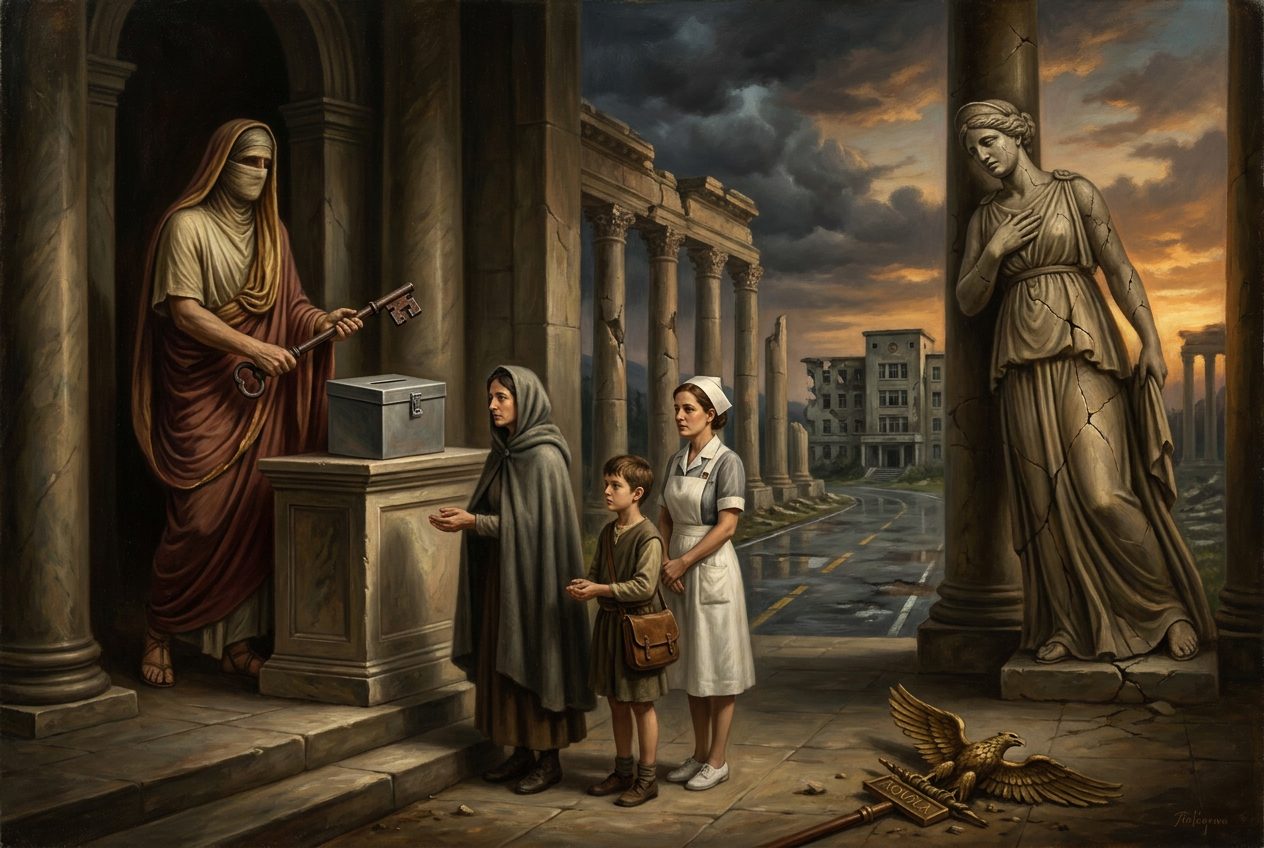
Tab. IAerarium Clausum, sive Fides Rupta. Tabula Actis Mundi more veterum picta (a machina).The Treasury Closed, or Good Faith Broken. Painted for Acta Mundi in the classical manner (AI-generated).
Relationes · De aerario communi et suffragiis provinciarumReports to the Emperor · On the common treasury and the votes of the provinces
Aerarium non est clavis suffragiorum
The Treasury Is Not a Key to the Ballot
Ut Die Welt nuntiat, Marcus Söder, princeps factionis CSU, postulat ut in communi pecuniae inter Germaniae civitates aequatione clausula de extremismo inseratur, qua provinciae a factione AfD aut Linke rectae subsidiis priventur; eodem tempore factio eius in augurio Bavarico ad triginta sex ex centenis delapsa est. Pecuniam communem civibus deberi, non consentientibus, censeo.
As Die Welt reports, Markus Söder, leader of the CSU, demands that an extremism clause be written into the common equalisation of funds among the German states, so that provinces governed by the AfD or Die Linke would be deprived of support; at the same time his party has slid to thirty-six per cent in the Bavarian augury of the polls. I hold that common money is owed to citizens, not to those who agree.
Cur hoc legimusWhy we read this Quia pecunia publica non factionum praemium sed totius rei publicae vinculum esse debet.Because public money must be the bond of the whole commonwealth, not a bounty for factions.
1. Domini imperatores, die Iovis, ante diem XI Kalendas Novembres, rem ad vos refero quae parva videtur, magna est. Ut acta Die Welt nuntiant, Marcus Söder, princeps factionis CSU in Bavaria, postulat ut in aequatione pecuniae publicae inter Germaniae civitates, quam Finanzausgleich vocant, clausula de extremismo inseratur, qua civitates quas olim factio AfD aut factio Linke regat a communibus subsidiis abscindantur. Eadem acta referunt in augurio comitiorum quod Bayerntrend appellant factionem ipsius ad triginta sex ex centenis delapsam esse, factionem autem AfD ad viginti unum ex centenis, quantum numquam antea, ascendisse.
1. My lords and emperors, on Thursday, the eleventh day before the Kalends of November, I lay before you a matter that seems small and is great. As Die Welt reports, Markus Söder, leader of the CSU in Bavaria, demands that an extremism clause be inserted into the equalisation of public money among the German states, which they call the Finanzausgleich, so that states which the AfD or Die Linke might one day govern would be cut off from the common funds. The same paper reports that in the augury of the polls they call the Bayerntrend his own party has slid to thirty-six per cent, while the AfD has climbed to twenty-one per cent, higher than ever before.
2. Plura acta non tradunt. Quis extremismum definiat, quo iudice, qua lege, silent; utrum postulatio augurium secuta sit an praecesserit, non dicunt, sed tantum coniungunt; quid ceterae civitates aut factiones responderint, non narrant. Ego coniuncta non confundo. Quaero tamen, ut maiores nostri solebant, cui bono sit: viro cuius factio suffragiis decrescit utile est hostem ostendere quem non comitiis vincat, sed aerario.
2. The report tells us no more. Who is to define extremism, before what judge, under what law, it does not say; whether the demand followed the poll or preceded it, it does not state, but merely sets the two side by side; what the other states or parties answered, it does not relate. I do not confuse what is placed together. Yet I ask, as our ancestors were wont to ask, who gains: a man whose party is shrinking at the ballot finds it useful to display an enemy he will defeat not at the polls but at the treasury.
3. Memini, domini, quo modo olim caerimoniae avitae non edicto, sed inopia oppugnatae sint. Non vetiti sunt ritus; detracti sunt sumptus. Vestalibus alimenta publica negata sunt, sacris stipendia; ita quod lege tolli pudebat, fame tolli speratum est. Supplex tunc pro senatu scripsi, neque auditus sum. Agnosco hodie eandem rationem: factio quam nemo iudicio damnavit non vetatur, sed provincia quae eam elegerit pecunia communi spoliabitur. Mutatum est nomen rei, ars eadem manet.
3. I remember, my lords, how the ancestral rites were once attacked not by edict but by want. The rites were not forbidden; their funds were withdrawn. The Vestals were denied their public sustenance, the sacred offices their stipends; what men were ashamed to abolish by law, they hoped to abolish by hunger. I wrote then as a suppliant for the senate, and was not heard. Today I recognise the same method: a party no court has condemned is not banned, but the province that elects it will be stripped of the common purse. The name of the thing has changed; the craft remains the same.
4. Pecunia autem communis non est praemium consentientium, sed debitum civium. Qui in civitate aliqua tributum pendunt, ut cives pendunt, non ut sectatores factionis; ut cives igitur recipiant oportet. Si magistratus improbi sint, poenam luant magistratus; at clausula aerarii non magistratum ferit, sed viduam, puerum in schola, viam publicam, valetudinarium. Foedus inter civitates fide constat, et fundamentum iustitiae fides est; qui condiciones foederis ex eventu comitiorum mutat, is non factioni, sed populo fidem fallit.
4. Common money is not a reward for those who agree; it is a debt owed to citizens. Those who pay their taxes in any state pay them as citizens, not as followers of a faction; as citizens, therefore, they ought to receive. If the magistrates are wicked, let the magistrates pay the penalty; but a clause on the treasury strikes not the magistrate but the widow, the child at school, the public road, the hospital. A compact among states stands on good faith, and good faith is the foundation of justice; whoever alters the terms of the compact according to the outcome of an election breaks faith not with a faction but with a people.
Pecunia autem communis non est praemium consentientium, sed debitum civium.
Common money is not a reward for those who agree; it is a debt owed to citizens.
5. Concedo esse posse factiones rei publicae infestas. Sed remedium maiores nostri non in arca, sed in foro quaerebant: accusatio palam, iudices, lex scripta. Si qua factio leges fundamentales Germaniae evertere conatur, iudices summi id pronuntient, et lex de ea statuat. Quod nondum factum esse acta non negant, sed ne attingunt quidem. Mirum etiam mihi videtur duas factiones inter se contrarias, alteram a dextra, alteram a sinistra parte, una mensura comprehendi, quasi omnis dissensus idem crimen esset. Laudatus est olim princeps qui «inter religionum diversitates medius stetit nec quemquam inquietavit»; non minus laudandus esset qui inter factiones medius staret neque civitatem ullam ob suffragia inquietaret.
5. I grant that there may be factions hostile to the commonwealth. But our ancestors sought the remedy not in the strongbox but in the forum: open accusation, judges, written law. If any party attempts to overturn the fundamental laws of Germany, let the highest judges pronounce on it, and let the law decide its fate. That this has not yet been done the report does not deny; it does not even touch on it. It seems strange to me, too, that two parties opposed to each other, one of the right and one of the left, should be caught in a single measure, as though all dissent were one and the same crime. A prince was once praised because "amid the diversity of religions he stood in the middle and troubled no one"; no less praise would be due to one who stood in the middle among the parties and troubled no state for the way it voted.
6. Audite, quaeso, provinciam ipsam loquentem: «Tributum pependi, legibus parui, magistratus creavi quos volui. Si erravi, comitia mea errorem corrigent, non alienum aerarium. Quod ceteris civitatibus debetur, mihi quoque debetur, quia una res publica sumus. Nolite me pecunia mea castigare quod libere suffragium tuli.» Suus enim cuique mos, suus ritus est; et sua cuique provinciae comitia, quorum fructum non aliena maior pars ademerit.
6. Hear, I beg you, the province herself speaking: "I have paid my tribute, obeyed the laws, and elected the magistrates I wished. If I have erred, my own elections will correct the error, not another's treasury. What is owed to the other states is owed to me as well, because we are one commonwealth. Do not punish me with my own money for having cast my vote freely." For each has his own custom, each his own rite; and each province has its own elections, whose fruit no foreign majority may take away.
7. Remedium itaque peto vetus neque arduum: Marcus Söder cives amissos persuadendo, bene administrando, consilio et gravitate recuperet, non claves aerarii agitando. Factio quae suffragia amittit suffragia quaerat, non seras. Hoc postremo considerate, domini: instrumentum quod hodie maior pars contra minorem fabricat, maioribus partibus non manet; quae nunc viginti unum ex centenis tenet, cras fortasse plus tenebit. Qui aerarium clavem suffragiorum facit, eadem clave olim ipse excludetur.
7. The remedy I ask is therefore old and not hard: let Markus Söder win back the citizens he has lost by persuasion, by good administration, by counsel and gravity, not by rattling the keys of the treasury. A party that is losing votes should seek votes, not locks. Consider this last, my lords: the instrument a majority forges today against a minority does not stay with majorities; the party that now holds twenty-one per cent may hold more tomorrow. Whoever makes the treasury a key to the ballot will one day be locked out with that same key.
FONTES ANTIQVIANCIENT SOURCES
- Amm. Marc. 30.9.5inter religionum diversitates medius stetit nec quemquam inquietavit
- Symm. Rel. III.8Suus enim cuique mos, suus ritus est
FONTES HODIERNITODAY’S SOURCES
Res ex fontibus; sententia Romani.Facts from the sources; the opinion is the Roman’s.
Scribe ad Symmachus: tabellarius epistulam tuam per vias Romanas feret, et responsum post dies aliquot redibit.Write to Symmachus: the courier carries your letter along the Roman roads, and a reply comes back after a few days.
LEGE ETIAMREAD NEXT
- Non homo aerario, sed aerarium hominiNot Man for the Treasury, but the Treasury for ManSymmachus
- De virgine quae intrare vultOf the Maiden Who Wishes to Go InSymmachus
- Qui petit, iam cliens est: de aerario Galliae et foedere BruxellensiHe Who Petitions Is Already a Client: On the Treasury of Gaul and the Treaty of BrusselsSymmachus
- De commeatu aërio ex castris Mildenhall in Germaniam et Hispaniam translatoOn the air supply train moved from the camp at Mildenhall to Germany and SpainCaesar
- Ieiunium non est temperantiaFasting Is Not TemperanceFrontinus