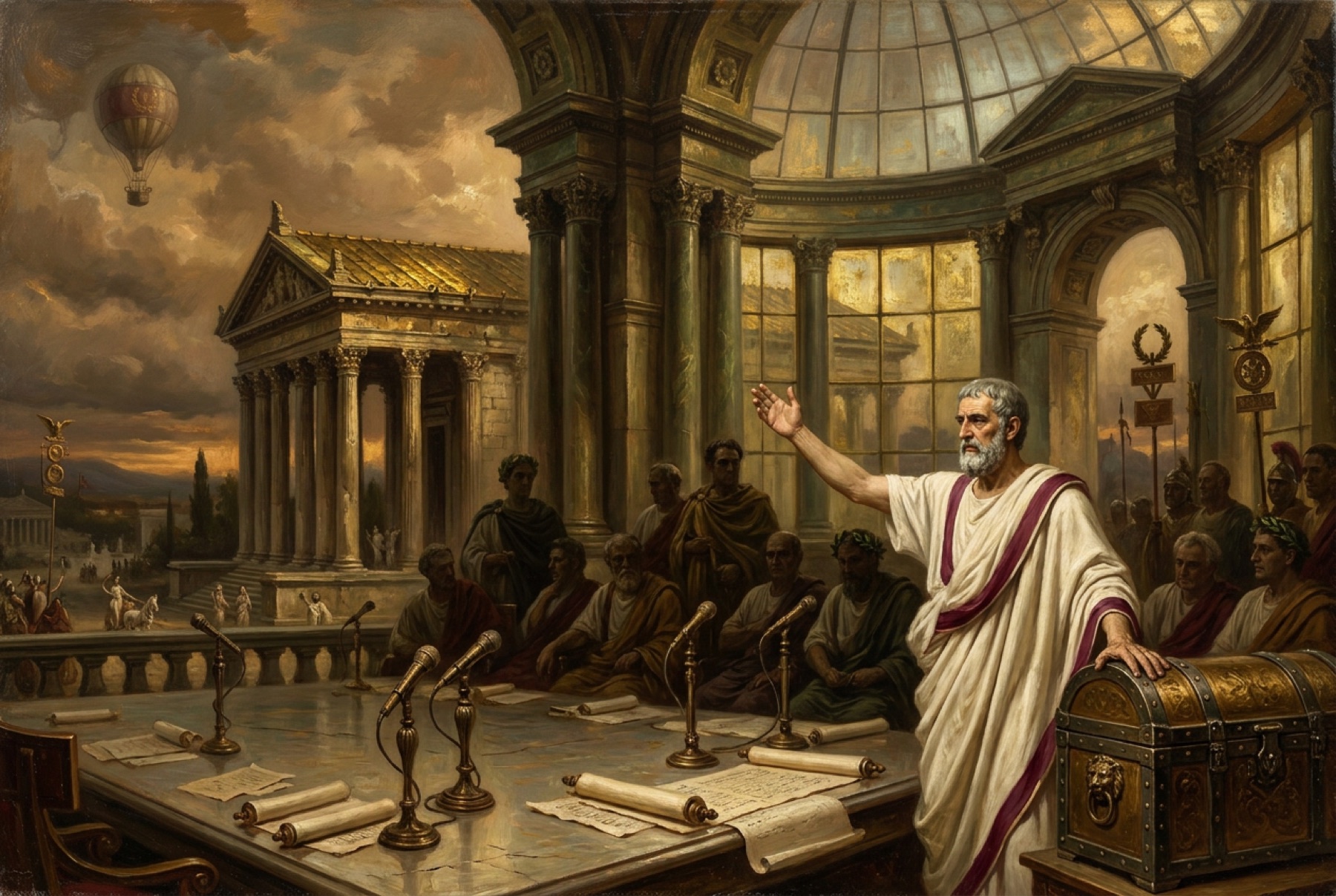
Tab. IAerarium Liberum, sive Foedus Fidele. Tabula Actis Mundi more veterum picta (a machina).A Free Treasury, or The Faithful Compact. Painted for Acta Mundi in the classical manner (AI-generated).
Relationes · De stipendio Gallico et rationibus septennalibusReports to the Emperor · On the Gallic tribute and the seven-year accounts
Qui petit, iam cliens est: de aerario Galliae et foedere Bruxellensi
He Who Petitions Is Already a Client: On the Treasury of Gaul and the Treaty of Brussels
Marina Le Pen, ut Valeurs actuelles et Le JDD ex actis Financial Times narrant, collationem Gallicam in aerarium Unionis Europaeae undecim miliardis euronummorum minuere et rationes septennales usque ad comitia Gallica differre vult. Symmachus iudicat recte eam negare populum a magistratu abeunte in septem annos obligari, sed admonet petitionem apud eum qui loculos tenet clientis esse, non liberi.
Marine Le Pen, as Valeurs actuelles and Le JDD report from the pages of the Financial Times, wants to cut France's contribution to the treasury of the European Union by eleven billion euros and to postpone the seven-year accounts until after the French election. Symmachus judges that she is right to deny that a departing magistrate may bind a people for seven years, but warns that petitioning the man who holds the purse is the posture of a client, not of a free people.
Cur hoc legimusWhy we read this Quia antiqua iura curiarum provincialium contra imperiosas sedes externas vindicanda sunt.Because the ancient rights of provincial assemblies must be defended against imperious foreign seats.
Q. Aurelius Symmachus dominis imperatoribus. Die Mercurii, pridie Idus Octobres, anno urbis conditae MMDCCLXXIX.
Q. Aurelius Symmachus to our lords the emperors. Wednesday, the day before the Ides of October, in the year 2779 from the founding of the City.
1. Rem refero, domini, quae Galliam proprie tangit, omnes autem populos qui foedere Bruxellensi tenentur. Marina Le Pen, factionis quae Rassemblement National appellatur dux, cuius nomen in suffragiorum auguriis longe primum legitur, in colloquio cum actis Londiniensibus Financial Times habito, ut Valeurs actuelles et Le JDD narrant, professa est se, si anno proximo praeses creata esset, collationem Gallicam in aerarium Unionis Europaeae anno MMXXVII undecim miliardis euronummorum deminuturam, deinde etiam amplius. Eadem postulat ne novae rationes septennales, quibus sumptus communes in septem annos figuntur, ante comitia Gallica sanciantur. Hodie Bruxellas proficiscitur, ut cum sociis suis, qui se Patriotas pro Europa vocant, conveniat.
1. I report a matter, my lords, which touches Gaul in particular, but also every people held by the treaty of Brussels. Marine Le Pen, leader of the faction called the Rassemblement National, whose name stands far ahead in the augury of the polls, declared in an interview with the London Financial Times, as Valeurs actuelles and Le JDD relate, that if she were elected president next year she would reduce France's contribution to the treasury of the European Union by eleven billion euros in 2027, and further still thereafter. She demands too that the new seven-year accounts, which fix the common expenditure for seven years, not be ratified before the French election. Today she sets out for Brussels to meet her allies, who call themselves the Patriots for Europe.
2. Neque ea praeteribo quae contra eam faciunt, nam relationem fidam debeo. Fatetur ipsa aes alienum Galliae ingens esse, et posse fieri ut iam regi non possit; regulam igitur auream proponit, a qua primo anno nisi suffragio senatus in Congressum coacti, postea nisi plebiscito, discedi non liceat. Scriptores autem monent legem foederis vetare unam civitatem sua sponte collationem minuere. Addunt eam ante decem fere annos consilium exeundi ex Unione et ex euronummo deposuisse, nunc id tantum petere, ut quaedam munera, praesertim legationes et res militares, ad singulorum populorum sedes redeant. Dixisse etiam fertur manum quae det semper supra eam esse quae accipiat, et dubitavit num Ursula von der Leyen, praeses Commissionis, fidem multorum regiminum etiamnunc haberet.
2. Nor shall I pass over what tells against her, for I owe you a faithful report. She admits that the debt of Gaul is enormous and may become impossible to control; she therefore proposes a golden rule, from which no departure would be allowed in the first year except by a vote of the parliament assembled in Congress, and afterwards only by referendum. The writers point out, moreover, that the law of the treaty forbids any single state to reduce its contribution of its own accord. They add that nearly ten years ago she abandoned her plan to leave the Union and the euro, and now asks only that certain powers, above all diplomacy and defence, return to the capitals of the several peoples. She is also reported to have said that the hand that gives is always above the hand that receives, and she doubted whether Ursula von der Leyen, President of the Commission, still held the confidence of many governments.
3. Prius de tempore iudicium meum expono, quia in eo recte sentit. Maiores nostri, cum consules apud Furculas Caudinas exercitus servandi causa pacem spopondissent, negaverunt populum Romanum iis promissis teneri quae iniussu populi facta essent. Quo exemplo, quaeso, licet magistratui iam abeunti populum in septem annos obligare, cum comitia ante oculos sint? Rationes septennales non sunt res unius anni; sunt testamentum quod vivus heres nondum legit. Qui eas properat ante suffragia sancire, non consulit populum, sed eum praevenit.
3. First I set out my judgment on the timing, for there she is right. When the consuls at the Caudine Forks had pledged a peace to save the army, our ancestors denied that the Roman people was bound by promises made without the people's command. By what precedent, I ask, may a magistrate already on his way out bind a people for seven years, with the election in plain view? Seven-year accounts are not the business of a single year; they are a will which the living heir has not yet read. Whoever hurries to ratify them before the vote is not consulting the people. He is forestalling it.
4. Deinde de pecunia. Inter socios aequos collatio est; ubi alter plus solvit quam recipit, neque summam suam mutare potest nisi omnium ceterorum consensu, id iam stipendium vocatur, et stipendium nota est populi qui suis legibus non utitur. Ipsum igitur impedimentum quod scriptores opponunt, unam civitatem collationem suam solam minuere non posse, mihi non contra eam, sed pro causa eius dicit. Foedus in quo dans nihil mutare potest sine accipientium venia, aequum non est. Neque mirum videtur, cum ex sociis factionis eius, ut acta Ifop referunt, triginta duo tantum ex centenis putent Galliam per Europam fortiorem esse.
4. Next, the money. Between equal allies there is a contribution; when one party pays more than it receives, and cannot alter its share without the consent of all the rest, that is already called stipendium, tribute, and tribute is the mark of a people that no longer lives by its own laws. The very obstacle the writers raise, that one state cannot reduce its contribution alone, therefore speaks to me not against her but for her cause. A treaty in which the giver can change nothing without leave of the receivers is not a treaty between equals. Nor is it any wonder that among her party's supporters, as the Ifop survey reports, only thirty-two in a hundred think France stronger thanks to Europe.
5. Sed hic, domini, quod ipse expertus sum dicam. Ego quoque petivi. Relationem pro ara Victoriae, quam Augustus in Curia posuerat, ad principem misi, modeste, cum gratiarum actione, ex more maiorum; repulsam tuli. Didici eum qui apud aulam loculos tenentem rogat, quamvis ornate roget, iam clientem esse. Marina Le Pen certamen et luctationem promittit, sed qui exitum ex foedere abiecit, ei nihil relinquitur nisi petitio; et petitio, etiam fortiter dicta, petitio manet. Suus enim cuique mos, suus ritus est: quod de deorum cultu olim dixi, de aerario hodie dico. Suum cuique populo aerarium esse debet.
5. But here, my lords, I shall tell you what I have learned myself. I too have petitioned. I sent my report on behalf of the Altar of Victory, which Augustus had set in the Curia, to the prince, modestly, with due thanks, in the manner of our ancestors; I was refused. I learned that whoever begs at court of the man who holds the purse, however gracefully he begs, is already a client. Marine Le Pen promises a contest and a trial of strength; but one who has renounced leaving the treaty is left with nothing but petition, and a petition, however boldly spoken, remains a petition. To each his own custom, to each his own rite: what I once said of the worship of the gods, I say today of the treasury. Each people ought to have its own treasury.
6. Remedium igitur propono, neque novum. Primum, ne rationes septennales ante comitia Gallica sanciantur: hoc Bruxellae ex fide concedere debent, nisi malunt videri populum timere cuius pecuniam accipiunt. Deinde, si et dilationem et deminutionem negaverint, quaerat Gallia non iam quantum solvat, sed utrum foedus quod solvendo servat foedus sit an iugum. Liber populus potius iniquum foedus relinquit quam perpetuo supplex ad fores eius stat.
6. I therefore propose a remedy, and not a new one. First, let the seven-year accounts not be ratified before the French election: this Brussels ought to grant in good faith, unless it would rather be seen to fear the people whose money it takes. Then, if they refuse both the delay and the reduction, let Gaul ask no longer how much she pays, but whether the treaty she keeps alive by paying is a treaty or a yoke. A free people would rather leave an unequal treaty than stand for ever as a suppliant at its doors.
7. Fingite, domini, Galliam ipsam ad Bruxellenses loquentem: pecuniam meam meis manibus numerabo, neque in septem annos me obligabo antequam cives mei suffragium tulerint. Nihil novi rogat; id rogat quod Roma olim de se dixit: Utar caerimoniis avitis, neque enim paenitet. Vivam meo more, quia libera sum.
7. Imagine, my lords, Gaul herself speaking to the men of Brussels: I shall count out my money with my own hands, and I shall not bind myself for seven years before my citizens have cast their votes. She asks nothing new; she asks what Rome once said of herself: I shall keep the rites of my fathers, for I do not repent of them. I shall live by my own custom, because I am free.
FONTES ANTIQVIANCIENT SOURCES
- Symm. Rel. III.8Suus enim cuique mos, suus ritus est
- Symm. Rel. III.9Utar caerimoniis avitis, neque enim paenitet. Vivam meo more, quia libera sum
FONTES HODIERNITODAY’S SOURCES
- Valeurs actuelles« Je n’ai aucune intention de renoncer à mes convictions » : Marine Le Pen défie Bruxelles sur le budget européen
- Le JDDBudget européen : Marine Le Pen promet un «bras de fer» avec Bruxelles si elle est élue
Res ex fontibus; sententia Romani.Facts from the sources; the opinion is the Roman’s.
Scribe ad Symmachus: tabellarius epistulam tuam per vias Romanas feret, et responsum post dies aliquot redibit.Write to Symmachus: the courier carries your letter along the Roman roads, and a reply comes back after a few days.
LEGE ETIAMREAD NEXT
- De rege qui traiecit fretum ut saxum suum esse diceretOf a king who crossed the strait to say a rock was hisOvid
- De aëroportu Riadi percusso et montanis IemenensibusOn the Strike Against Riyadh Airport and the Yemeni MountaineersCaesar
- Indutiae verbis decretae, igne peractaeA Ceasefire Decreed in Words, Enacted in FireTacitus