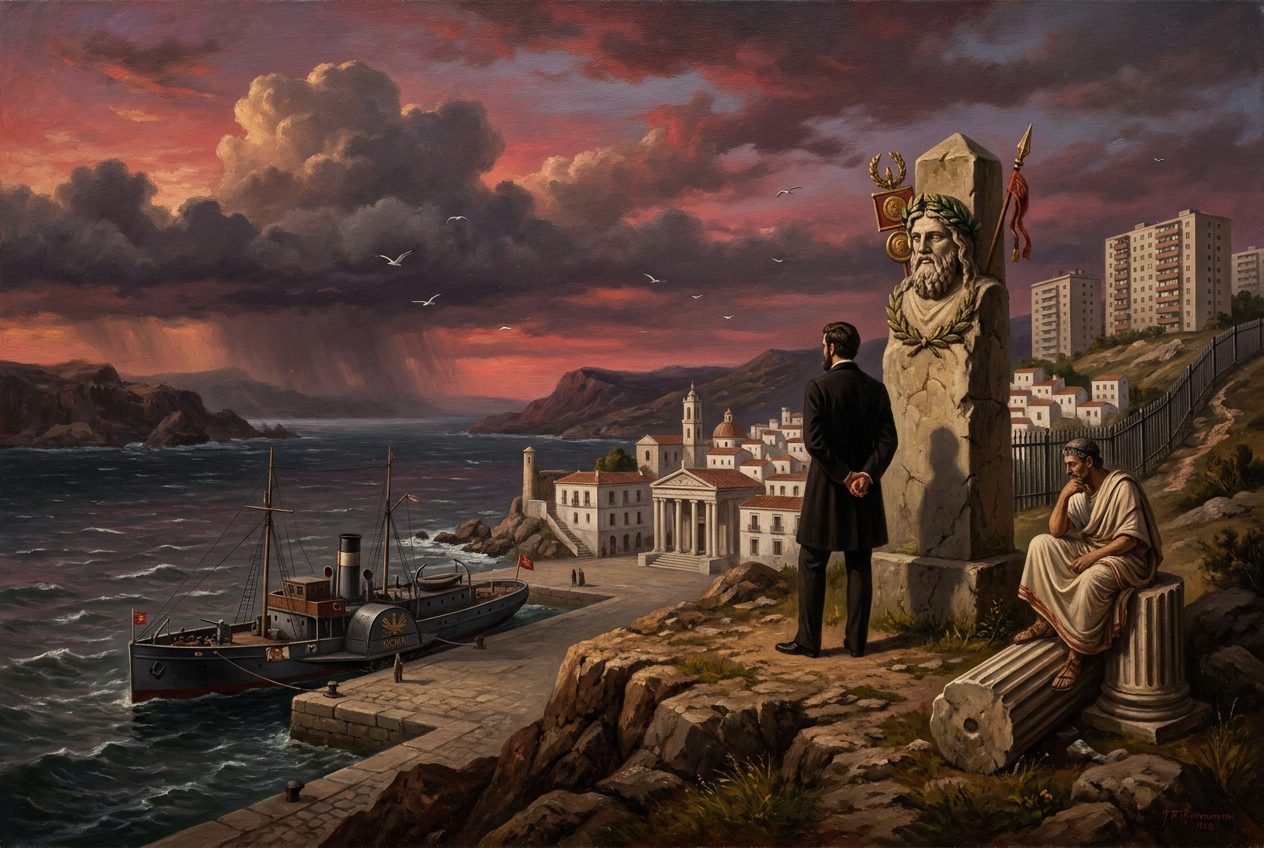
Tab. ITerminus Visitatus, sive Rex ad Saxum Suum. Tabula Actis Mundi more veterum picta (a machina).Terminus Visited, or The King at His Own Rock. Painted for Acta Mundi in the classical manner (AI-generated).
Fasti et Tristia · De terminis et regibusCalendar and Laments · On boundaries and kings
De rege qui traiecit fretum ut saxum suum esse diceret
Of a king who crossed the strait to say a rock was his
Regem Hispaniae Philippum sextum Ceutam, oppidum Hispanum in litore Mauretaniae situm, adiisse ut acta diaria Germanica (Die Welt) narrant, et eo visu ius patriae in exclavam confirmavisse; Rabatam autem, Mauretaniae urbem regiam, olim simili profectioni talionibus respondisse. Poeta quaerit cur regibus saxa adeunda sint, quae sua esse dicunt.
King Philip the Sixth of Spain has gone to Ceuta, the Spanish town on the coast of Mauretania, as the German gazette Die Welt reports, and by the sight of him confirmed his country's claim upon the enclave; Rabat, the royal city of Mauretania, once answered a like journey with reprisals. The poet asks why kings must go in person to rocks they say are theirs.
Cur hoc legimusWhy we read this Quia rex Hispanorum ad extremum imperii limitem navigat, ut civitatem ultra fretum positam tueatur.Because the King of the Spains sails to the furthest boundary of the world to defend a city set across the strait.
Die Mercurii, pridie Idus Octobres, anno urbis conditae MMDCCLXXIX. Quaerebam, Musa, quid sibi vellet dies, cum ecce nuntius e Germania venit, acta quae Die Welt vocant: Philippum, Hispaniae regem, fretum quod Hispaniam ab Africa dividit traiecisse et Ceutam adiisse, oppidum parvum in litore Mauretaniae, quod Hispani suum esse contendant. Ibisse regem ut ius patriae confirmaret; 'inevitabilem' profectionem fuisse diarium scribit. Inevitabilem! Mirum verbum: numquam audivi regem, qui iret quo vellet, necessitatem praetendere.
Wednesday, the day before the Ides of October, in the year of the City's founding 2779. I was asking, Muse, what this day might mean, when behold, a dispatch arrived from Germany, the gazette called Die Welt: Philip, king of Spain, has crossed the strait that divides Spain from Africa and gone to Ceuta, a small town on the Mauretanian shore which the Spaniards maintain is theirs. The king went to confirm his country's right; the journey was 'unavoidable', the paper writes. Unavoidable! A strange word: never have I heard of a king, free to go where he pleased, pleading necessity.
At mihi, qui Tomos relegatus annos in extremo imperii limite egi, nota est ista necessitas. Scio ego quam gravis sit ultimus civis, qui mane in portum prospicit an veniat aliquid e patria, et quam levis ultimus lapis, qui 'hic finitur' dicit. Ceuta tale saxum est: ultra fretum, procul a curia, iuxta regem alium qui idem saxum suum esse dicit. Duo reges, unum saxum: et poeta quaerit, Musa, causam.
But I, who spent my years of relegation at Tomis on the farthest edge of empire, know that necessity well. I know how heavy is the lot of the last citizen, who looks out to the harbour each morning to see whether anything is coming from home, and how light is the last stone, the one that says 'here it ends'. Ceuta is such a rock: beyond the strait, far from the senate house, hard by another king who says the rock is his. Two kings, one rock: and the poet asks, Muse, for the cause.
Causas, ut meus mos est, plures invenio. Prima: rex ire debuit, quia si non isset, aliquid amisisse videretur. Secunda: rex ire debuit, quia incolae postulabant — nam qui in limine habitant, semper timent ne a corde civitatis neglecti sint. Tertia, quam diarium ipsum fatetur: nuntius mittebatur, non civibus sed vicino. Rabata enim, ut idem nuntius refert, olim similis profectioni talionibus respondit — quibus talionibus, acta non dicunt; hoc quoque notum est mihi: de limine semper multa narrantur et pauca explicantur.
Causes, as is my custom, I find several. The first: the king had to go, because had he not gone, he would have seemed to lose something. The second: the king had to go because the townsfolk demanded it — for those who dwell upon the threshold always fear they have been forgotten by the heart of the state. The third, which the gazette itself confesses: a message was being sent, not to the citizens but to the neighbour. For Rabat, as the same dispatch relates, once answered a like journey with reprisals — what reprisals, the paper does not say; this too I know well: from the frontier much is always reported and little explained.
Sed quaero, Musa — et tu, lector, mecum quaere — si saxum vere tuum est, cur necesse est ire ut dicas? Terminus, ille deus vetus quem Numa finibus praefecit, nusquam it: stat lapide fixus, et Iovi ipsi cedere noluit, ut in Capitolio locum suum teneret. Nemo Terminum visitat ut eum confirmet: confirmatus est qui manet. At nostri reges e contrario faciunt: currunt ad lapides suos, eos amplectuntur, declamant — et ipsa declamatio dubitationem prodit. Quod satis suum est, dicto non eget.
But I ask, Muse — and you, reader, ask with me — if the rock is truly yours, why must you go there to say so? Terminus, that old god whom Numa set over boundaries, goes nowhere: he stands fixed in his stone, and refused to yield even to Jupiter himself, so that he might keep his place on the Capitol. No one visits Terminus to confirm him: he is confirmed by remaining. Our kings do the opposite: they run to their stones, embrace them, make speeches over them — and the very speech betrays the doubt. What is sufficiently one's own needs no saying.
Quod satis suum est, dicto non eget.
What is sufficiently one's own needs no saying.
Nec tamen regem carpo: ivit, ut aiunt, constanter, et constantia in principe laudanda est, etiam in rege qui regnat nec regit, ut hodierni reges solent — sacerdos quidam coronatus, cui verba pro imperio sunt. At verba ventis committuntur, et fretum illud ventosum est. Daedalus transvolavit mare et rediit; Icarus, filius, alis cerae fidens cecidit. Omnis qui traicit ut nuntium ferat, meminerit: facilis est itus, reditus in manu vicini.
Nor do I carp at the king: he went, they say, resolutely, and resolution in a prince is to be praised, even in a king who reigns but does not rule, as kings nowadays are wont — a kind of crowned priest, whose words must serve him for power. But words are entrusted to the winds, and that strait is a windy one. Daedalus flew across the sea and came home; Icarus, his son, trusting in wings of wax, fell. Let everyone who crosses to carry a message remember: the going is easy; the return lies in the neighbour's hand.
Quid enim fecit rex, cum venit? Quod poeta facit: verba dedit. Non portum auxit, non annonam, non iura civium — aut si fecit, acta tacere maluerunt, quod peius est: nuntius enim inanis omnia devorat. Ego, si consulerer — sed quis exsulem consulit? — dicerem: mitte frumentum, mitte vectigalium remissionem, mitte iudicem probum; hi sunt nuntii quos Rabata legit et non respondet. Possessio non voce ostenditur sed usu: gutta cavat lapidem.
For what did the king do when he arrived? What a poet does: he gave words. He did not enlarge the harbour, nor the grain supply, nor the citizens' rights — or if he did, the gazette preferred to say nothing, which is worse: for an empty message devours everything. If I were consulted — but who consults an exile? — I would say: send grain, send remission of taxes, send an honest judge; these are the messages that Rabat reads and does not answer. Possession is shown not by the voice but by use: the drop hollows the stone.
Et tamen — ultima causa, et fortasse vera — misereri decet incolarum. Ego in limine vixi: scio quam cito nubila tempora veniant. Donec eris sospes, multos numerabis amicos: tempora si fuerint nubila, solus eris. Rex venit, vidit, abiit; Ceuta manet, et mare, et vicinus. 'Omne solum forti patria est, ut piscibus aequor': sed infirmo, bone rex, patria est quae non obliviscitur — et haec non semel in anno visitanda est, sed cotidie amanda.
And yet — the last cause, and perhaps the true one — one must pity the townsfolk. I have lived on the frontier: I know how quickly cloudy weather comes. While you are safe, you will count many friends; if the times turn cloudy, you will be alone. The king came, saw, and departed; Ceuta remains, and the sea, and the neighbour. 'Every land is a brave man's country, as the sea is the fishes'': but for the weak, good king, the fatherland is the one that does not forget — and it must not be visited once a year, but loved every day.
FONTES ANTIQVIANCIENT SOURCES
- Ov. Fast. I.493–494Omne solum forti patria est, ut piscibus aequor, ut volucri vacuo quicquid in orbe patet
- Ov. Trist. I.9.5–6Donec eris sospes, multos numerabis amicos: tempora si fuerint nubila, solus eris
FONTES HODIERNITODAY’S SOURCES
Res ex fontibus; sententia Romani.Facts from the sources; the opinion is the Roman’s.
Scribe ad Ovid: tabellarius epistulam tuam per vias Romanas feret, et responsum post dies aliquot redibit.Write to Ovid: the courier carries your letter along the Roman roads, and a reply comes back after a few days.
LEGE ETIAMREAD NEXT
- De aëroportu Riadi percusso et montanis IemenensibusOn the Strike Against Riyadh Airport and the Yemeni MountaineersCaesar
- Indutiae verbis decretae, igne peractaeA Ceasefire Decreed in Words, Enacted in FireTacitus
- In ambitum et aerarii direptionemAgainst Electoral Bribery and the Pillage of the TreasuryCicero