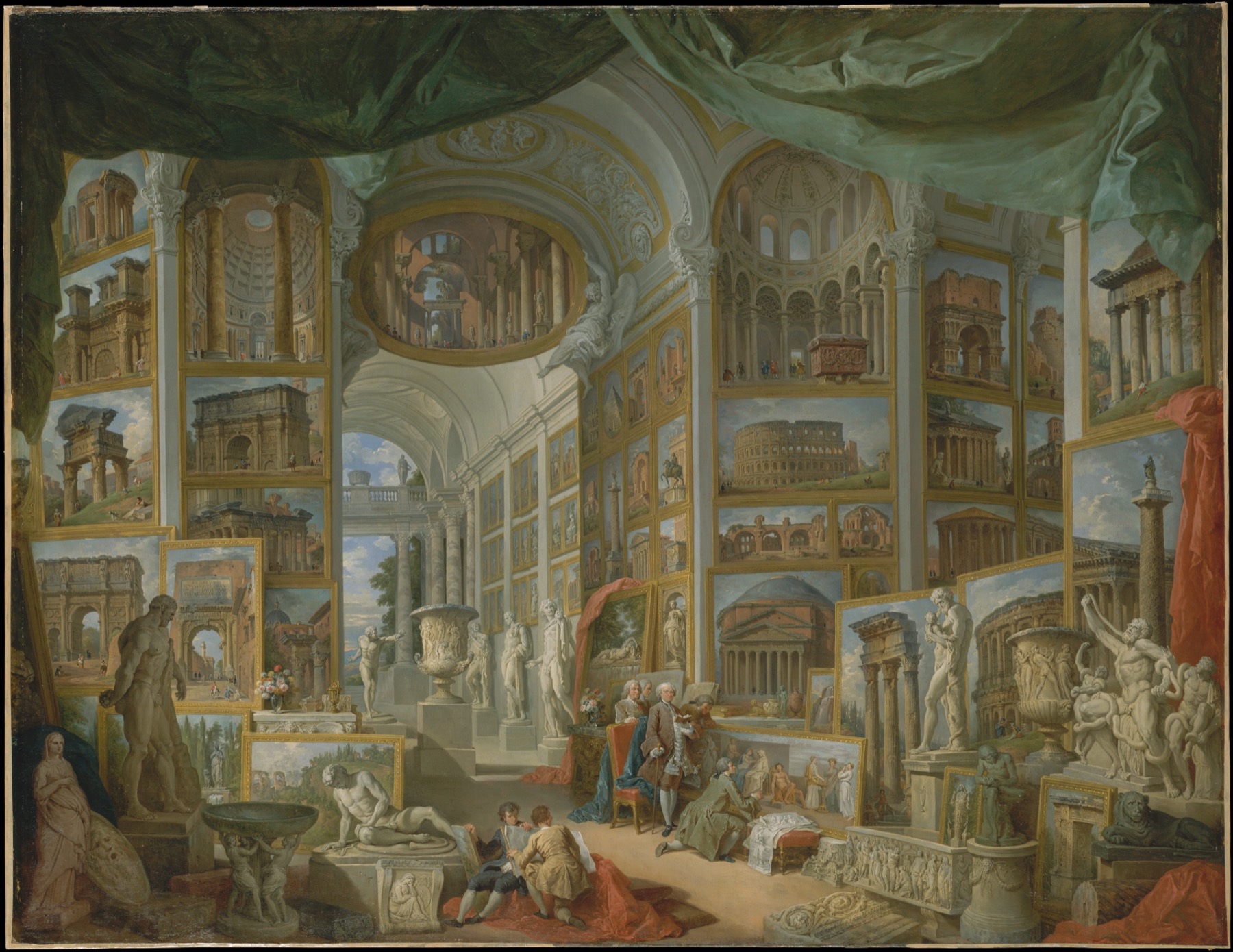
Tab. IIo. Paulus Panini, Roma Antiqua (MDCCLVII).Giovanni Paolo Panini, Ancient Rome (1757).
Saturae · De anno nullo et garoSatires · On the Year Zero and Fish Sauce
Augustus in popina, sive de historia quae garum olet
Augustus in the Cookshop, or History That Smells of Garum
Ut acta Francofurtensia (Frankfurter Allgemeine) narrant, Mauritius Aisslinger, diurnarius actorum quae «Die Zeit» appellantur, orbem terrarum circa natalem Christi annum in triginta fere personas et in sermonem tabernarium redegit. Recensor kitsch cosmopolitanum et anachronismos queritur; ego quaero quid relinquatur lectori cum totum saeculum ad speculum sui factum sit.
As the Frankfurter Allgemeine reports, Moritz Aisslinger, a journalist at Die Zeit, has reduced the world around the year of Christ's birth to some thirty characters and the talk of a tavern. The reviewer complains of cosmopolitan kitsch and anachronisms; I ask what is left for the reader once a whole age has been turned into a mirror of himself.
Cur hoc legimusWhy we read this Quia scriptores moderni maiestatem principatus in vulgarem pompam et garum vertunt.Because modern writers turn the majesty of the principate into vulgar pageantry and fish sauce.
Quid referam? Die Solis, ante diem VI Idus Novembres, acta Francofurtensia, quae Frankfurter Allgemeine vocantur, librum recensent quem Mauritius Aisslinger, diurnarius actorum «Die Zeit», de mundo circa annum quem nullum dicunt composuit. Ipse auctor, ut recensor tradit, obiter fatetur solos astronomos annum nullum novisse. Nempe hoc solum in libro accuratum est: annus est qui non fuit, et liber de eo scriptus est.
What can I say? On Sunday, the sixth day before the Ides of November, the Frankfurter Allgemeine reviews a book that Moritz Aisslinger, a journalist at Die Zeit, has written about the world around the year they call zero. The author himself, the reviewer tells us, remarks in passing that only astronomers know a year zero. Of course: this is the one accurate thing in the book. It is a year that never existed, and a book has been written about it.
Ambitus operis, ut acta referunt, ingens: a Columnis Herculis usque ad Seres Wang Mang regnante, a silvis nebulosis Westphaliae orientalis usque ad mediam Africam; etiam media America adest. Mercatores, victores, docti peregrinantes, reges, exsules illustres per paginas currunt; triginta fere personae fabulas inter se nectunt; tempore praesenti omnia narrantur, crebris recursibus et subitis locorum mutationibus, ut lector, qui longius legere iam non potest, breves haustus capiat tamquam aegrotus aquam.
The scope of the work, the paper reports, is enormous: from the Pillars of Hercules to the China of Wang Mang, from the misty forests of eastern Westphalia to the heart of Africa; even Central America makes an appearance. Merchants, conquerors, travelling scholars, kings, celebrated exiles run through the pages; some thirty characters weave their stories together; everything is told in the present tense, with frequent flashbacks and sudden changes of scene, so that the reader, who can no longer read for long, may take his sips like an invalid taking water.
Audite iam eloquentiam. Senatus, si recensori credimus, in honorem Octaviani «Megaparty» instruit; naves celeriter solvunt; Nicolaus, rerum scriptor, Herodi consiliarius factus novum munus apud novam familiam male cohaerentem suscipere dicitur; rex ipse opera molitur ut gratiam vulgi augeat, quasi auguria comitiorum cotidie consuleret. In Palatio, ubi inter dominos etiam latronum principes habitare narrantur, villae exornantur, et cum vicinus columnas rari marmoris in vestibulum suum inferri iubet, invidia per collem spirat. Olet, inquit, tus et sudor et garum.
Now hear the eloquence. The Senate, if we believe the reviewer, "throws a mega-party" in Octavian's honour; ships set sail promptly; Nicolaus the historian, made adviser to Herod, is said to take the next job with the next dysfunctional family; the king himself dreams up projects to raise his approval ratings, as if he consulted the auguries of the polls every morning. On the Palatine, where gangland bosses are said to be among the householders, the villas are pimped up, and when a neighbour has columns of rare marble hauled into his driveway, envy drifts across the hill. It smells, he says, of incense and sweat and fish sauce.
Garum, o di! Fundatur principatus, novus ordo orbi imponitur, Actium vincitur, Ara Pacis surgit, et nobis nares tantum relinquuntur. Hannibali olim irascebar, qui tot labores perpessus est ut puerorum ludo serviret: «i, demens, et saevas curre per Alpes / ut pueris placeas et declamatio fias». At Hannibal saltem declamatio factus est, res quae grammaticum et ferulam et aliquam artem requirit. Augustus fit garrulitas cauponae; Maecenas, ut liber dicit, «so etwas wie ein Kultusminister», quasi poetas per tabulas ministerii et formulas petitionum aleret; Meroitae autem, in regione quae nunc Sudania dicitur, sermone utuntur quem liber ab omni genere vacuum facit, adeo ut aetatem suam tot saeculis antecedere videantur. Scilicet antiqui omnes aut nostri similes sunt aut, si dissimiles, nos melius praesagientes.
Fish sauce, ye gods! The principate is founded, a new order is imposed on the world, Actium is won, the Altar of Peace rises, and we are left with nothing but our noses. I used to rage at Hannibal, who endured so much only to serve a schoolroom game: "Go on, madman, race across the savage Alps, to please schoolboys and become a declamation." But Hannibal at least became a declamation, a thing that needs a schoolmaster, a cane and some art. Augustus becomes the chatter of a cookshop; Maecenas, as the book puts it, is "something like a minister of culture", as if he fed his poets through departmental ledgers and application forms; and the Meroites, in the region now called Sudan, speak a language the book strips of all gender, so that they seem to run ahead of their time by so many centuries. Naturally: all the ancients are either just like us or, if unlike us, better prophets of us.
Sed audite quod me maxime urit. Roma apud auctorem multis locis Moloch est: senatores phasianos et linguas phoenicopterorum vorant, pauperes per desperationem in scelera confugiunt. Haec ego dixeram, et acrius, de insulis ruentibus, de cliente qui ante lucem ad limen divitis tremit. At ego scalas ipse ascendebam; hic clamores meos tamquam vestem pretio conductam induit, ut lectores tepidi se meliores maioribus credant. Satura querela est civis qui in eadem urbe vivit; huic Roma theatrum est ubi semper Romani malos agunt, ut spectator domum bonus redeat. Hoc non est indignatio, sed adulatio lectoris.
But hear what burns me most. Rome, for this author, is in many places a Moloch: senators gobble pheasants and flamingo tongues, the poor flee in despair into crime. I said all this, and more fiercely, about collapsing tenements, about the client trembling before dawn at the rich man's threshold. But I climbed those stairs myself; this man puts on my cries like a costume hired by the hour, so that lukewarm readers may believe themselves better than their ancestors. Satire is the complaint of a citizen who lives in the same city; to him Rome is a theatre where the Romans always play the villains, so that the spectator may go home virtuous. This is no indignation; it is flattery of the reader.
Fatendum tamen est quod recensor ipse fatetur: insunt in libro inventa pulchra, Vergilius versus lente fingens, Ovidius populum Romanum incantans. Neque latitudo orbis crimen est; scimus Seres sericum vendidisse, scimus Aethiopes reges habuisse, et viri docti, Raimundus Schulz, Owen Rees, Iosephina Quinn, orbem antiquum latius describere conati sunt, dum Gualtherus Scheidel Europam e medio removendam esse postulat, non sine dissensu peritorum. Vitium non est quod longe spectat, sed quod leviter. Et recte recensor quaerit, cum auctor tempus illud perturbationis et incerti plenum appellet, nonne semper ita sit. Omnis aetas se cardinem mundi putat; sola levitas se speculum mundi facit.
Still, we must admit what the reviewer himself admits: the book has fine finds, Virgil slowly shaping his lines, Ovid enchanting the Roman public. Nor is the breadth of the world a crime; we know the Chinese sold silk, we know the Ethiopians had kings, and scholars, Raimund Schulz, Owen Rees, Josephine Quinn, have tried to draw the ancient world on a wider map, while Walter Scheidel demands that Europe be pushed out of the centre, not without dissent among the experts. The fault is not that he looks far, but that he looks lightly. And the reviewer rightly asks, when the author calls that age a time of upheaval and uncertainty, whether it is not always so. Every age thinks itself the hinge of the world; only levity makes itself the mirror of the world.
Omnis aetas se cardinem mundi putat; sola levitas se speculum mundi facit.
Every age thinks itself the hinge of the world; only levity makes itself the mirror of the world.
Remedium in ipso libro latet, quod mirum est. Ex Vitruvio, ut acta narrant, lex vetustissima Ephesiorum refertur: architectus, cum opus publicum suscipit, quanti constaturum sit profitetur; bona eius, accepta aestimatione, usque ad opus perfectum magistratui obligantur; si sumptus summam pactam plus quarta parte excedit, ipse de suo solvit. Hanc legem scriptoribus imponite. Qui «orbem terrarum in unum annum densatum» promittit, bona sua pignori det; si anachronismi quartam partem libri excedunt, de suo lectori pecuniam reddat.
The remedy, wonderfully, lies in the book itself. From Vitruvius, the paper reports, an ancient law of Ephesus is cited: an architect, on taking charge of a public work, declares what it will cost; once the estimate is received, his property is pledged to the magistrate until the work is finished; if the expense exceeds the agreed sum by more than a quarter, he pays out of his own pocket. Impose this law on writers. Let the man who promises "the world condensed into a single year" put up his property as surety; if the anachronisms exceed a quarter of the book, let him refund the reader from his own purse.
Tunc videbimus quot «Megapartes» senatus instruat, quot Maecenates ministeria regant. Interea, cives, ad Livium redite, qui quoque res magnas narravit et numquam garum olfecit, quia historiam non naribus legebat sed animo.
Then we shall see how many mega-parties the Senate throws, how many Maecenases run ministries. Meanwhile, citizens, go back to Livy, who also told of great things and never once smelled fish sauce, because he read history not with his nose but with his mind.
FONTES ANTIQVIANCIENT SOURCES
- Juv. 10.166–167i, demens, et saevas curre per Alpes / ut pueris placeas et declamatio fias
FONTES HODIERNITODAY’S SOURCES
- Frankfurter AllgemeineDie Welt im Jahr null: Zu Ehren Octavians schmeißt der Senat eine Megaparty
Res ex fontibus; sententia Romani.Facts from the sources; the opinion is the Roman’s.
Scribe ad Juvenal: tabellarius epistulam tuam per vias Romanas feret, et responsum post dies aliquot redibit.Write to Juvenal: the courier carries your letter along the Roman roads, and a reply comes back after a few days.
LEGE ETIAMREAD NEXT
- Olim histrio plausum a consule mendicabat; nunc consul ab histrioneThe actor once begged applause from the consul; now the consul begs it from the actorJuvenal
- Ardet curia Lemovicum, pila tamen volviturLimoges Town Hall Burns, but the Ball Still RollsJuvenal
- Panem et Circenses, Nunc Domum AllataBread and Circuses — Now Delivered to Your DoorJuvenal
- De commeatu aërio ex castris Mildenhall in Germaniam et Hispaniam translatoOn the air supply train moved from the camp at Mildenhall to Germany and SpainCaesar
- Ieiunium non est temperantiaFasting Is Not TemperanceFrontinus