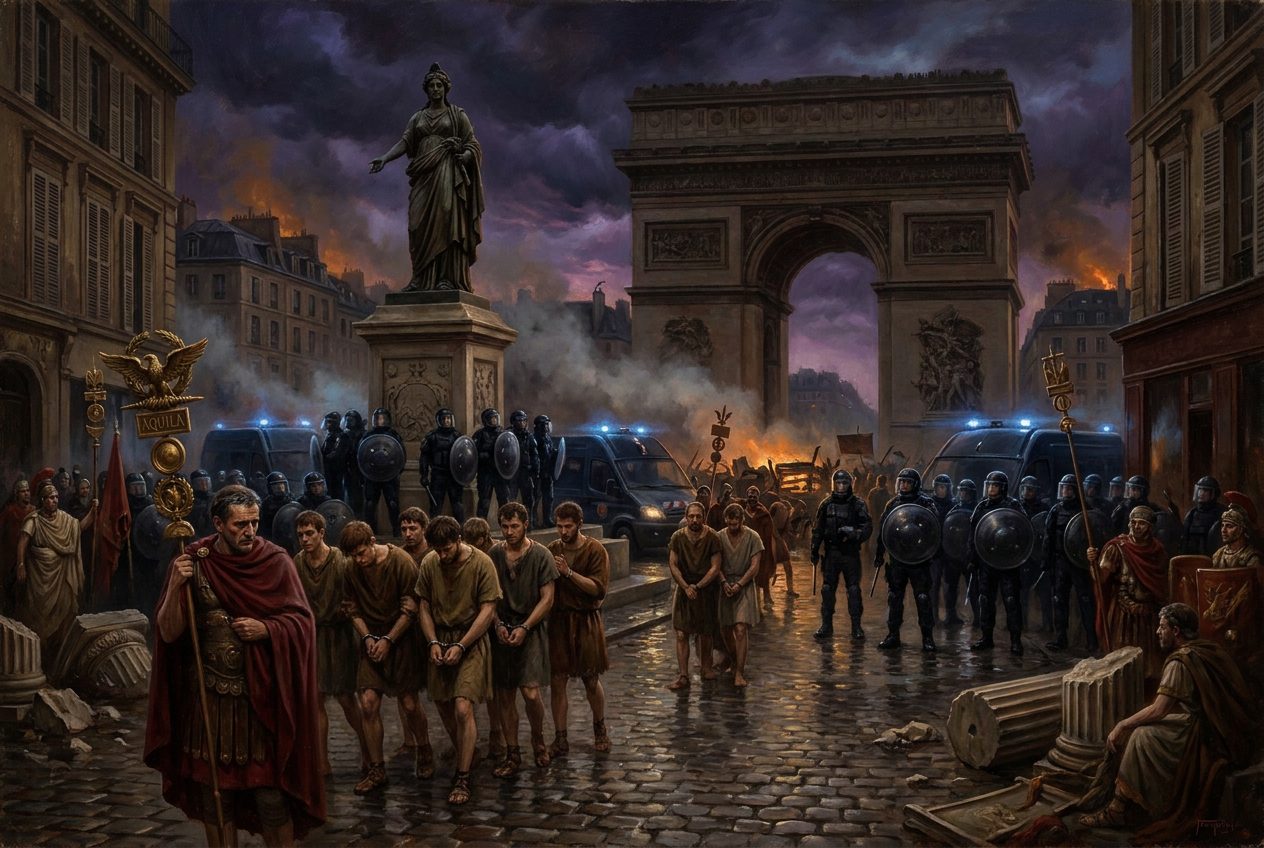
Tab. ITriumphus Captivorum, sive Urbs Nocte Clausa. Tabula Actis Mundi more veterum picta (a machina).The Triumph of Captives, or The City Shut by Night. Painted for Acta Mundi in the classical manner (AI-generated).
Annales Nostri Temporis · De Gallia noctu clausaAnnals of Our Time · On Gaul Locked by Night
Captivos numerant, urbes claudunt
They Count Prisoners, They Lock Cities
Pridie Kalendas Novembres trecenta viginti milia hominum per Galliam in vias processerunt; quingenti sexaginta quinque comprehensi, vigil flammis correptus, urbes noctu interclusae, ut Le Figaro nuntiat. Laurentius Nuñez rem bene gestam praedicat; ego in numero captivorum imperium labefactum lego.
On the last day of October three hundred and twenty thousand people marched through Gaul; five hundred and sixty-five were arrested, a policeman was engulfed in flames, and cities were shut by night, as Le Figaro reports. Laurent Nuñez proclaims a job well done; in the tally of prisoners I read an authority that has begun to give way.
Cur hoc legimusWhy we read this Quia cum praefecti victoriam iactent ex multitudine vinctorum, ipsa multitudo fractam imperii auctoritatem testatur.Because when magistrates boast of victory by the number of captives, the very number testifies to broken authority.
Pridie Kalendas Novembres, die Saturni, tertius in Gallia motus, quem ipsi actum tertium vocant quasi in scaena, trecenta viginti milia hominum per totam provinciam, septuaginta milia Lutetiae in vias eduxit, ut Le Figaro ex praefectura vigilum refert. Comprehensi per Galliam quingenti sexaginta quinque; Lutetiae quinque milia septingenti quadraginta quinque homines sisti et nomen reddere iussi, undeoctoginta abducti; apud Namnetes et in portu Sancti Nazarii duo et quinquaginta. Vigil quidam, missilibus incendiariis petitus, flammis correptus est. Quis iecerit, nondum compertum.
On the day before the Kalends of November, a Saturday, the third rising in Gaul, which its people call Act Three as if it were a play, brought three hundred and twenty thousand people into the streets across the whole province, seventy thousand of them in Paris, as Le Figaro reports from the prefecture of police. Arrested across Gaul: five hundred and sixty-five. In Paris, five thousand seven hundred and forty-five people were stopped and made to give their names, and seventy-nine taken away; at Nantes and the port of Saint-Nazaire, fifty-two. A policeman, struck by incendiary missiles, was engulfed in flames. Who threw them is not yet known.
Simul praefecti noctem civibus ademere. Lutetiae circa forum Rei Publicae et Castelletum ab hora undecima noctis ad sextam matutinam vias interclusere; Gratianopoli, Caesaroduni, Burdigalae, Insulis ceterisque septentrionis oppidis idem; Lugduni, Massiliae, Avenione pueris sine comite domi manendum edictum. Urbes, quae interdiu libertatis nomine strepunt, noctu ut castra obsessa clauduntur. Iter quoque a Bastilia ad Nationem, ut in ipsis Le Figaro actis inscriptum est, Consilium Status interdixerat.
Meanwhile the prefects took the night from the citizens. In Paris, around the Place de la République and Châtelet, the streets were closed from eleven at night until six in the morning; at Grenoble, Tours, Bordeaux, Lille and the other towns of the north, the same; at Lyon, Marseille and Avignon, children without an escort were ordered to stay indoors. Cities that clamour by day in the name of liberty are shut by night like a besieged camp. The route from the Bastille to the Nation, as the Figaro's own pages record, had been forbidden by the Council of State.
Laurentius Nuñez, cui res interior mandata est, dispositum suum, ut ipse ait, «robuste et agile» laudavit: eo effectum esse ut pompae indictae procederent, ut loquendi libertas servaretur, ut impedirentur qui agmina in tumultum vertere voluissent; turbatores et praedatores, centenos numero, a factione ultimae sinistrae, ut ipse vocat, incitatos esse. Addidit Rem Publicam ideo stare quod vigiles adsint. Ceterum de auctoribus Le Figaro nihil praeter ministri verba profert; quid trecenta viginti milia petierint, quis convocaverit, quomodo vigil se habeat, an incendiarius inter captos sit, acta silent. Eundem, post tumultus mense Octobri ortos, magistratu se abdicare voluisse, Emmanuelem Macron recusasse, Le JDD et Euronews tum nuntiabant. Manet igitur in sella qui iam semel fassus est se oneri imparem.
Laurent Nuñez, to whom the interior is entrusted, praised his arrangements as, in his words, "robust and agile": through them the declared processions had gone ahead, freedom of speech had been preserved, and those who wished to turn the marches into riot had been thwarted; the wreckers and looters, some hundreds of them, had been stirred up by what he calls the faction of the ultra-left. He added that the Republic stands because the police are there. For the authors, however, Le Figaro offers nothing beyond the minister's words; what the three hundred and twenty thousand wanted, who called them out, how the policeman fares, whether the arsonist is among those taken, the reports do not say. That this same man, after the disturbances that broke out in October, wished to resign his office, and that Emmanuel Macron refused, Le JDD and Euronews reported at the time. So the chair is still held by one who has already once confessed himself unequal to the burden.
Nomen est: Res Publica stat. Res est: stat inter custodes, ut reus stat. Imperium quod catenarum numero aestimatur auctoritate regere desiit, potestate sola tenetur. Maiores urbem non eo tutam putabant quod noctu vigiles discurrerent, sed quod cives iniussi quiescerent. Domitianus, cum ex Germania nihil vere victum reportasset, triumphum egit captivis per commercia emptis et in Germanorum habitum compositis; ridebant qui viderant. Haud dico ministrum captivos emisse. Dico idem genus gloriae esse, quae bellum non victum multitudine abductorum metiatur.
The name: the Republic stands. The thing: it stands among guards, as a defendant stands. An authority measured by the number of its chains has ceased to rule by auctoritas and is held by force alone. Our ancestors thought a city safe not because watchmen ran about it by night, but because its citizens were quiet unbidden. Domitian, having brought back nothing truly conquered from Germany, celebrated a triumph with captives bought in trade and dressed up as Germans; those who had seen it laughed. I do not say the minister bought his prisoners. I say it is the same kind of glory, which measures a war not won by the crowd of those led away.
Nomen est: Res Publica stat. Res est: stat inter custodes, ut reus stat.
The name: the Republic stands. The thing: it stands among guards, as a defendant stands.
Neque tamen turbae ignoscendum. Qui vigilem incendit caedem, non libertatem, petit; Brunus Retailleau caedis conatum appellavit, Marina Le Pen summam severitatem poposcit, quarum vocum fructum in proximis comitiis fore non latet. Alexis Corbière vigilum miseritus est, sed hilarem pompam et surdum regimen obiecit. Utrumque simul verum esse potest: paucos sceleratos esse, multos querelam habere quam nemo audit. Id ipsum ministri praeconium tegit, quippe facilius est quinque milia praetereuntium nomina rogare quam unius querelae causam.
Yet the mob is not to be excused. Whoever sets a policeman on fire seeks murder, not liberty; Bruno Retailleau called it attempted murder, Marine Le Pen demanded the utmost severity, and it is no secret that these voices will bear their fruit at the coming elections. Alexis Corbière took pity on the police, but set against them a joyful march and a deaf government. Both can be true at once: that the criminals are few, and that many have a grievance no one hears. This is exactly what the minister's proclamation covers up; it is easier, after all, to ask five thousand passers-by their names than to ask the cause of a single grievance.
Remedium, si quod est, vetus: unum incendiarium quaerere, invenire, lege de vi damnare; causam motus, de qua acta tacent, in curia audire, non in viis compescere; magistratum, qui fortunam suam saluti publicae praetulit, non laudare sed rationem reddere cogere. Quod si non fiet, restat annalium munus, quod sic definio: «praecipuum munus annalium reor, ne virtutes sileantur utque pravis dictis factisque ex posteritate et infamia metus sit». Posteri legent Galliam hoc anno pueros domi inclusisse, praetoria loricatis curribus munivisse, captivos pro victoria numeravisse. Ubi noctem civibus adimunt, ordinem appellant.
The remedy, if there is one, is old: to seek out the one arsonist, find him, and condemn him under the law on violence; to hear the cause of the rising, on which the reports are silent, in the chamber, not to suppress it in the streets; and to compel the magistrate who put his own fortune before the public safety, not to be praised, but to render account. If that is not done, there remains the office of the annals, which I define thus: "I hold it the chief duty of annals that virtues should not go unrecorded, and that evil words and deeds should fear the infamy of posterity." Posterity will read that in this year Gaul shut its children indoors, ringed its prefectures with armoured cars, and counted prisoners in place of victory. They take the night from the citizens, and call it order.
FONTES ANTIQVIANCIENT SOURCES
- Tac. Ann. 3.65praecipuum munus annalium reor, ne virtutes sileantur utque pravis dictis factisque ex posteritate et infamia metus sit
FONTES HODIERNITODAY’S SOURCES
Res ex fontibus; sententia Romani.Facts from the sources; the opinion is the Roman’s.
Scribe ad Tacitus: tabellarius epistulam tuam per vias Romanas feret, et responsum post dies aliquot redibit.Write to Tacitus: the courier carries your letter along the Roman roads, and a reply comes back after a few days.
LEGE ETIAMREAD NEXT
- Nihil scivisse officium erat; nunc crimen estTo know nothing was the duty; now it is the crimeTacitus
- Persona detracta, vox eademThe Mask Removed, the Voice UnchangedTacitus
- Indutiae verbis decretae, igne peractaeA Ceasefire Decreed in Words, Enacted in FireTacitus
- De commeatu aërio ex castris Mildenhall in Germaniam et Hispaniam translatoOn the air supply train moved from the camp at Mildenhall to Germany and SpainCaesar
- Ieiunium non est temperantiaFasting Is Not TemperanceFrontinus