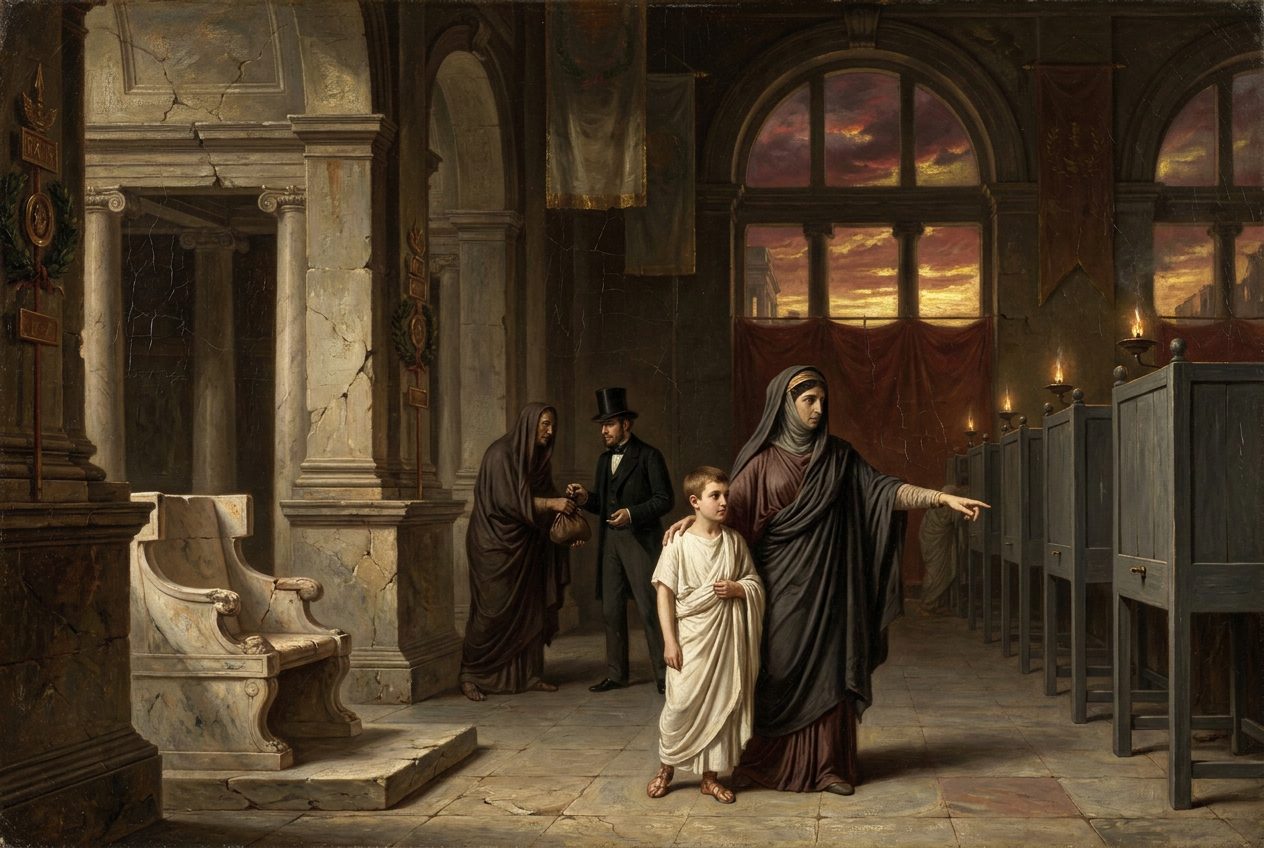
Tab. ICensura Domestica, sive Mater Filium ad Suffragia Monens. Tabula Actis Mundi more veterum picta (a machina).The Censorship of the Home, or A Mother Warning Her Son at the Polls. Painted for Acta Mundi in the classical manner (AI-generated).
Epistulae Matris · De comitiis trans OceanumA Mother's Letters · On the Elections Across the Ocean
Qui domum non regit, rem publicam non reget
He Who Cannot Rule His House Will Not Rule the Republic
Acta Novi Eboraci, quae New York Post appellantur, nuntiant cives Americanos in comitiis mediis inter candidatos legere cogi quorum alii saevitiae domesticae, alii fraudis, alii pecuniae externae insimulantur. Cornelia filium monet ut suffragium ferens se censorem esse meminerit.
The New York Post reports that American citizens in the midterm elections are forced to choose among candidates accused, some of cruelty at home, some of fraud, some of foreign money. Cornelia warns her son to remember, when he casts his vote, that he is a censor.
Cur hoc legimusWhy we read this Quia qui propriam domum regere nescit, frustra rei publicae curam exposcit.Because he who cannot govern his own household seeks the care of the commonwealth in vain.
Cornelia filio suo salutem.
Cornelia to her son, greetings.
Legi hodie, die Veneris, ante diem III Kalendas Novembres, in actis quae New York Post appellantur, cives Americanos comitiis mediis cogi eligere inter candidatos ex utraque factione quos crimina premunt. Max Miller, ex Ohio, ab uxore quondam sua Emilia Moreno insimulatur eam Kalendis Februariis, cum filiola inter parentes traderetur, impulisse, et anno MMXXIV aquam calidam de industria superfudisse. Ipse vehementer negat et crimina in acerba de filia lite nata esse contendit; de iugulo filiolae fracto quaesitum est, nemo delatus. Socer eius quondam, senator Bernardus Moreno, eum abire et medicos animi quaerere iussit; ille in petitione perstat. Kenneth Paxton, Texiae accusator publicus, anno MMXXIII a domo inferiore accusatus, a senatu suo aegre absolutus, nunc senatum petit contra Iacobum Talarico. Domus Ilhan Omar Washingtoniae die Columbo sacro a ministris publicis perscrutata est; quaeri dicitur de fraude in civitate adipiscenda. Ipsa negat, et LaMonica McIver, quae vim ministris intulisse accusatur, idem queritur: se ob dissensionem oppugnari. Henricus Cuellar reus est quod sescenta milia dollariorum a re publica Azerbaigianica et argentaria Mexicana accepisse arguitur.
I read today, Friday, the third day before the Kalends of November, in the paper they call the New York Post, that American citizens in their midterm elections are forced to choose among candidates from both factions who stand weighed down by charges. Max Miller, of Ohio, is accused by his former wife, Emily Moreno, of shoving her on the Kalends of February, while their little daughter was being handed from one parent to the other, and of deliberately pouring hot water over her in 2024. He denies it vehemently, and maintains that the charges were born of a bitter quarrel over the child; there was an inquiry into the little girl's broken collarbone, and no one was charged. His former father-in-law, Senator Bernie Moreno, told him to step down and seek the help of doctors of the mind; he persists in his canvass. Ken Paxton, the attorney general of Texas, impeached by the lower house in 2023 and narrowly acquitted by his own senate, now stands for the Senate against James Talarico. The house of Ilhan Omar in Washington was searched by federal officers on Columbus Day; the inquiry is said to concern fraud in obtaining citizenship. She denies it, and LaMonica McIver, who is accused of using force against officers, makes the same complaint: that they are attacked for their dissent. Henry Cuellar is under indictment, charged with taking six hundred thousand dollars from the government of Azerbaijan and a Mexican bank.
Haec, mi fili, non ut fabulam lege. Pater tuus, cum censor esset, non solum censum civium agebat sed mores; quaerebat quomodo quisque domum, uxorem, liberos, servos regeret. Nam maiores nostri non credebant eum qui suam domum non regeret rem publicam recte recturum. Nunc autem cives rogantur ut honestatem privatam a magistratu seiungant, quasi alius homo in atrio, alius in curia vivat. Quando hoc didicerunt? Ecquando domus et urbs duae res fuerunt? Quis filiam suam ei committet cui patriam committere paratus est?
Do not read this, my son, as a tale. Your father, when he was censor, took the census not only of citizens but of their morals; he asked how each man ruled his house, his wife, his children, his slaves. For our ancestors did not believe that a man who could not rule his own house would rule the republic rightly. Yet now citizens are asked to sever private honour from public office, as though one man lived in the atrium and another in the Curia. When did they learn this? When were the house and the city ever two things? Who will entrust his daughter to the man to whom he is ready to entrust his fatherland?
Quis filiam suam ei committet cui patriam committere paratus est?
Who will entrust his daughter to the man to whom he is ready to entrust his fatherland?
Concedo, et libenter concedo: accusatio non est iudicium. Miller negat; Omar et McIver se a magistratibus vexari affirmant, et scio ego ipsa quam saepe apud nos reus factus sit vir non quia peccavisset sed quia obstaret. Sed ideo iudicium celeriter fieri oportebat, priusquam comitia haberentur, non post. Factio quae virum dubium in campum producit, quia sedes plus valet quam homo, non civibus servit sed sibi. Cui bono? Ei qui sedem vult, non ei qui rem publicam.
I grant it, and gladly: an accusation is not a verdict. Miller denies; Omar and McIver insist that the magistrates are harassing them, and I know myself how often among us a man was put on trial not because he had done wrong but because he stood in the way. But that is exactly why the trial ought to have come quickly, before the elections, not after. A faction that leads a doubtful man onto the Field because the seat is worth more than the man serves not the citizens but itself. Cui bono? The one who wants the seat, not the one who wants the republic.
Gravissimum autem mihi videtur crimen pecuniae externae, si verum est quod accusatores dicunt. Iugurtha de urbe nostra dixisse fertur eam esse «urbem venalem et mature perituram, si emptorem invenerit». Rex qui senatorem emit non unum hominem emit, sed partem civitatis.
Gravest of all, to my mind, is the charge of foreign money, if what the prosecutors say is true. Jugurtha is reported to have said of our own city that it was "a city for sale, and soon to perish, if it finds a buyer." A king who buys a senator buys not one man but a part of the state.
Remedium non novum est. Domus prima schola est rei publicae; ibi discitur imperare, quia ibi discitur parere. Ostendi olim matronae gemmas suas iactanti filios meos, et dixi «haec ornamenta sunt mea». Ornamenta candidati non sunt orationes nec factio nec pecunia, sed domus composita et manus purae. Itaque, mi fili, cum suffragium feres, censor esto: noli virum tuae partis eligere quia tuae partis est. Malo te victum in comitiis videre quam victorem per hominem quem domi timeant. Vale.
The remedy is not new. The house is the first school of the republic; there one learns to command, because there one learns to obey. Once, when a matron was flaunting her jewels, I showed her my sons and said, "These are my ornaments." A candidate's ornaments are not his speeches, nor his faction, nor his money, but a well-ordered house and clean hands. So, my son, when you cast your vote, be a censor: do not choose a man of your party because he is of your party. I would rather see you beaten at the polls than victorious through a man whom his own household fears. Farewell.
FONTES ANTIQVIANCIENT SOURCES
- Sall. Iug. 35.10urbem venalem et mature perituram, si emptorem invenerit
- Val. Max. 4.4 pr.haec ornamenta sunt mea
FONTES HODIERNITODAY’S SOURCES
- New York PostMidterm voters forced to choose between alleged adulterers, abusers, criminals and other ethically challenged pols
- NPR2026 midterm election voter guides: Find local resources in your community
Res ex fontibus; sententia Romani.Facts from the sources; the opinion is the Roman’s.
Scribe ad Cornelia: tabellarius epistulam tuam per vias Romanas feret, et responsum post dies aliquot redibit.Write to Cornelia: the courier carries your letter along the Roman roads, and a reply comes back after a few days.
LEGE ETIAMREAD NEXT
- Tutela pupillorum est, non civiumGuardianship Is for Wards, Not CitizensCornelia
- Suffragium hereditas est, non praedaThe Vote Is an Inheritance, Not PlunderCornelia
- De commeatu aërio ex castris Mildenhall in Germaniam et Hispaniam translatoOn the air supply train moved from the camp at Mildenhall to Germany and SpainCaesar
- Ieiunium non est temperantiaFasting Is Not TemperanceFrontinus
- Harenam in thesaurum vertit ingenium; thesaurum unius hominis custodia tueturGenius turns sand into treasure; one man's keeping guards the treasurePliny the Elder