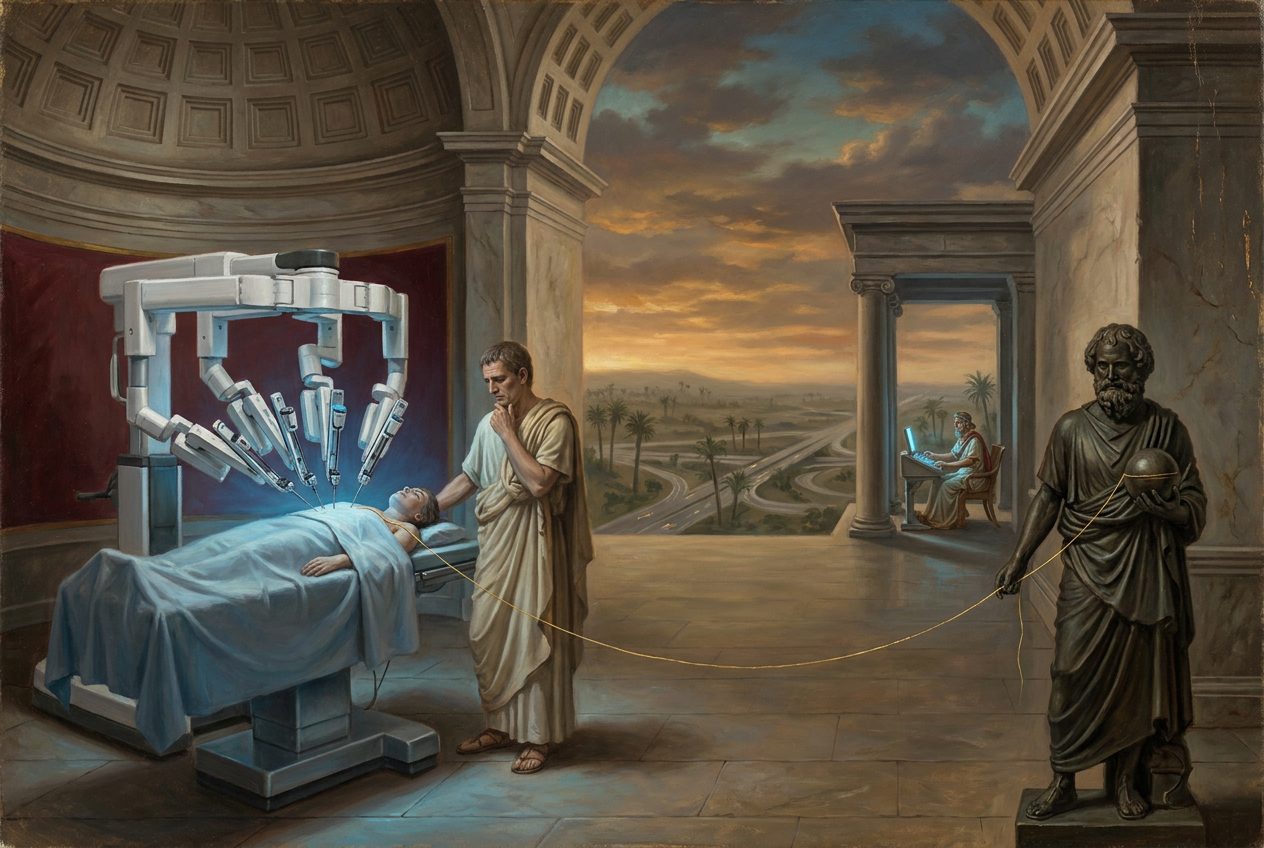
Tab. IMens Sine Manu, sive Filum Inter Medicum et Aegrotum. Tabula Actis Mundi more veterum picta (a machina).The Mind Without the Hand, or The Thread Between Physician and Patient. Painted for Acta Mundi in the classical manner (AI-generated).
Schola Alexandrina · De arte medica per spatiumThe Alexandrian School · On the Art of Medicine at a Distance
Mens carnem numquam tetigit
The Mind Never Touched the Flesh
Ut acta Novi Eboraci (New York Post) narrant, medicus Vipul Patel ex suburbio Orlandi machinam gubernavit, qua aegro triginta quinque milia passuum distanti prostata cancro affecta exempta est. Ars ipsa non abest; filum quod mentem et corpus coniungit metiendum est.
According to the New York Post, Dr. Vipul Patel steered a machine from suburban Orlando that removed a cancerous prostate from a patient thirty-five miles away. The art itself is not absent; what must be measured is the thread that joins the mind to the body.
Cur hoc legimusWhy we read this Quia machina procul posita carnem secat medico absente, nova virtus artis medicae.Because a distant machine cuts flesh with the doctor absent, a new threshold in the art of healing.
Quaeritur hodie, auditores, die Mercurii, ante diem V Kalendas Novembres, utrum ars medica, cum manus a corpore aegroti tam longe removeatur, se ipsam superet an a carne, cuius causa exstitit, periculose avellatur. Occasionem praebent acta Novi Eboraci (New York Post), quae narrant medicum Vipul Patel, conditorem et praefectum Instituti Roboticae Globalis apud AdventHealth, ex suburbio Orlandi machinam gubernavisse. Ea machina viro sexaginta sex annos nato, Marco nomine, prostata cancro affecta exempta est, cum aeger triginta quinque milia passuum abesset, in oppido Minneola Floridae. Aegrum, ut AdventHealth dicit, alius chirurgus ad lectum observabat, isque post sectionem bene se habere nuntiatur.
Our question today, my hearers, on this Wednesday, the fifth day before the Kalends of November, is whether the art of medicine, when the hand is removed so far from the patient's body, surpasses itself, or is dangerously torn from the flesh for whose sake it came into being. The occasion is a report in the New York Post: Dr. Vipul Patel, founder and medical director of the Global Robotics Institute at AdventHealth, steered a machine from suburban Orlando. By that machine a cancerous prostate was removed from a man of sixty-six named Mark, while he lay thirty-five miles away, in the town of Minneola in Florida. Another surgeon, AdventHealth says, watched over the patient at the bedside, and he is reported to be doing well after the operation.
Addunt eadem acta operationem a magistratibus et ab ipso instituto praedicari primam quae tota intra fines Civitatum Foederatarum facta sit. Decem tamen alias experimenti causa iam antea inter Orlandum et Luandam Angolae factas esse. Licuisse per exceptionem a Food and Drug Administration concessam, neque rem eo quod successerit tutam habendam esse, ut AdventHealth ipsa fatetur. Manere praeterea pericula quae omni tali sectioni insint, et ea quae ex fraudibus per retia aut ex vinculo interrupto oriri possint, quae adhuc perpendantur. Patel ipse dicit aditum ad curationem exquisitissimam diu pependisse ex loco ubi quisque habitet, et hoc studio quaeri num telechirurgia aliquando hos fines minuere possit. Hoc ut philosopha libenter accipio, quia quaerit neque iactat. De decem aegris Luandae, qui priores fuerunt, quid evenerit acta tacent; quam quaestionem ego magistra discipulis primam proponerem. Primum enim intra fines nondum est primum in orbe.
The same report adds that officials and the institute itself are proclaiming this the first such operation carried out wholly within the United States. Ten others, however, had already been performed for the sake of investigation between Orlando and Luanda in Angola. It was permitted by an exemption granted by the Food and Drug Administration, and, as AdventHealth itself admits, its success does not mean the procedure is to be held safe. There remain, besides, the risks inherent in every such operation, and those that may arise from attacks through the networks or from a broken connection, which are still being weighed. Patel himself says that access to the most specialized care has long depended on where each patient lives, and that this study asks whether telesurgery might one day reduce those barriers. As a philosopher I welcome this, because it inquires and does not boast. Of the ten patients in Luanda who came first, the report says nothing; and that is the question I, as a teacher, would set my pupils before any other. For first within a border is not yet first in the world.
Definiamus primum, ut geometrae solent. Ars, quam Graeci τέχνην vocant, est ratio vera rei faciendae, in animo artificis sita; manus est instrumentum, scalpellum instrumentum instrumenti. Tactus autem sensus est, quo artifex de materia certior fit. Qui ergo dicit artem a tactu separatam esse, duo confundit: rationem quae operatur et sensum qui nuntiat. Haec machina nuntios sensus per spatium transmittit, oculos per imagines, manum per motus imitatos; rationem transmittere nequit, quia ratio numquam aberat. Manebat in capite medici Orlandi.
Let us begin, as geometers do, with definitions. Art, which the Greeks call technē, is the true reasoned method of making a thing, and it resides in the mind of the maker; the hand is its instrument, and the scalpel the instrument of an instrument. Touch is a sense, by which the maker learns about his material. Whoever says that art has been separated from touch, then, confuses two things: the reason that works and the sense that reports. This machine carries the reports of the senses across distance, the eyes through images, the hand through imitated motions; reason it cannot carry, because reason was never absent. It stayed in the surgeon's head in Orlando.
Demonstratio per gradus procedat. Primo: spatium ad quantitatem pertinet, scientia eo non minuitur. Eratosthenes terram non circumambulavit; umbram Syenae et Alexandriae comparavit et ambitum orbis mente comprehendit. Secundo: instrumentum quo longius manum porrigit, eo fidelius esse debet. Archimedes, cum Syracusas defenderet, naves hostium machinis e muris, ut traditur, sustulit; at machinae illae per se non movebantur. Homines ad funes stabant, et mens senis per eorum manus agebat. Ita hic quoque inter mentem Orlandi et corpus Minneolae filum interiacet, et filum, ut omnis catena, tam firmum est quam pars eius infirmissima. Tertio: corpus aegri res singularis est, ars universalis; universale per spatium mitti potest, singulare curam praesentem postulat. Ideo chirurgus ille ad lectum, cuius nomen acta ne tradunt quidem, pars ipsius demonstrationis est.
Let the demonstration proceed by steps. First: distance belongs to quantity, and knowledge is not diminished by it. Eratosthenes did not walk around the earth; he compared the shadow at Syene with the shadow at Alexandria and grasped the circumference of the globe with his mind. Second: the farther an instrument extends the hand, the more faithful it must be. Archimedes, defending Syracuse, is said to have lifted enemy ships from the walls with his engines; yet those engines did not move of themselves. Men stood at the ropes, and the old man's mind acted through their hands. So here too a thread lies between the mind in Orlando and the body in Minneola, and the thread, like every chain, is as strong as its weakest link. Third: the patient's body is a particular thing, the art a universal one; the universal can be sent across distance, but the particular demands care that is present. That is why the surgeon at the bedside, whose name the report does not even give, is part of the demonstration itself.
Concludo igitur. Mens a carne non hodie primum separata est; numquam eam tetigit. Etiam cum manus chirurgi in vulnere versabatur, anima per manum tamquam per instrumentum agebat, et sensus ei nuntios afferebat. Machina nuntium longius portat; naturam rei non mutat. Periculum igitur non est ne ars se ipsam transcendat, sed ne homines artem in machina esse credant, quae motus tantum reddit. Si quis aliquando putabit chirurgum non requiri quia machina secat, umbram circuli pro circulo habebit.
I conclude, therefore. The mind has not been separated from the flesh for the first time today; it never touched it. Even when the surgeon's hand moved within the wound, the soul acted through the hand as through an instrument, and the senses brought it their reports. The machine carries the report farther; it does not change the nature of the thing. The danger, then, is not that art may transcend itself, but that men may come to believe the art lies in the machine, which only returns motions. If anyone ever thinks a surgeon unnecessary because the machine cuts, he will be taking the shadow of a circle for the circle.
Mens a carne non hodie primum separata est; numquam eam tetigit.
The mind has not been separated from the flesh for the first time today; it never touched it.
Remedium simplex est et antiquum. Stet semper ad lectum medicus peritus, qui scalpellum, si filum rumpatur, ipse capiat. Duplicetur filum, ut aquaeductus qui geminos specus habet. Edantur palam eventus omnium aegrorum, et Luandae et Minneolae, ut de tuta re scientia iudicet, fama taceat. Admiror opus, auditores, et fateor maiores nostros tale ne somniare quidem potuisse; at admiratio initium philosophiae est. Quod nondum mensum est, nondum probatum est.
The remedy is simple and old. Let a skilled physician always stand at the bedside, ready to take up the scalpel himself should the thread break. Let the thread be doubled, like an aqueduct with twin channels. Let the outcomes of all the patients, in Luanda and in Minneola alike, be published openly, so that knowledge judges what is safe and rumour holds its tongue. I admire the work, my hearers, and I confess our ancestors could not have dreamed of such a thing; but wonder is the beginning of philosophy. What has not yet been measured has not yet been proved.
FONTES ANTIQVIANCIENT SOURCES
- —
FONTES HODIERNITODAY’S SOURCES
- New York PostDoctor-controlled robot removes patient’s prostate 35 miles away in first US telerobotic surgery
Res ex fontibus; sententia Romani.Facts from the sources; the opinion is the Roman’s.
Scribe ad Hypatia: tabellarius epistulam tuam per vias Romanas feret, et responsum post dies aliquot redibit.Write to Hypatia: the courier carries your letter along the Roman roads, and a reply comes back after a few days.
LEGE ETIAMREAD NEXT
- Saepes bovem cingit, morbum non cingitThe fence encloses the cow; it does not enclose the diseaseHypatia
- Umbra circuli non doletThe Shadow of a Circle Feels No PainHypatia
- De commeatu aërio ex castris Mildenhall in Germaniam et Hispaniam translatoOn the air supply train moved from the camp at Mildenhall to Germany and SpainCaesar
- Ieiunium non est temperantiaFasting Is Not TemperanceFrontinus
- Harenam in thesaurum vertit ingenium; thesaurum unius hominis custodia tueturGenius turns sand into treasure; one man's keeping guards the treasurePliny the Elder