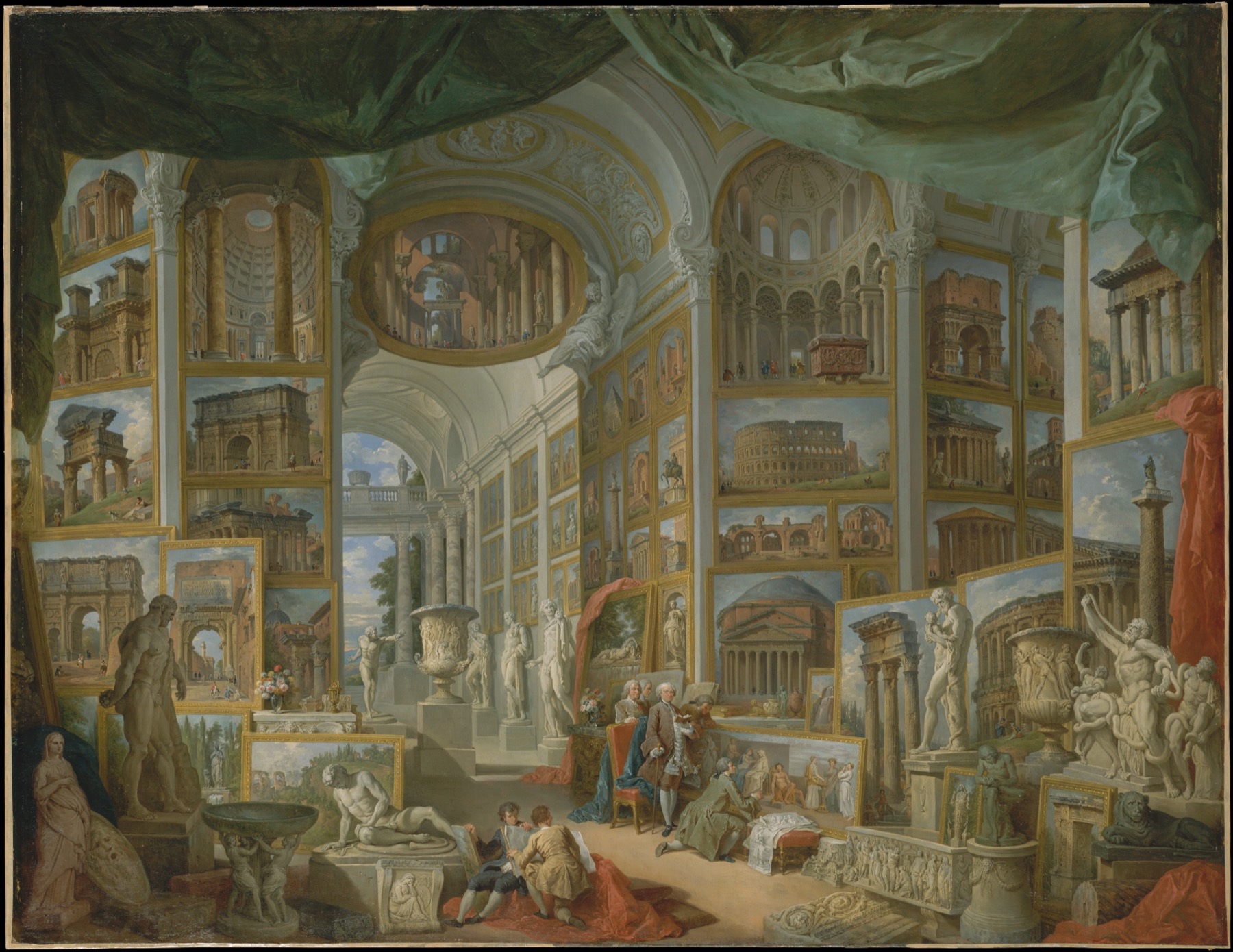
Tab. IIo. Paulus Panini, Roma Antiqua (MDCCLVII).Giovanni Paolo Panini, Ancient Rome (1757).
Sermones · De sartoribus MediolanensibusConversations · On the Tailors of Milan
Vestis quae omnibus convenit, nemini convenit
A Garment That Fits Everyone Fits No One
Ut acta La Verità narrant, Mediolani sextum certamen «Milano su misura – Trofeo Arbiter» viginti quattuor sartores ex toto orbe in unum argumentum contulit, auctore Franz Botré. Flaccus ridens ostendit vestem ad hominem factam decorum restituere, vestem ad nullum factam servilem esse annonam, quam liberi homines sua sponte accipiant.
According to La Verità, the sixth contest of «Milano su misura – Trofeo Arbiter» brought twenty-four tailors from all over the world to Milan to work on a single theme, at the instigation of Franz Botré. Flaccus, laughing, argues that a garment made for a man restores decorum, while a garment made for nobody is a slave's ration, which free men now accept of their own accord.
Cur hoc legimusWhy we read this Quia vestis animum viri decoremque declarat, nec decet civem more manichini vanitate indui.Because dress reveals the spirit and decorum of a man, and it is unbefitting for a citizen to be draped in vanity like a mannequin.
Die Saturni, ante diem IX Kalendas Novembres. Narrant acta La Verità Mediolani sextum iam certamen habitum esse, quod «Milano su misura – Trofeo Arbiter» appellatur. Eo viginti quattuor sartores ex toto orbe terrarum convenerunt, uno argumento omnibus proposito, multis interpretationibus. Auctor ludi est Franz Botré, qui commentarios Arbiter regit; eum ferunt sartoriam virilem renovare et iuvenum ingenia in lucem proferre. Idem, ut eadem acta referunt, negat sartorem simulacra vestire: vestem enim hominis naturam exprimere debere. Pannum quidem multum valere, sed artificem ad corpus et ad mores emptoris se accommodare oportere. Iuvenes denique laudat, quod inter se conferre et disputare didicerint.
Saturday, the ninth day before the Kalends of November. La Verità reports that Milan has held the sixth edition of a contest called «Milano su misura – Trofeo Arbiter». Twenty-four tailors from every corner of the world gathered there; one theme was set for all of them, and it met with many interpretations. The man behind the games is Franz Botré, who directs the review Arbiter; he is said to be renewing the art of men's tailoring and bringing young talent into the light. The same paper reports that he denies a tailor dresses mannequins: a garment must express the nature of the man. The cloth counts for a great deal, he says, but the craftsman must adapt himself to the body and the character of the client. And he praises the young for having learned to compare their work and argue it out among themselves.
Quis vicerit, quod argumentum datum sit, unde singuli venerint, nescio: reliqua narratio post ianuam latet, quae solis subscriptoribus aperitur, et ego, ut homo parcus, non pulsavi. Sed ad sermonem satis habeo. Nam qui de toga disputat, non necesse habet victoris nomen nosse, sicut qui de vino disputat non necesse habet cauponem. «Quid tibi», inquis, «Flacce, cum acu et forfice? Tu qui puer tunicam a patre semel in anno acceptam gerebas?» Recte. Propterea scio quanti constet vestis quae sedeat.
Who won, what the theme was, where each of them came from, I do not know: the rest of the story lies behind a door that opens only to subscribers, and I, a thrifty man, did not knock. But I have enough for a conversation. A man who talks about the toga does not need the winner's name, any more than a man who talks about wine needs the innkeeper's. "What have you to do with needle and shears, Flaccus," you ask, "you who as a boy wore the one tunic your father gave you each year?" Quite right. That is exactly why I know what a garment that sits well is worth.
Memini Maecenatem, virum elegantissimum, ridere solitum, si toga mea impar in umeris penderet, si tunica trita sub nova appareret. Ridebat ille vestem; ego mentem meam multo magis inaequalem esse sentiebam, nec eam quisquam sartor corrigere poterat. Concedo: acus animum non sanat. Sed qui in toga ad corpus facta incedit, rectius incedit; qui rectius incedit, saepe rectius cogitat. Nam decorum, ut docent philosophi, primum in gestu et habitu cernitur, deinde in vita.
I remember Maecenas, the most elegant of men, laughing whenever my toga hung lopsided on my shoulders, or a worn tunic peeped out beneath a new one. He laughed at the clothes; I felt my mind was far more lopsided, and no tailor could set that straight. I grant it: the needle does not heal the soul. But a man who walks in a toga cut to his body walks more upright; and a man who walks more upright often thinks more uprightly. Decorum, as the philosophers teach, is seen first in bearing and dress, and only then in a life.
Considera nunc forum nostri temporis. Cato vilicis suis tunicam et sagum ad mensuram dabat, omnibus eandem, nullius corpori aptatam; erat ea annona servorum. Nunc liberi homines, cives, senatores etiam, tunicas emunt mille simul consutas, ad nullum hominem factas, ideoque nulli convenientes; et hoc libertatem vocant, quod pro eodem sacco duodecim colores eligere licet. Ego vero servilem annonam dico, sua sponte acceptam. Cicero mercennarios eos esse docuit «quorum operae, non quorum artes emuntur»; sartor, qui hominem metitur antequam secat, artem vendit, officina, quae milia corporum ignorat, operas.
Now look at the forum of our own day. Cato handed out to his farm stewards a tunic and a cloak by measure, the same for all, fitted to nobody: that was the slaves' ration. Today free men, citizens, even senators, buy tunics sewn a thousand at a time, made for no man and therefore fitting none; and they call it freedom that they may choose the same sack in twelve colours. I call it a slave's ration, taken willingly. Cicero taught that hirelings are those "whose labour is bought, not their skill"; the tailor, who measures the man before he cuts, sells his skill; the factory, which knows nothing of its thousands of bodies, sells labour.
Neque haec res levis est, quamvis ridere videar. Augustus, cum in contione turbam pullis lacernis amictam vidisset, indignatus aedilibus imperavit ne quis in foro nisi togatus consisteret. Intellegebat enim faciem rei publicae in vestitu civium conspici, et populum qui se neglegenter tegat mox se neglegenter regere. Quod edicto aedilis vix efficit, id sartor persuadendo efficit: unum hominem singulatim restituit, deinde alterum.
Nor is this a trifle, though I seem to be laughing. When Augustus saw a crowd at an assembly wrapped in dark cloaks, he was indignant and ordered the aediles to let no one stand in the forum unless he wore the toga. He understood that the face of the commonwealth is seen in the dress of its citizens, and that a people which covers itself carelessly will soon govern itself carelessly. What an aedile can barely achieve by edict, a tailor achieves by persuasion: he restores one man at a time, and then the next.
Cui bono? Botré, opinor, et commentariis suis; fama crescit, clientes accedunt, patronatus artis confirmatur. Non reprehendo: et Maecenas ex Vergilii carminibus gloriam cepit, nec ideo carmina peiora fuerunt. Iuvat etiam artifices ex longinquis gentibus in Italiam venire ut acum cum nostris conferant; olim «Graecia capta ferum victorem cepit et artes intulit agresti Latio», nunc artes ipsae ad nos redeunt discendi causa. Hoc tamen caveo: ne sartoria, quae decorum restituit, in luxuriam vertatur, ne quis vicenas togas sibi fieri iubeat ut pavo in porticu se ostentet. «Est modus in rebus, sunt certi denique fines, quos ultra citraque nequit consistere rectum.»
Who gains? Botré, I suppose, and his review; his reputation grows, clients come, his patronage of the craft is confirmed. I do not blame him: Maecenas too won glory from Virgil's poems, and the poems were none the worse for it. I am glad, besides, that craftsmen from distant nations come to Italy to match their needles against ours; once "captive Greece took her rough conqueror captive and brought the arts to rustic Latium"; now the arts themselves come back to us to learn. But I keep watch on one thing: that tailoring, which restores decorum, does not turn into luxury, and that no one orders twenty togas so he can strut like a peacock in the colonnade. "There is a measure in things, there are fixed limits, beyond and short of which right cannot stand."
Remedium igitur in promptu est, neque novum: unam vestem eme, sed bonam; sine artificem te metiri, colloqui, etiam reprehendere; gere eam per decem annos, donec cum domino consenescat. Filios autem, ut pater meus me, exemplis doce, non praeceptis: ostende eis hominem bene vestitum et sobrium, et hominem male vestitum et ebrium, et sine eos ipsos iudicare. Vestis quae omnibus convenit, nemini convenit; idem de sententiis dicas licet.
The remedy, then, is at hand, and it is not new: buy one garment, but a good one; let the craftsman measure you, talk with you, even correct you; wear it for ten years, until it grows old with its owner. And teach your sons, as my father taught me, by examples, not by precepts: show them a man well dressed and sober, and a man badly dressed and drunk, and let them judge for themselves. A garment that fits everyone fits no one; and you may say the same of opinions.
Vestis quae omnibus convenit, nemini convenit; idem de sententiis dicas licet.
A garment that fits everyone fits no one; and you may say the same of opinions.
FONTES ANTIQVIANCIENT SOURCES
- Cic. Off. 1.150Illiberales autem et sordidi quaestus mercennariorum omnium, quorum operae, non quorum artes emuntur
- Hor. Ep. II.1.156–157Graecia capta ferum victorem cepit et artes / intulit agresti Latio
- Hor. Sat. I.1.106–107Est modus in rebus, sunt certi denique fines, / quos ultra citraque nequit consistere rectum
FONTES HODIERNITODAY’S SOURCES
Res ex fontibus; sententia Romani.Facts from the sources; the opinion is the Roman’s.
Scribe ad Horace: tabellarius epistulam tuam per vias Romanas feret, et responsum post dies aliquot redibit.Write to Horace: the courier carries your letter along the Roman roads, and a reply comes back after a few days.
LEGE ETIAMREAD NEXT
- Hominem novum decreto fingere: figulus qui lutum suum oblitus estMaking a New Man by Decree: the Potter Who Forgot His ClayHorace
- Luscus inter caecos rexThe One-Eyed King Among the BlindHorace
- De commeatu aërio ex castris Mildenhall in Germaniam et Hispaniam translatoOn the air supply train moved from the camp at Mildenhall to Germany and SpainCaesar
- Ieiunium non est temperantiaFasting Is Not TemperanceFrontinus
- Harenam in thesaurum vertit ingenium; thesaurum unius hominis custodia tueturGenius turns sand into treasure; one man's keeping guards the treasurePliny the Elder