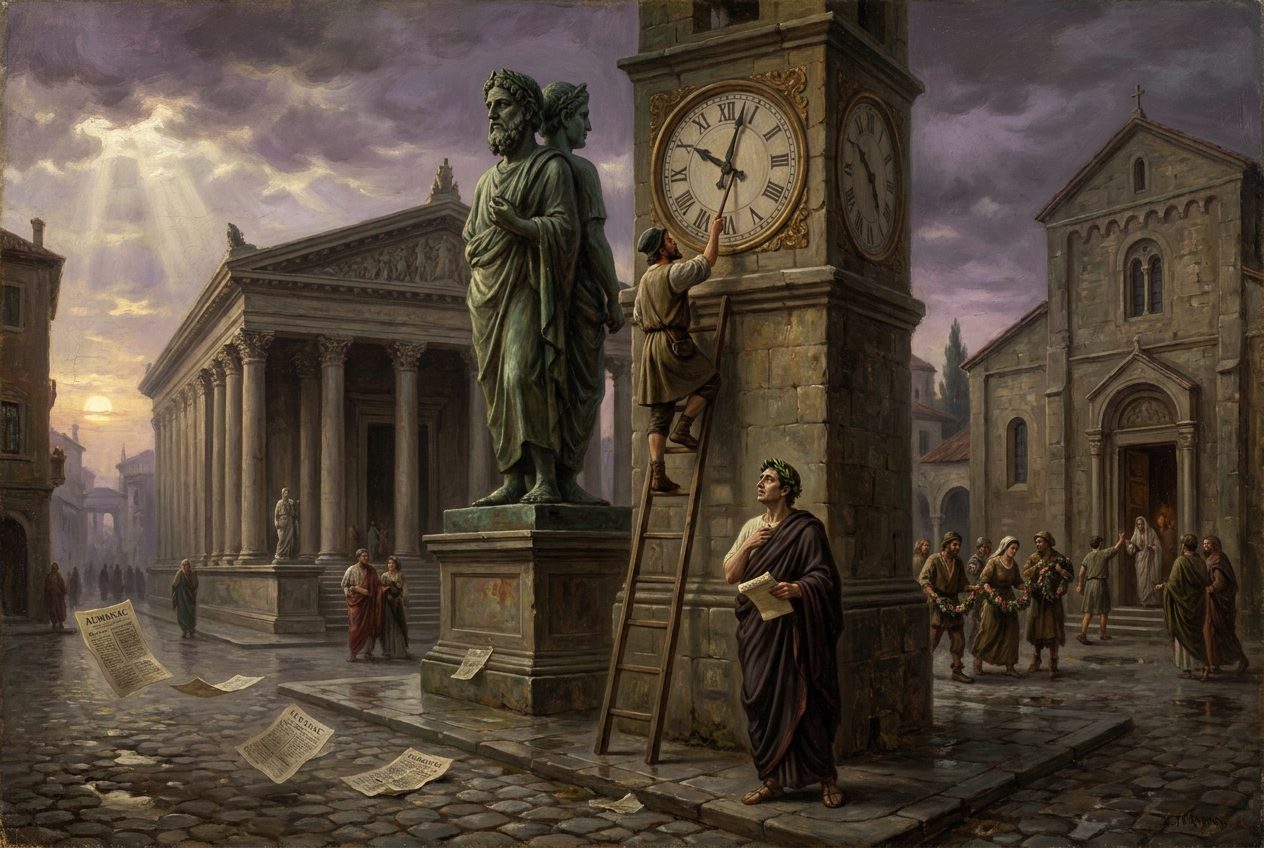
Tab. IHorae Revocatae, sive Sol Horologio Iussus. Tabula Actis Mundi more veterum picta (a machina).The Hours Turned Back, or The Sun Commanded by the Clock. Painted for Acta Mundi in the classical manner (AI-generated).
Fasti et Tristia · De hora redditaCalendar and Laments · On the Hour Returned
Hebdomas sine die Solis, annus sine feriis
A Week without Sunday, a Year without Holidays
Ut Frankfurter Allgemeine nuntiat, hoc fine hebdomadis horologia in Germania ad tempus hibernum revocabuntur, et diurnarius ea occasione rettulit quomodo Gilbertus Romme fastos rei publicae Francicae novos composuerit, quos Napoleo postea abrogavit. Fastorum vates causam quaerit: qui horas regere vult, solem regere conatur; populus autem fastos non mathematicis credit sed feriis.
The Frankfurter Allgemeine reports that this weekend the clocks in Germany will be turned back to winter time, and its writer takes the occasion to recall how Gilbert Romme composed a new calendar for the French republic, which Napoleon later abolished. The poet of the Calendar looks for the cause: whoever would rule the hours is trying to rule the sun; but a people trusts its calendar not to mathematicians but to holidays.
Cur hoc legimusWhy we read this Quia de fastis et ordine temporum agitur, quos antiquitus dii, nunc vani magistratus regere conantur.Because it concerns the calendar and the order of time, which the gods governed of old, but which vain magistrates now seek to rule.
Die Veneris, ante diem X Kalendas Novembres. Ut Frankfurter Allgemeine nuntiat, hoc ipso fine hebdomadis horologia in Germania ad tempus hibernum reducentur, et hora quae verno tempore ablata est nobis reddetur. Quis hoc iubeat, quo senatus consulto, quo magistratu auctore, acta tacent; ego, qui fastos scripsi, primum id quaero. Diurnarius autem, quasi hora sola parum esset, totam fastorum historiam retexuit, et a Lutetia orsus est.
Friday, the tenth day before the Kalends of November. The Frankfurter Allgemeine reports that this very weekend the clocks in Germany will be turned back to winter time, and the hour taken from us in spring will be given back. Who orders this, by what decree of the senate, on what magistrate's authority, the paper does not say; I, who wrote the Calendar, ask that first. The writer, as though a single hour were too little, has unwound the whole history of calendars, and he begins in Paris.
Vicesimo enim die Septembris anni MDCCXCIII Gilbertus Romme, mathematicus, vir in rebus novis parum notus, qui Bastiliae expugnationis tempore comitem Russicum per Europam ut praeceptor duxerat, ad conventum nationalem verba fecit de aetate rei publicae. Dixit tempus novum historiae caput aperire; addidit apud omnes gentes fastos potens quoddam amuletum fuisse, quo sacerdotes magnam imbecillorum animorum turbam sibi devincirent. Itaque, ut idem diurnarius narrat, anni a MDCCXCII "rei publicae anni" numerari iussi sunt, annus a die vicesimo altero Septembris incipere iussus est, quo die anno MDCCXCII et res publica proclamata erat et aequinoctium inciderat; hebdomas septem dierum sublata, decades dierum decem in eius locum substitutae sunt.
For on 20 September 1793 Gilbert Romme, a mathematician and a man little known among the revolutionaries, who at the time the Bastille was stormed had been escorting a Russian count through Europe as his tutor, addressed the National Convention on the era of the republic. Time, he said, was opening a new chapter of history; and he added that among all peoples the calendar had been a powerful talisman, by which priests bound to themselves the great crowd of feeble minds. And so, as the same writer tells it, years from 1792 were to be counted as "years of the republic", and the year was ordered to begin on 22 September, the day in 1792 when the republic was proclaimed and the equinox fell together; the seven-day week was abolished, and ten-day decades put in its place.
At fasti illi numquam plane valuerunt. Rustici, ut Frankfurter Allgemeine refert, veteribus Christianorum fastis adhaerebant, quippe qui plures dies festos promitterent. Napoleo, cum rerum potitus esset, veteres fastos restituit. Romme ipse id non vidit: duobus annis post orationem mortuus erat.
But that calendar never fully took hold. The country people, the Frankfurter Allgemeine reports, clung to the old Christian calendar, since it promised more feast days. Napoleon, once he had seized power, restored the old calendar. Romme himself did not see it: he had died two years after his speech.
Tempora cum causis Latium digesta per annum olim canere institui, et Ianum bifrontem interrogavi cur annus a frigore, non a vere, inciperet. Diurnarius Germanus causam simplicem reddit, eamque Romanam: Kalendis Ianuariis consules magistratum inibant, et ab eo die etiam nunc gentes annum novum celebrant. Idem meminit Caesarem dies intercalares instituisse, Augustum emendasse, Gregorium pontificem anno MDLXXXII perfecisse, ita ut duo menses aestivi nomina eorum adhuc gerant. Sed vide quid intersit: Caesar fastos caelo oboedire coegit, quod errantes ab eo recesserant; Romme fastos factioni servire iussit; qui horas bis in anno movent, solem ipsum horologio parere volunt.
I once undertook to sing the seasons of Latium arranged through the year with their causes, and I asked two-faced Janus why the year begins in the cold and not in spring. The German writer gives a simple cause, and a Roman one: on the Kalends of January the consuls entered office, and from that day the nations still celebrate the new year. He recalls too that Caesar introduced the leap days, Augustus corrected them, and Pope Gregory perfected them in 1582, so that two summer months still bear their names. But mark the difference. Caesar forced the calendar to obey the sky, because it had wandered away from it; Romme ordered the calendar to serve a faction; those who move the hours twice a year want the sun itself to obey the clock.
Phaethontem recordor, quem in carmine meo de formis mutatis cecini: a patre Sole currum petivit, equos regere non potuit, terras incendit, fulmine Iovis deiectus est. Puer erat qui putabat lucem iussu suo ortum et occasum mutaturam. Nostri horarum moderatores modestiores sunt, fateor: non totum currum sed unam horam petunt, nec terras urunt sed somnum infantium et boum mulgendorum ordinem turbant. Quod tamen petunt, idem est: ut dies non a sole sed a decreto oriatur.
I think of Phaethon, whom I sang in my poem of changing forms: he begged his father the Sun for the chariot, could not hold the horses, set the earth on fire, and was struck down by Jupiter's thunderbolt. He was a boy who believed the light would shift its rising and setting at his command. Our regulators of the hours are more modest, I grant: they ask not for the whole chariot but for a single hour, and they burn no lands; they only upset the sleep of infants and the milking of cows. Yet what they ask is the same: that the day should rise not from the sun but from a decree.
Hoc autem est quod Lutetiae doctissimi non intellexerunt. Fasti non sunt numerorum ratio sed donorum: dies festos, sacra, otium populo dant. Rusticus non decades sed ferias numerat; qui ei diem quietis aufert, frustra ei aequinoctium et rationem et novam aetatem pollicetur. Numa, cum Romanos feroces mansuefacere vellet, non horas mutavit sed sacra et dies festos addidit; ideo eius fasti saecula vicerunt, Rommeani vix decennium. Romme sacerdotes insimulabat fastis animos devinxisse; at plebs fastis devincta mansit quia illi fasti feriis eam alebant. Qui annum regere vult, prius ferias dare discat.
And this is what the learned men of Paris never grasped. A calendar is a reckoning not of numbers but of gifts: it gives the people feast days, rites and leisure. The countryman counts holidays, not decades; take his day of rest from him, and you may promise him the equinox, reason and a new age in vain. Numa, when he wished to tame the fierce Romans, did not change the hours; he added rites and feast days, and so his calendar outlasted the centuries, while Romme's barely lasted a decade. Romme accused the priests of binding minds with the calendar; yet the common people stayed bound to it because that calendar fed them with holidays. Let whoever would rule the year first learn to give a holiday.
Fasti non sunt numerorum ratio sed donorum: dies festos, sacra, otium populo dant.
A calendar is a reckoning not of numbers but of gifts: it gives the people feast days, rites and leisure.
Quid igitur faciendum? Primum quaerendum est cui bono hora bis in anno transferatur, quod acta non dicunt; deinde, si nemo bene respondet, horologia soli reddantur et semel quiescant. Magistratus qui in fastis memorari cupit diem festum addat, horam ne furetur. Ceterum consolor me Pythagorae verbis: omnia mutantur, nihil interit. Hora vere rapta autumno redit, ut Proserpina ab umbris; numquam perit, saepe vexatur. Utinam qui eam vexant tandem intellegant solem numquam decreta legisse.
What, then, is to be done? First we must ask who gains from shifting the hour twice a year, which the paper does not say; then, if no one answers well, let the clocks be given back to the sun and left in peace for good. A magistrate who longs to be remembered in the calendar should add a holiday, not steal an hour. For the rest, I console myself with the words of Pythagoras: all things change, nothing perishes. The hour snatched in spring returns in autumn, like Proserpina from the shades; it never dies, though it is often harried. If only those who harry it would at last understand that the sun has never read a decree.
FONTES ANTIQVIANCIENT SOURCES
- Ov. Fast. I.1–2Tempora cum causis Latium digesta per annum / lapsaque sub terras ortaque signa canam
- Ov. Met. XV.165Omnia mutantur, nihil interit
FONTES HODIERNITODAY’S SOURCES
- Frankfurter AllgemeineZeitumstellung: Eine Woche ohne Sonntag
Res ex fontibus; sententia Romani.Facts from the sources; the opinion is the Roman’s.
Scribe ad Ovid: tabellarius epistulam tuam per vias Romanas feret, et responsum post dies aliquot redibit.Write to Ovid: the courier carries your letter along the Roman roads, and a reply comes back after a few days.
LEGE ETIAMREAD NEXT
- Non lemures sed exules: de urbe vacua quae ludo facta estNot Ghosts but Exiles: On an Empty City Made into a GameOvid
- De rege qui traiecit fretum ut saxum suum esse diceretOf a king who crossed the strait to say a rock was hisOvid
- De commeatu aërio ex castris Mildenhall in Germaniam et Hispaniam translatoOn the air supply train moved from the camp at Mildenhall to Germany and SpainCaesar
- Ieiunium non est temperantiaFasting Is Not TemperanceFrontinus
- Harenam in thesaurum vertit ingenium; thesaurum unius hominis custodia tueturGenius turns sand into treasure; one man's keeping guards the treasurePliny the Elder