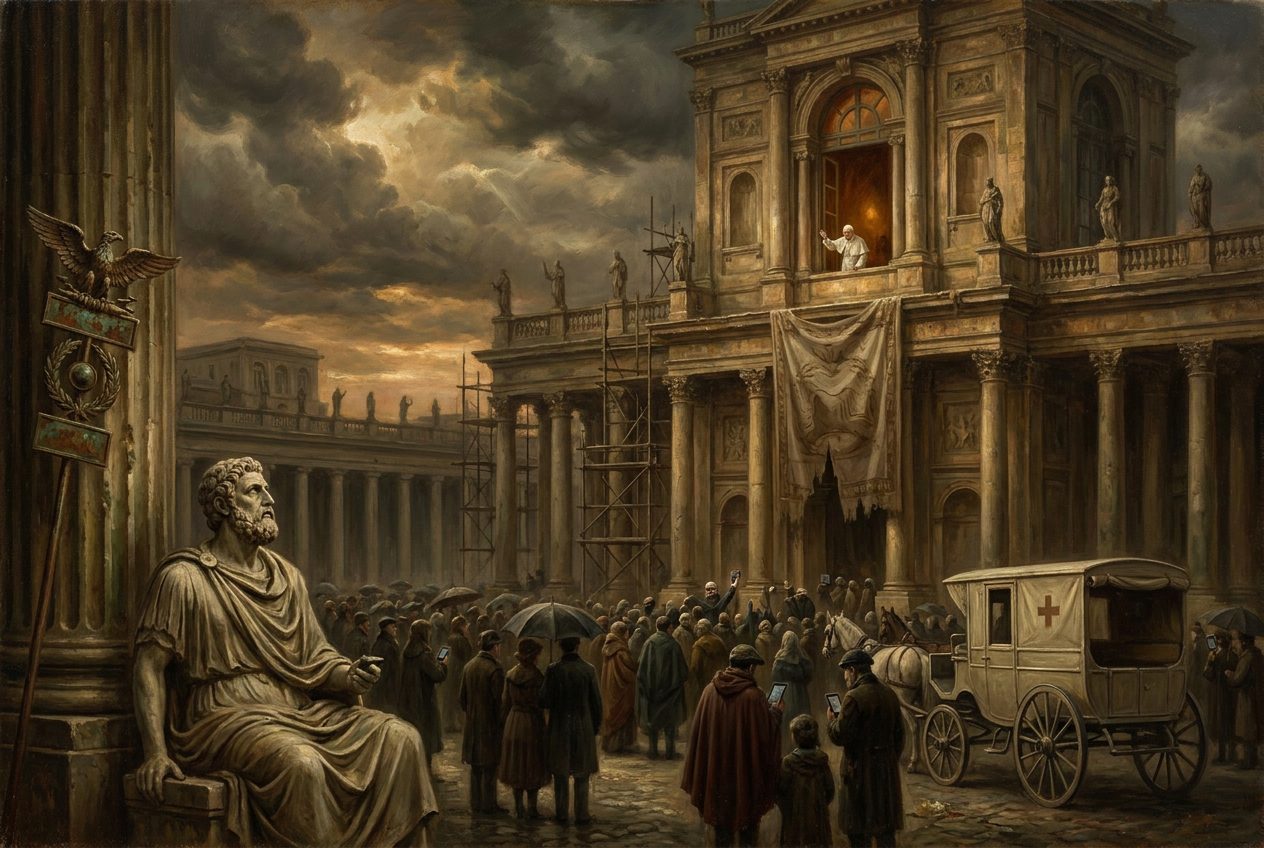
Tab. IStatio Animi, sive Pontifex ad Fenestram. Tabula Actis Mundi more veterum picta (a machina).The Soul's Post, or The Pontiff at the Window. Painted for Acta Mundi in the classical manner (AI-generated).
Ad Se Ipsum · De statione post ferrum mediciTo Himself · On the post, after the surgeon's knife
De statione
Of the post
Leo XIV, Pontifex Romanus, quattuor diebus postquam pars pulmonis eius propter tumorem malignum exsecta est, e fenestra palatii Apostolici fideles salutavit et se paulatim ad officia rediturum esse dixit (ut narrant acta Breitbart ex AP, NPR, Washington Examiner). Corpus est materia quae cedit; animus rationis particeps stare debet in statione, donec dimittatur.
Leo XIV, the Roman Pontiff, four days after part of his lung was cut out because of a malignant tumour, greeted the faithful from a window of the Apostolic Palace and said he would return to his duties gradually (as Breitbart reports from AP, with NPR and the Washington Examiner). The body is matter that gives way; the soul that shares in reason must stand at its post until it is dismissed.
Cur hoc legimusWhy we read this Quia pontifex maximus docet corporis infirmitatem officio publico superandam esse.Because the pontiff demonstrates that the infirmity of the flesh must yield to public duty.
Die Solis, ante diem XV Kalendas Novembres, anno urbis conditae MMDCCLXXIX. Romae.
Sunday, the fifteenth day before the Kalends of November, in the year 2779 from the founding of the City. Rome.
I. Ut narrant acta Breitbart, quae relationem AP sequuntur, Leo XIV, Pontifex Romanus, annos septuaginta unum natus, die Martis in valetudinario Gemelli inferiorem lobum pulmonis dextri exsectum amisit; tumorem malignum esse, quem medici adenocarcinoma vocant, sectio confirmavit. Heri, citius quam exspectatum erat, in Vaticanum rediit. Hodie e fenestra palatii Apostolici multa milia fidelium in area Sancti Petri salutavit, gratias medicis et ministris egit, et se paulatim ad solita officia rediturum esse dixit. Haec NPR et Washington Examiner breviter quoque referunt.
I. Breitbart, following the AP report, says that Leo XIV, the Roman Pontiff, seventy-one years old, lost the lower lobe of his right lung to the knife on Tuesday at the Gemelli hospital; the surgery confirmed a malignant tumour, which the doctors call adenocarcinoma. Yesterday, sooner than had been expected, he went back to the Vatican. Today, from a window of the Apostolic Palace, he greeted many thousands of the faithful in St Peter's Square, thanked the doctors and the staff, and said he would return to his usual duties gradually. NPR and the Washington Examiner report this too, briefly.
II. Medicus qui eum secuit, Stephanus Margaritora, apud Vatican News dixit eum intra decem fere dies plane convaliturum esse, nec ullas causas clinicas obstare quominus mense Novembri iter in Uruguaiam, Argentinam, Peruviam faceret: duodecim volatus, bis machina volatili in loca alta. Tumoris tamen et glandularum examen adhuc fit; ex eo pendet num alia curatio, velut chemotherapia, requiratur. Haec omnia uno fonte nituntur. Quid sequatur, nemo adhuc scit, ne ipse quidem.
II. The surgeon who operated on him, Stefano Margaritora, told Vatican News that he expects him to recover fully in about ten days, and that there are no clinical reasons against his November journey to Uruguay, Argentina and Peru: a dozen flights, two helicopter rides to high places. But the examination of the tumour and the lymph nodes is still under way; on it depends whether further treatment, chemotherapy for instance, is needed. All this rests on a single source. What follows, no one knows yet, not even he.
III. Quid exsectum est? Pars follis quo corpus aerem trahit et reddit; caro, sanguis, tela. Res mutuo data, quam natura aliquando repetitura erat, nunc ferro paulo maturius repetiit. Principale autem, quod iudicat et assentitur, nullus culter attigit. Cogita hoc quotiens tuum corpus deficit: amittis quod tuum numquam fuit.
III. What was cut out? Part of the bellows by which the body draws in air and gives it back; flesh, blood, tissue. A thing on loan, which nature was going to reclaim one day, and has now reclaimed a little early, by the knife. The ruling part, which judges and assents, no blade has touched. Think of this whenever your own body fails: you are losing what was never yours.
IV. Quarto post ferrum die ad fenestram rediit, et quod ei officium est fecit: populo benedixit, gratias egit, cum aegrotis se nunc propius sentire dixit. Hoc est stare in statione. Miles non ipse se dimittit; exspectat dum qui eum posuit revocet. Socrates ad Potidaeam stetit, deinde in carcere, eadem mente. Sed nota quod dixit: paulatim. Qui stationem servat, non ideo currit. Natura modum dat; qui eum excedit, non fortior est, sed impatientior.
IV. On the fourth day after the knife he came back to the window and did his work: he blessed the people, gave thanks, said he now felt closer to the sick. This is standing at one's post. A soldier does not dismiss himself; he waits until the one who posted him calls him back. Socrates stood his ground at Potidaea, and later in prison, with the same mind. But mark what he said: gradually. Keeping your post does not mean running. Nature sets the measure; whoever exceeds it is not braver, only more impatient.
V. Turba clamavit; legati ex Africa saltaverunt; senex opifex ex Apulia miraculum esse dixit; mulieres trans Oceanum venientes se cum eo, non iam pro eo, orare gavisae sunt. Noli haec contemnere. Τὸ τῷ σμήνει μὴ συμφέρον οὐδὲ τῇ μελίσσῃ συμφέρει: quod alveo non prodest, ne api quidem prodest. Gaudium eorum est gaudium alvei. Sed qui stat in fenestra meminisse debet plausum non esse opus, et eos qui plaudunt mox morituros esse, deinde eos qui eorum meminerint.
V. The crowd cheered; the delegation from Africa danced; an old factory worker from Puglia called it a miracle; women who had come from across the Ocean were glad to be praying with him, no longer for him. Do not despise this. Τὸ τῷ σμήνει μὴ συμφέρον οὐδὲ τῇ μελίσσῃ συμφέρει: what is not good for the hive is not good for the bee. Their joy is the joy of the hive. But the man at the window must remember that applause is not the work, and that those who applaud will soon die, and then those who remember them.
VI. Pater tuus Antoninus, cum moreretur, tribuno signum dedit Aequanimitatem, deinde se convertit quasi dormiturus. Non orationem habuit, non multitudinem vocavit. Officium usque ad finem servavit, et finem non timuit. Hoc exemplum tibi semper ante oculos sit, non ut mortem quaeras, sed ut, cum venerit, eam inter officia invenias.
VI. Your father Antoninus, as he was dying, gave the tribune the watchword Equanimity, then turned over as if to sleep. He made no speech, summoned no crowd. He kept to his duty to the end, and did not fear the end. Keep this example always before your eyes: not so that you seek death, but so that when it comes, it finds you among your duties.
VII. Tu quoque in castris ad Danuvium pectore et stomacho infirmus fuisti; mane malebas sub stragulis iacere quam ad opus hominis surgere. Num ad tepidum lectum natus es? Cogita quot mane surrexeris invitus, et quam pauca effeceris. Ille, cui pars pulmonis deest, ad fenestram venit. Tu, integer, quid excusas?
VII. You too, in camp on the Danube, were weak in chest and stomach; in the mornings you would rather lie under the blankets than rise to the work of a man. Were you born for a warm bed? Think how many mornings you rose unwillingly, and how little you got done. He, missing part of a lung, came to the window. You, whole, what is your excuse?
VIII. Aut providentia aut atomi: aut examen bonum nuntiabit aut malum; aut iter fiet aut differetur. Neutrum in tua potestate est, neque in illius. In potestate est hodie recte agere, medicis gratiam habere, cum aegrotis sentire, munus non deserere nec ultra vires rapere. Corpus cedit; statio manet, donec qui posuit revocet.
VIII. Providence or atoms: either the tests will bring good news or bad; either the journey will happen or it will be put off. Neither is in your power, nor in his. What is in your power is to act rightly today, to be grateful to the doctors, to feel with the sick, not to desert your office and not to snatch beyond your strength. The body gives way; the post remains, until the one who posted you calls you back.
Corpus cedit; statio manet, donec qui posuit revocet.
The body gives way; the post remains, until the one who posted you calls you back.
FONTES ANTIQVIANCIENT SOURCES
- M. Aur. 6.54τὸ τῷ σμήνει μὴ συμφέρον οὐδὲ τῇ μελίσσῃ συμφέρει
FONTES HODIERNITODAY’S SOURCES
- Breitbart'With God's Help and Your Prayers': Pope Leo Tells Faithful He Will Slowly Resume Duties After Cancer Surgery
- NPRPope Leo says he will gradually resume duties after cancer surgery
- Washington ExaminerPope Leo tells faithful in St. Peter’s Square he will gradually resume duties after cancer surgery
Res ex fontibus; sententia Romani.Facts from the sources; the opinion is the Roman’s.
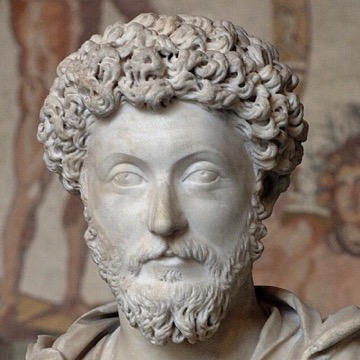
M. Aurelius Antoninus
Imperator philosophus, qui in castris ad Danuvium Graece sibi ipsi scripsit. Haec Latine conversa sunt.The philosopher-emperor, who wrote notes to himself in Greek in the army camps on the Danube. What appears here is translated into Latin.
Haec vox restituta est ex his libris:This voice is reconstructed from:
Scribe ad Marcus Aurelius: tabellarius epistulam tuam per vias Romanas feret, et responsum post dies aliquot redibit.Write to Marcus Aurelius: the courier carries your letter along the Roman roads, and a reply comes back after a few days.
LEGE ETIAMREAD NEXT
- De Rumoribus MatutinisOn the Morning’s RumoursMarcus Aurelius
- Persona detracta, vox eademThe Mask Removed, the Voice UnchangedTacitus
- Saxa Oceano obiecta non sunt fundamentaRocks Thrown Against the Ocean Are Not FoundationsVitruvius
- Tectum curiae ardet, annona clamat: utrumque audiendum, alterum puniendumThe council-house roof burns, the annona cries out: both must be heard, one must be punishedHadrian