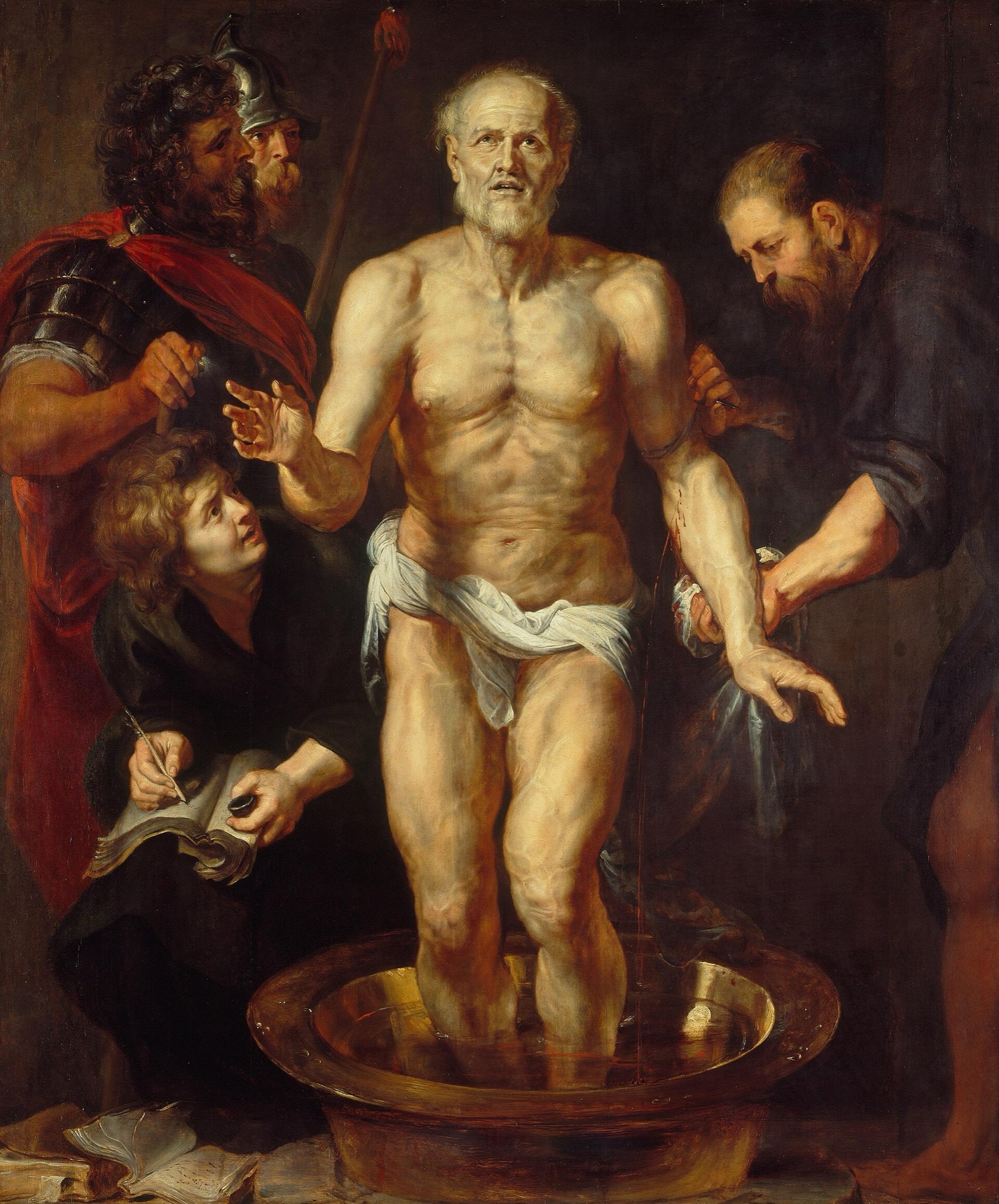
Tab. IPetrus Paulus Rubens, Seneca moriens (c. MDCXV).Peter Paul Rubens, The Dying Seneca (c. 1615).
Sermones · De homine novoConversations · On the New Man
Hominem novum decreto fingere: figulus qui lutum suum oblitus est
Making a New Man by Decree: the Potter Who Forgot His Clay
Iohannes-Christianus Petitfils, historicus regum Borboniorum, in actis Valeurs actuelles disserit Revolutionem Gallicam sibi opus esse duxisse hominem novum fingere, et regis Ludovici XVI reformationem fiscalem a privilegio munitis ordinibus impeditam esse. Flaccus ridet; tamen utrosque, et avaros et fabricatores hominum, eadem regula metitur.
Jean-Christian Petitfils, historian of the Bourbon kings, argues in Valeurs actuelles that the French Revolution felt it needed to create a 'new man', and that Louis XVI's fiscal reform was blocked by the orders shielded by privilege. Flaccus laughs; but he measures both, the misers and the manufacturers of men, by the same rule.
Cur hoc legimusWhy we read this Quia nemo umquam hominem novum legibus creavit, cum natura antiqua semper recurrat.Because no one has ever fashioned a new man by decree, since ancient nature will always return.
Die Saturni, ante diem VII Idus Novembres, legebam in actis Gallicis quae Valeurs actuelles inscribuntur colloquium cum Iohanne-Christiano Petitfils, historico qui reges Borbonios ab Henrico IV usque ad Ludovicum XVI libris prosecutus est. Ait ille, ut titulus ipse nuntiat, Revolutionem Gallicam sensisse sibi opus esse hominem novum creare. Risi primum, fateor. Nam apud nos homo novus est qui sine imaginibus in atrio, suffragiis et labore, ad consulatum ascendit, ut Marius, ut Cicero; illi vero hominem novum non comitiis sed decretis fabricari volebant, tamquam figulus qui ex luto quod libuit urceum ducit.
On Saturday, the seventh day before the Ides of November, I was reading in the French paper called Valeurs actuelles an interview with Jean-Christian Petitfils, a historian who has followed the Bourbon kings through his books from Henri IV to Louis XVI. He says, as the headline itself announces, that the French Revolution felt it needed to create a new man. I laughed at first, I confess. With us a new man is one who climbs to the consulship without ancestral masks in his atrium, by votes and by labour, like Marius, like Cicero; they wanted to manufacture their new man not in the assembly but by decree, like a potter who draws whatever jug he pleases out of the clay.
Res autem ab historico narratae non ridiculae sunt. Regem Ludovicum dicit tectum quidem fuisse, timidum, interdum dubium, sed intellegentem, eruditum, officii sui conscium, neque eum fuisse principem sine voluntate quem pingunt. Eundem iam annis MDCCLXXXVI et MDCCLXXXVII, Calonne fisci curatore adhibito, privilegia tributorum tollere et tributum soli omnibus commune imponere conatum esse. Restitisse vero duos ordines privilegio munitos, clerum et nobilitatem, primum in conventu notabilium, qui mensibus Februario et Martio anni MDCCLXXXVII habitus est, deinde in Parlamentis; eamque repugnantiam, ut ait, ultimam veteris regni ruinam maturavisse.
The facts the historian relates, though, are no laughing matter. King Louis, he says, was secretive, timid, sometimes indecisive, but intelligent, educated and conscious of his duty, and not the prince without a will that people paint. As early as 1786 and 1787, with Calonne at the head of the finances, the same king tried to abolish the tax privileges and impose a land tax common to all. The two orders shielded by privilege, the clergy and the nobility, resisted: first in the Assembly of Notables, held in February and March of 1787, then in the Parlements; and that resistance, he says, hastened the final ruin of the old kingdom.
Quid tu, inquis, Flacce? Nonne avaritia divitum regnum evertit, non clubi philosophantium? Concedo, amice, et libenter. Qui nummum suum pluris facit quam patriam, is domum suam incendit ut sibi frigus pellat. Sed audi reliqua. Negat Petitfils populum illum revolutionarium rem unam et sibi similem fuisse; paucorum manus actuosas fuisse dicit, clubos, societates cogitationis, circulos, academias, consociationes patrioticas, loggias latomorum, quae opiniones fabricarent ac deinde pro voluntate generali imponerent. Cochin, quem laudat, id machinam quandam appellasse; societatem veram, ex hominibus variis compositam, paulatim a societate abstracta, quae populi nomine loqueretur, submotam esse; ab anno MDCCXCIII Iacobinos solos se voluntatem populi esse professos.
What now, Flaccus, you say? Wasn't it the greed of the rich that brought the kingdom down, not the clubs of philosophers? Granted, my friend, and gladly. The man who values his coin above his country sets fire to his house to keep out the cold. But hear the rest. Petitfils denies that the revolutionary people was one uniform thing; he says it was active minorities, clubs, societies of thought, circles, academies, patriotic associations, Masonic lodges, which manufactured opinions and then imposed them as the general will. Cochin, whom he praises, called this a kind of machine; the real society, made of varied men, was gradually pushed aside by an abstract society that spoke in the people's name; and from 1793 the Jacobins alone claimed to be the will of the people.
Haec ego non e libris didici. Clodii collegia memini, quae in vicis paucorum clamorem pro populo Romano venditabant; et sodalicia, quae lege sublata sunt quia suffragia pro civibus ferebant. Populus noster in tribubus et centuriis, ordine et loco suo, suffragium fert; qui in taberna clamat, populus non est, etiam si clamat bene. Et me ipsum memini, iuvenem Athenis philosophia ebrium, qui sub Bruto tribunus putabam libertatem uno ictu et pulchris verbis refici posse. Philippis didici quam celeriter sententiae elegantes in fugam vertantur; parmulam reliqui, non bene, et sapientiam inveni.
I did not learn this from books. I remember Clodius' gangs, which hawked the shouting of a few in the back streets as the voice of the Roman people; and the electoral clubs, abolished by law because they cast votes in the citizens' place. Our people votes in its tribes and centuries, each in his rank and place; the man who shouts in a tavern is not the people, even if he shouts well. And I remember myself, a young man drunk on philosophy at Athens, a tribune under Brutus, who thought liberty could be restored at a stroke and with fine words. At Philippi I learned how quickly elegant opinions turn to flight; I left my little shield behind, not well, and found wisdom.
Nam hoc est quod novorum hominum fabricatores semper obliviscuntur: naturam, etiam si furca expellas, tamen usque recurrere, quod Fusco meo olim scripsi. Decernas licet hominem ex hodierno die novum esse; cras mane surget idem, agrum suum amans, filios suos patriae praeferens, nummos in arca numerans, vicino invidens, deos patrios in angulo colens. Lex quae naturae repugnat non hominem mutat, sed legum latorem ridiculum reddit, deinde, cum risus non sufficit, crudelem.
For this is what the manufacturers of new men always forget: drive nature out with a pitchfork, and she will still come running back, as I once wrote to my Fuscus. Decree, if you like, that from this day man is new; tomorrow morning the same man will get up, loving his field, putting his sons before his country, counting the coins in his strongbox, envying his neighbour, worshipping his fathers' gods in a corner. A law that fights nature does not change the man; it makes the lawgiver ridiculous, and then, when laughter is not enough, cruel.
Lex quae naturae repugnat non hominem mutat, sed legum latorem ridiculum reddit, deinde, cum risus non sufficit, crudelem.
A law that fights nature does not change the man; it makes the lawgiver ridiculous, and then, when laughter is not enough, cruel.
Ridentem dicere verum quid vetat? Est modus in rebus, sunt certi denique fines, quos ultra citraque nequit consistere rectum. Hinc notabiles, qui ne assem quidem communem pendere volebant; illinc clubi, qui hominem totum de integro fingere. Utrique a medio aberrant, et quidem in contrarias partes, sed eodem pervenerunt. Unum tamen desidero in hoc colloquio, nec tacebo: de pretio frumenti, de pane, de annona nihil legitur. Magistratus Romanus, priusquam de machinis ideologicis quaereret, quaesisset quanti panis in foro veniret; nam esuriens facilius a clubo ducitur quam satur.
What forbids a man to tell the truth laughing? There is a measure in things, there are fixed limits, beyond and short of which right cannot stand. On one side the Notables, who would not pay a penny in common; on the other the clubs, who would mould man entire afresh. Both stray from the middle, and in opposite directions, yet they arrived at the same place. One thing, though, I miss in this interview, and I will not keep quiet about it: of the price of grain, of bread, of the annona, not a word. A Roman magistrate, before inquiring into ideological machines, would have asked what bread was selling for in the market; a hungry man is more easily led by a club than a fed one.
Remedium vetus est neque mihi novum. Pater meus, libertinus, me non praeceptis abstractis sed exemplis docebat: vide illum prodigum, vide illum avarum, cave ne fias similis. Ita civis fit, non ita fabricatur. Qui rem publicam reficere volunt, primum divites suam partem pendere cogant, priusquam pauperibus disciplinam praedicent; deinde templa et domus et iuventutem paulatim restituant, non hominem demoliantur. Galli, quos his ipsis mensibus de pretio vitae in viis clamantes audivimus, hoc fortasse melius norunt quam philosophi sui.
The remedy is old, and not new to me. My father, a freedman, taught me not by abstract precepts but by examples: look at that spendthrift, look at that miser, take care you don't become like them. That is how a citizen is made; that is not how he is manufactured. Those who wish to repair the commonwealth should first make the rich pay their share before they preach discipline to the poor; then restore, little by little, the temples and the households and the young, rather than demolish the man. The Gauls, whom we have heard shouting in the streets these very months about the cost of living, perhaps know this better than their philosophers.
Hominem novum facere voluerunt; veterem invenerunt, eundemque paulo esurientiorem.
They wanted to make a new man; they found the old one, and a little hungrier.
FONTES ANTIQVIANCIENT SOURCES
- Hor. Sat. I.1.24–25ridentem dicere verum / quid vetat?
- Hor. Sat. I.1.106–107Est modus in rebus, sunt certi denique fines, / quos ultra citraque nequit consistere rectum
FONTES HODIERNITODAY’S SOURCES
- Valeurs actuellesJean-Christian Petitfils : « La Révolution a ressenti le besoin de créer un “homme nouveau” »
Res ex fontibus; sententia Romani.Facts from the sources; the opinion is the Roman’s.
Scribe ad Horace: tabellarius epistulam tuam per vias Romanas feret, et responsum post dies aliquot redibit.Write to Horace: the courier carries your letter along the Roman roads, and a reply comes back after a few days.
LEGE ETIAMREAD NEXT
- Vestis quae omnibus convenit, nemini convenitA Garment That Fits Everyone Fits No OneHorace
- Luscus inter caecos rexThe One-Eyed King Among the BlindHorace
- De commeatu aërio ex castris Mildenhall in Germaniam et Hispaniam translatoOn the air supply train moved from the camp at Mildenhall to Germany and SpainCaesar
- Ieiunium non est temperantiaFasting Is Not TemperanceFrontinus
- Harenam in thesaurum vertit ingenium; thesaurum unius hominis custodia tueturGenius turns sand into treasure; one man's keeping guards the treasurePliny the Elder