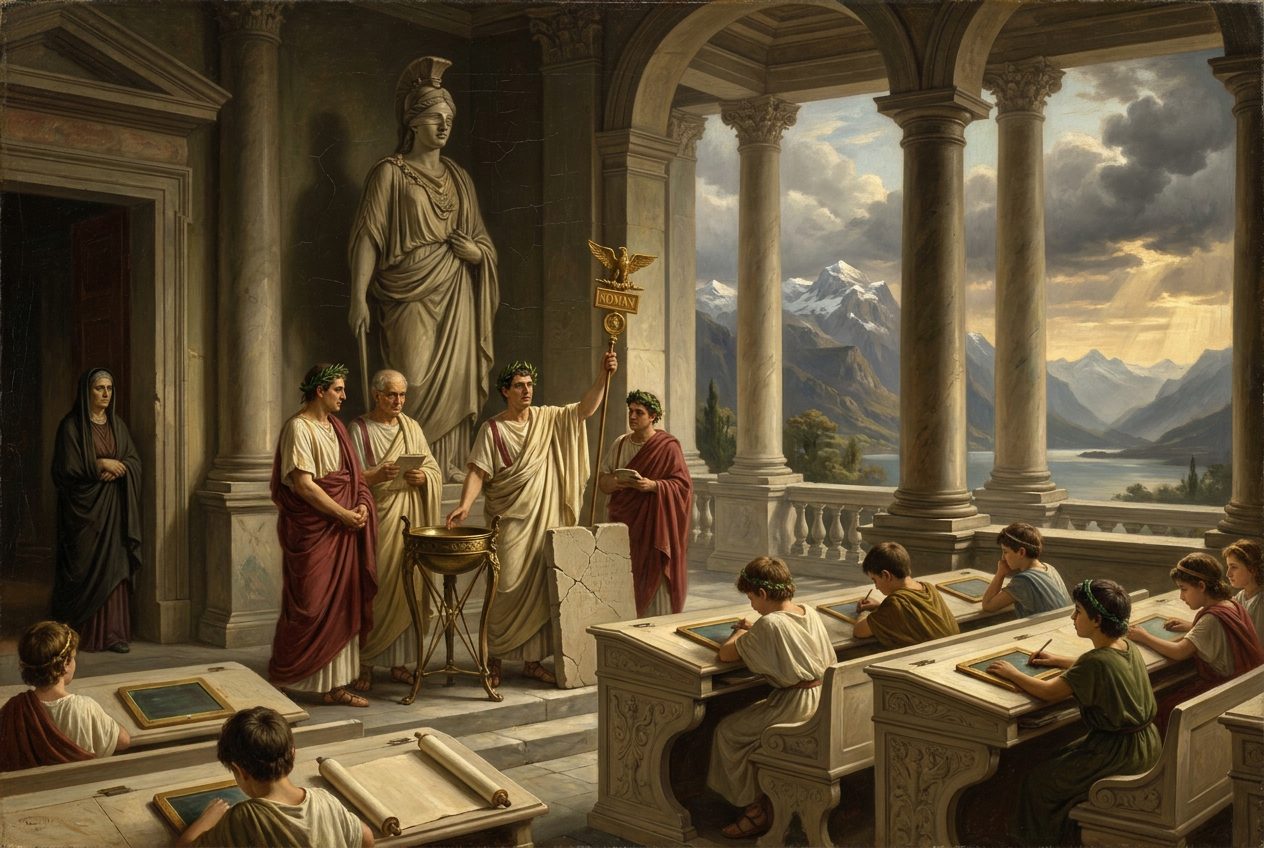
Tab. ILuscus Inter Caecos, sive Triumphus de Mediocritate. Tabula Actis Mundi more veterum picta (a machina).The One-Eyed Among the Blind, or A Triumph Over the Average. Painted for Acta Mundi in the classical manner (AI-generated).
Sermones · De scholis HelvetiorumConversations · On the Schools of Helvetia
Luscus inter caecos rex
The One-Eyed King Among the Blind
Ut Neue Zürcher Zeitung narrat, pueri Helvetii in examine PISA pessime omnium umquam responderunt, peius etiam quam anno MM, cum magistratus scholarum se tamen supra mediocritatem esse gloriarentur. Horatius quaerit quid sit mediocritas, et cur divites pueri linguam quam domi non audiant nemo cogat discere.
According to the Neue Zürcher Zeitung, Swiss pupils have produced their worst PISA results ever, worse even than in 2000, while the school authorities boasted that they stand above the average. Horace asks what the average is, and why no one makes the children of the rich, or children who never hear it at home, learn the language of the country.
Cur hoc legimusWhy we read this Quia divitiis corrupta iuventus laborem fugit, unde omnis reipublicae virtus intercidit.Because youth corrupted by riches flees toil, whence all the commonwealth's virtue perishes.
Die Veneris, ante diem XVII Kalendas Novembres. Amicus mihi in porticu acta ostendit et ridet. «Lege», inquit, «Helvetios, gentem frugi et modestam, de se ipsis triumphum agere.» Lego. Ut Neue Zürcher Zeitung narrat, pueri Helvetii in examine quod PISA vocant pessime omnium umquam responderunt, peius etiam quam anno MM. Conventus tamen praefectorum scholarum, quos cantones creant, mense Septembri renuntiavit iuvenes iterum bene vel optime respondisse, in mathematicis, in legendo, in rerum natura longe supra mediocritatem civitatum OECD esse, Helvetiam inter primas gentes manere.
Friday, the seventeenth day before the Kalends of November. A friend shows me the gazette in the portico and laughs. "Read this," he says. "The Swiss, that thrifty and modest people, are holding a triumph over themselves." I read. According to the Neue Zürcher Zeitung, Swiss pupils in the examination they call PISA have done worse than ever before, worse even than in 2000. Yet in September the conference of school directors appointed by the cantons announced that the young had once again done well or very well, that in mathematics, reading and the natural sciences they stood well above the OECD average, and that Switzerland remained among the leading nations.
Neque solus ille conventus plausit. Collegium magistrorum quod per totam Helvetiam patet, eodem auctore, mediam rationem laudare maluit; diurnarii paucos dies rem tractaverunt, deinde ad quaestionem graviorem scilicet redierunt, num lingua Gallica serius in scholis tradita concordiam gentis periclitetur. Interea, ut eadem acta referunt, sexaginta quinque tantum ex centenis discipulis ad infimum gradum peritiae in mathematicis, in rerum natura, in legendo perveniunt. Ceteri, plus quam tertia pars, ne illum quidem attingunt. Scriptor ille Turicensis vetus proverbium adhibet: inter caecos luscum regnare.
Nor was that conference alone in applauding. The national association of teachers, on the same authority, preferred to praise the average; the journalists handled the matter for a few days and then went back to the weightier question, of course, whether teaching French later in school endangers the concord of the nation. Meanwhile, as the same paper reports, only sixty-five per cent of pupils reach the minimum level of competence in mathematics, the sciences and reading. The rest, more than a third, do not even reach that. The Zurich writer reaches for the old proverb: among the blind, the one-eyed man is king.
Causas quoque affert, quas ut ipsius sententiam refero, non ut rem compertam; unus enim scriptor est, una acta, nec quisquam magistrorum aut parentum respondet. Post annum MM, ut ait, Helvetii perterriti multa decreverunt, et numeri meliores facti sunt; at Stefanum Wolter, rerum scholasticarum peritum, demonstrasse eam laudem maxime liberis advenarum bene eruditorum deberi, qui foedere de libero commeatu hominum venissent. Nunc infimam quartam partem discipulorum miserrime respondere, in qua multi sint ex familiis tenuibus, quae domi nullam linguam patriae loquantur; et studium Universitatis Basiliensis invenisse septuaginta ex centenis infantibus quibus lingua Germanica non sit materna auxilio sermonis egere, cum primum ludum ingrediantur.
He also offers causes, which I report as his opinion and not as established fact; for this is one writer in one paper, and no teacher or parent answers him. After 2000, he says, the frightened Swiss passed a great many measures, and the numbers improved; but the education economist Stefan Wolter showed that the credit belonged chiefly to the children of well-educated foreigners who had come under the agreement on the free movement of persons. Now, he says, the bottom quarter of pupils does miserably, and many of them come from poor families who speak none of the country's languages at home; and a study by the University of Basel found that seventy per cent of children whose mother tongue is not German need language support when they first enter school.
Quid hinc colligam? Primum de mediocritate, quam ego, si quis alius, amo. «Est modus in rebus, sunt certi denique fines, quos ultra citraque nequit consistere rectum.» Modus est mensura recti, non media turba vicinorum. Avarum olim irrisi, qui se pauperem putabat quia vicinus plus haberet; hi praefecti fabulam meam inverterunt et se divites putant quia vicini minus habent. Ita qui supra mediam rationem stat, si ratio ipsa cadit, nihil aliud quam cum ceteris cadit, sed paulo altius.
What am I to make of this? First, something about the mean, which I love if any man does. "There is a measure in things; there are, in short, fixed limits, beyond which and short of which the right cannot stand." The mean is the measure of what is right, not the middle of the neighbours' crowd. I once laughed at the miser who thought himself poor because his neighbour had more; these directors have turned my fable inside out and think themselves rich because their neighbours have less. So the man who stands above the average, when the average itself is falling, merely falls with everyone else, only from a little higher up.
Modus est mensura recti, non media turba vicinorum.
The mean is the measure of what is right, not the middle of the neighbours' crowd.
Deinde de pueris. Ego, libertino patre natus, Venusinus, linguam urbanam non in cunis didici. Pater meus, homo tenuis, noluit me in ludum municipalem mitti, ubi centurionum filii tabulas lacerto suspensas gestabant; Romam me duxit, ad magistros ipse comitatus est, custos incorruptissimus, et quod bene aut male fieret exemplis vicinorum monstrabat. Lingua discitur labore, non natura. Quod septuaginta ex centenis auxilio egent, id non est infantium crimen sed officium scholae; et schola quae id officium non exigit, quae infimos numeros in angulo relationis abscondit, nec advenis nec civibus fidem praestat.
Next, the children. I, a freedman's son from Venusia, did not learn the speech of the city in my cradle. My father, a man of small means, would not send me to the local school, where the centurions' sons went with their tablets slung over their arms; he took me to Rome and walked me to my teachers himself, the most incorruptible of guardians, and showed me what was done well or badly by the examples of the neighbours. A language is learned by labour, not by nature. That seventy per cent need help is no fault of the children but a duty of the school; and a school that does not exact that duty, that hides the worst figures in a corner of its report, keeps faith neither with the newcomers nor with the citizens.
Sed acta Turicensia aliud quoque vitium nominant, quod editori meo carius est: odium laboris inter divites. Hoc ego facile credo. Paupertas puerum ad libros cogit; opulentia blanditur, excusat, omnia molliter sternit. Patrem meum, si quis in mensa nummos numerasset, aliud dixisse puto. Vereor ne vetus meum carmen Helvetiis vaticinatum sit: «aetas parentum peior avis tulit nos nequiores, mox daturos progeniem vitiosiorem.»
But the Zurich paper names another vice too, one dearer to my editor: the hatred of effort among the rich. This I readily believe. Poverty drives a boy to his books; wealth flatters him, excuses him, smooths every path beneath him. My father, had anyone sat counting coins at his table, would have said something else, I think. I fear my old ode may have been a prophecy for the Swiss: "Our parents' age, worse than our grandfathers', bore us, more worthless still, soon to bring forth offspring more vicious yet."
Remedium in promptu est, neque novum. Lingua patriae ante omnia, primo die, omni puero, sine indulgentia et sine contumelia doceatur; examinetur verum, non medium; magistratus qui se laudant tertiam illam partem nominatim recitent, antequam de lingua Gallica disputent. Plagosum Orbilium non posco, cuius ferulam adhuc sentio; posco magistrum qui non aduletur. Ridentem dicere verum quid vetat? Luscus inter caecos rex est; at luscus qui oculum suum laudat, dum eum claudit, mox caecis par erit.
The remedy is ready to hand, and it is not new. Let the language of the country be taught before all else, from the first day, to every child, without indulgence and without contempt; let the truth be examined, not the average; and let the magistrates who praise themselves read out that third by name before they argue about French. I do not ask for Orbilius and his rod, which I can still feel; I ask for a teacher who does not flatter. What forbids a man to tell the truth laughing? The one-eyed man is king among the blind; but the one-eyed man who praises his eye while keeping it shut will soon be the equal of the blind.
FONTES ANTIQVIANCIENT SOURCES
- Hor. Sat. I.1.106–107Est modus in rebus, sunt certi denique fines, / quos ultra citraque nequit consistere rectum
- Hor. Carm. III.6.46–48aetas parentum peior avis tulit / nos nequiores, mox daturos / progeniem vitiosiorem
- Hor. Sat. I.1.24–25ridentem dicere verum / quid vetat?
FONTES HODIERNITODAY’S SOURCES
- Neue Zürcher ZeitungKOMMENTAR - Der brutale Absturz der Wohlstandsverwöhnten. Noch nie hatte die Schweiz so schlechte Schüler. Warum stört das niemanden?
Res ex fontibus; sententia Romani.Facts from the sources; the opinion is the Roman’s.
Scribe ad Horace: tabellarius epistulam tuam per vias Romanas feret, et responsum post dies aliquot redibit.Write to Horace: the courier carries your letter along the Roman roads, and a reply comes back after a few days.
LEGE ETIAMREAD NEXT
- Caput fluit, ductus deficitThe source flows; the conduit failsFrontinus
- De civitate non ad arbitrium factionis eripiendaThat Citizenship Must Not Be Snatched Away at a Faction's PleasureCicero
- Qui petit, iam cliens est: de aerario Galliae et foedere BruxellensiHe Who Petitions Is Already a Client: On the Treasury of Gaul and the Treaty of BrusselsSymmachus