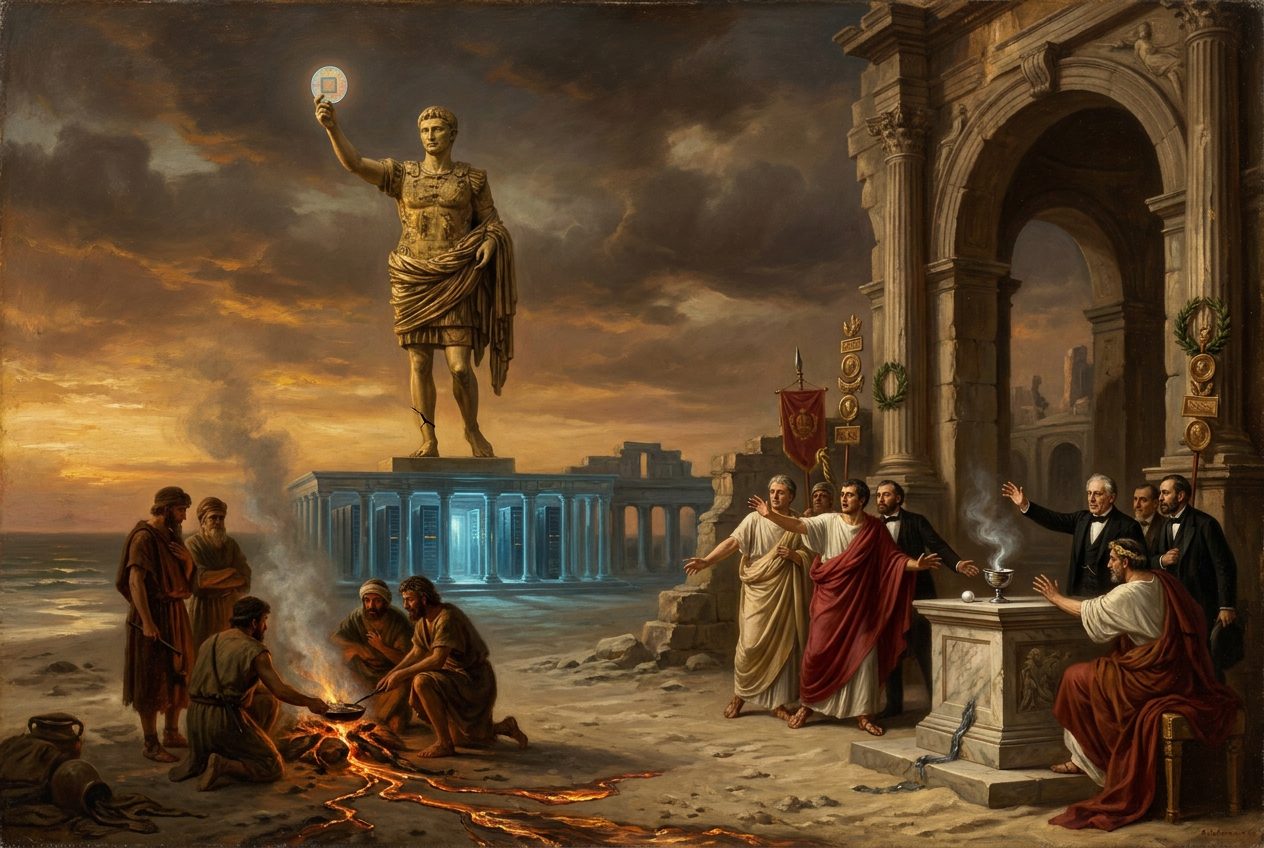
Tab. IHarena in Thesaurum, sive Colossus Pedibus Fragilibus. Tabula Actis Mundi more veterum picta (a machina).Sand into Treasure, or The Colossus on Fragile Feet. Painted for Acta Mundi in the classical manner (AI-generated).
Naturalis Historia · Liber XXXVIII, caput I: De silice cogitante et de custodia eiusNatural History · Book XXXVIII, Chapter I: On the Thinking Stone and Its Keeping
Harenam in thesaurum vertit ingenium; thesaurum unius hominis custodia tuetur
Genius turns sand into treasure; one man's keeping guards the treasure
Ut acta Gallica Le Figaro et Euronews nuntiant, Iensen Huang, praepositus societatis Nvidia, consuetudinem cum negotiatrice Sinensi, quam speculatricem Pechinensem esse suspicantur, confessus est; senatus societatis inquisitionem instituit, et partes eius quinque ex centenis ceciderunt. Ego quaero quam fragilis sit opulentia quae ex harena nata uni homini innititur.
As the French paper Le Figaro and Euronews report, Jensen Huang, head of the company Nvidia, has confessed to an affair with a Chinese businesswoman suspected of spying for Beijing; the company's board has opened an inquiry, and its shares fell five per cent. I ask how fragile a fortune is that was born of sand and rests upon a single man.
Cur hoc legimusWhy we read this Quia opes orbis et subtilissimae rationum machinae in levi vitio unius opificis trepidant.Because the wealth of the world and the subtlest engines of calculation tremble upon the petty vice of a single maker.
Die Martis, ante diem IV Idus Novembres. Rem novam et nostrae memoriae dignam ex terris trans Oceanum affero. Iensen Huang, praepositus atque unus ex conditoribus societatis Californiensis Nvidia, cuius laminae siliceae machinas intellegentiae artificialis cogitare docent, diebus Saturni et Solis in commentario ad suos misso confessus est se consuetudinem extra matrimonium habuisse cum muliere Sinensi, negotiorum principe, quam suspicantur speculatricem Pechino conductam esse. Uxori se infidelem fuisse, nihil id quod fecisset excusare, se vehementer dolere scripsit, ac totam culpam et omnem quae inde oriretur reprehensionem suscepturum. Ita refert Le Figaro, qui addit societatem, cum per aliquot dies rumor serperet, primo negavisse.
Tuesday, the fourth day before the Ides of November. I bring from the lands across the Ocean something new and worth our remembering. Jensen Huang, head and one of the founders of the Californian company Nvidia, whose silicon wafers teach the machines of artificial intelligence to think, confessed over Saturday and Sunday, in a memorandum sent to his staff, that he had carried on an affair outside his marriage with a Chinese woman, a leader in business, who is suspected of being a spy in Beijing's pay. He wrote that he had been unfaithful to his wife, that nothing excused what he had done, that he was deeply sorry, and that he would take on the whole blame and all the criticism that might follow from it. So reports Le Figaro, which adds that the company, while the rumour crept about for several days, at first denied it.
Euronews autem, cuius verba per nuntios publicos currunt, tradit consilium moderatorum societatis inquisitionem quam vocant independentem instituisse; societatem vero affirmare nullam sibi causam esse cur credat arcana artis suae aut securitatem Americanorum laesa esse. Die Lunae, ante mensas argentariorum apertas, partes societatis circiter quinque ex centenis deciderunt. Dan Ives, rerum aestimator apud Yorkville Ives & Co, Huang paene heroa quendam partium dominis fuisse dixit, quem multi aliter ac ceteros principes negotiorum spectarent. Mulier quae sit, cuius imperio paruerit, quid viderit aut auferre potuerit, neuter auctor dicit.
Euronews, whose words run along the public wires, relates that the company's board of directors has opened what they call an independent investigation; the company, for its part, asserts that it has no reason to believe that the secrets of its craft or the security of the Americans have been compromised. On Monday, before the bankers' tables opened, the company's shares fell about five per cent. Dan Ives, an analyst at Yorkville Ives & Co, said that Huang had been almost a kind of hero to the shareholders, a man whom many regarded differently from other leaders of business. Who the woman is, whose orders she obeyed, what she saw or could have carried off: neither source says.
Prius tamen naturam rei expendamus, ut soleo. In libro de lapidibus narravi, mercatores nitri ad litus fluminis Beli cum ollis sustinendis lapidem non invenissent, glaebas nitri e nave sumpsisse, quibus igne liquefactis cum harena litoris rivos novi liquoris, vitrum dico, fluxisse. Ex eadem harena, purgata et in tenuissimas laminas secta, nunc fiunt instrumenta quae numeros innumerabiles momento computant. Quid magis mirandum? Silex, quo maiores nostri vias sternebant, nunc cogitat, aut certe cogitantem imitatur; et nos, qui de sucino et magnete tot verba fecimus, ne nomen quidem huius artis habebamus.
But first, as is my habit, let us weigh the nature of the thing. In my book on stones I told how merchants of natron, finding no stone on the shore of the river Belus on which to rest their cooking-pots, took lumps of natron from their ship; and when these were melted by the fire with the sand of the beach, streams of a new liquid flowed out: glass, I mean. From that same sand, purified and cut into the thinnest of wafers, are now made instruments that reckon numberless numbers in an instant. What could be more marvellous? The flint with which our ancestors paved their roads now thinks, or at least imitates a thinker; and we, who spent so many words on amber and the lodestone, had not even a name for this art.
Verum audite pretium. Huius tanti operis opes, quae regnorum aerariis aequantur, non lapidi sed homini innituntur. Ipse aestimator, laudans, crimen fatetur: si unus homo heros est, unus homo et ruina esse potest. Commentario uno domestico, non terrae motu, non incendio, non bello, quinque ex centenis evanuerunt. Cleopatra margaritam, maximum orbis pretium, aceto solutam una potione hausit; hic nulla regina, nullum acetum, sed sola fama de homine vacillante tantam pecuniam uno mane dissolvit. Tam levis est fides mensarum, quae deos in hominibus colit.
Now hear the price. The wealth of this vast work, equal to the treasuries of kingdoms, rests not on stone but on a man. The analyst himself, in praising, confesses the fault: if one man is a hero, one man can also be a ruin. By a single domestic memorandum, not by earthquake, not by fire, not by war, five per cent vanished. Cleopatra dissolved a pearl, the costliest thing in the world, in vinegar and drank it off in one draught; here there was no queen and no vinegar, only the rumour of a man tottering, and it dissolved so great a sum in a single morning. So flimsy is the faith of the bankers' tables, which worships gods in the shape of men.
Exemplum quaero non celeberrimum, sed aptissimum. Syracusas unius senis ingenium diu defendit: Archimedis machinae naves Romanas e mari sublatas illidebant, et Marcellus vim apertam frustra temptabat. Urbs tamen capta est, non quod machinae defecerint, sed quod custodes, festo die Dianae epulis vinoque soluti, muros neglexerunt, qua milites nostri scalis ascenderunt. Ipse Archimedes, figuris in pulvere intentus, a milite ignaro occisus est. Opera ingenii immortalia, custodes mortales: hoc semper fuit, hoc est.
I seek an exemplum, not the most famous, but the most apt. For a long time the genius of one old man defended Syracuse: Archimedes' engines lifted Roman ships out of the sea and dashed them down, and Marcellus tried open force in vain. Yet the city was taken, not because the engines failed, but because the guards, slack with feasting and wine on the festival of Diana, neglected the walls where our soldiers climbed up on ladders. Archimedes himself, bent over his figures in the dust, was killed by a soldier who did not know him. The works of genius are immortal, their keepers mortal: so it always was, so it is.
Opera ingenii immortalia, custodes mortales: hoc semper fuit, hoc est.
The works of genius are immortal, their keepers mortal: so it always was, so it is.
Quaeret aliquis, quod L. Cassius «identidem in causis quaerere solebat 'cui bono' fuisset». Aemuli societatis in arte laminarum lucrantur, dum princeps titubat; et si vera sunt quae suspicantur, ii quorum intererat proxime ad cubiculum principis artis Occidentalis accedere. Sed haec suspicio est, non res comperta, et ita servanda. Illud magis miror, quod nuntii tacent: quis inquisitionem illam ducat, an acta eius in lucem proferantur, quamdiu negatum sit quod deinde confessum est. Magistratus Romanus haec prima interrogaret.
Someone will ask what L. Cassius 'was in the habit of asking again and again in trials: who had benefited'. The company's rivals in the craft of wafers profit while its chief stumbles; and, if the suspicions are true, so do those who had an interest in coming as close as possible to the bedchamber of the chief of the West's art. But this is suspicion, not established fact, and must be kept as such. What I wonder at more is what the reports leave unsaid: who is leading that investigation, whether its findings will be brought to light, how long the thing was denied that was afterwards confessed. A Roman magistrate would ask these questions first.
Remedium neque novum neque obscurum. Thesauri artis, quae nunc ad bellum et ad pacem aeque valet, ut limes custodiantur, non ut res privata unius domus; nullum imperium in unius hominis integritate positum sit; inquisitio palam fiat, nomina dicantur, poena aut absolutio publice sequatur. Inventores honoro, nomina eorum in libris meis libenter servo; sed ingenium sine custodia praeda est, non praesidium. Natura harenam dedit, ingenium thesaurum fecit; custodiam neutrum praestat, sed homini relinquitur.
The remedy is neither new nor obscure. Let the treasures of this art, which now serves war and peace alike, be guarded like the frontier, not like the private property of one house; let no power be staked on the integrity of a single man; let the inquiry be held in the open, the names spoken, and punishment or acquittal follow publicly. I honour inventors, and gladly preserve their names in my books; but genius without a guard is plunder, not protection. Nature gave the sand, genius made the treasure; neither supplies the guard, which is left to man.
FONTES ANTIQVIANCIENT SOURCES
- Cic. Rosc. Am. 84identidem in causis quaerere solebat 'cui bono' fuisset
FONTES HODIERNITODAY’S SOURCES
- Le FigaroAffaire Nvidia : pourquoi la liaison de Jensen Huang avec une espionne chinoise pourrait faire vaciller tout le secteur de l’IA
- EuronewsHow could the Jensen Huang 'spy' scandal affect Nvidia's future?
Res ex fontibus; sententia Romani.Facts from the sources; the opinion is the Roman’s.
Scribe ad Pliny the Elder: tabellarius epistulam tuam per vias Romanas feret, et responsum post dies aliquot redibit.Write to Pliny the Elder: the courier carries your letter along the Roman roads, and a reply comes back after a few days.
LEGE ETIAMREAD NEXT
- Venalis cum titulo: servus qui se fugere posse fateturSold with a Placard: The Slave Who Confesses He May RunPliny the Elder
- De volucribus sine nido: Praedatores in caelo Hispaniae se exercentOn Birds Without a Nest: Predators Exercise in the Skies of HispaniaPliny the Elder
- In Viscera TerraeInto the Bowels of the EarthPliny the Elder
- De commeatu aërio ex castris Mildenhall in Germaniam et Hispaniam translatoOn the air supply train moved from the camp at Mildenhall to Germany and SpainCaesar
- Ieiunium non est temperantiaFasting Is Not TemperanceFrontinus