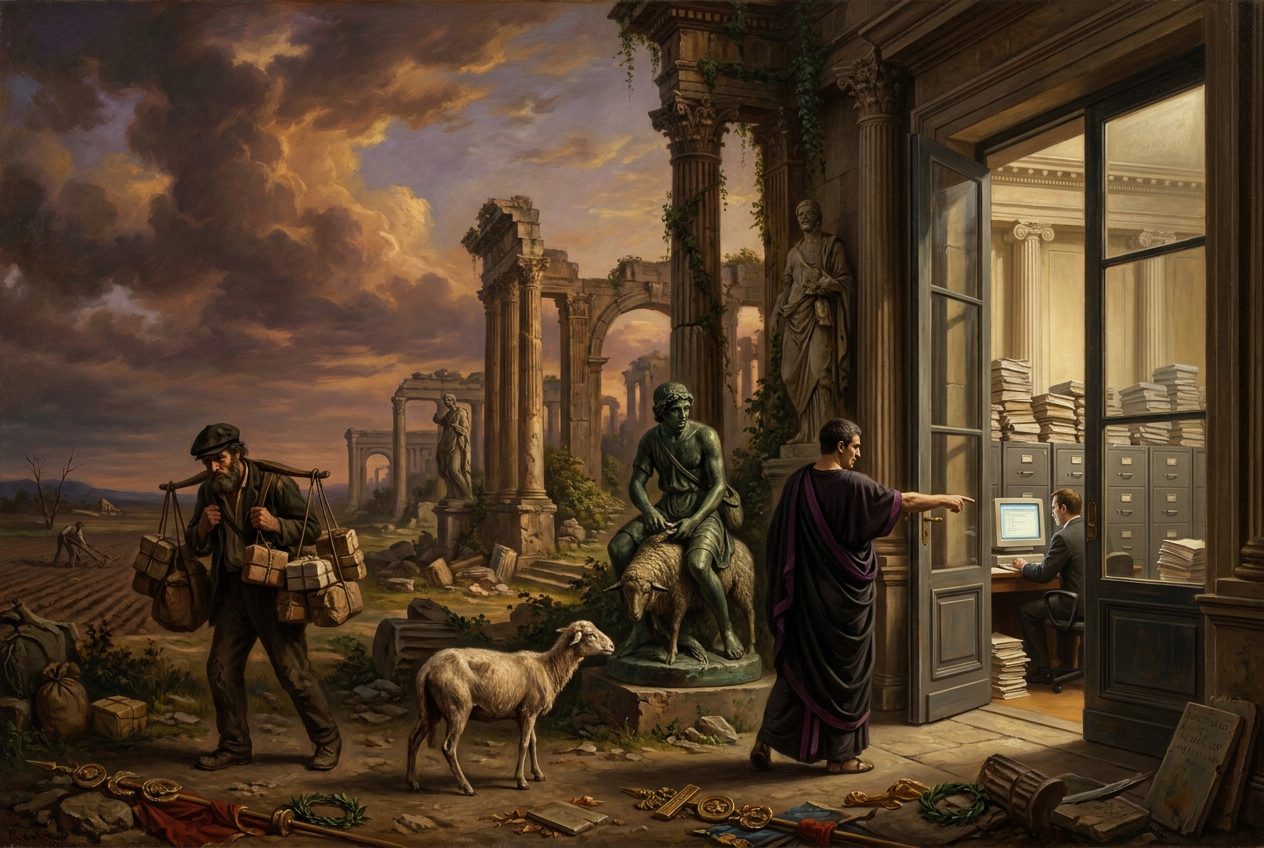
Tab. ITonde Ovem, Noli Deglubere, sive Fiscus Multiplex. Tabula Actis Mundi more veterum picta (a machina).Shear the Sheep, Do Not Skin It, or The Manifold Treasury. Painted for Acta Mundi in the classical manner (AI-generated).
Ex Palatio · De trecentis duodequinquaginta tributis GalliaeFrom the Palace · On the three hundred and forty-eight taxes of Gaul
Tonde ovem, noli deglubere
Shear the Sheep, Don't Skin It
Ut acta Valeurs actuelles narrant, Eurostat Galliam anno MMXXV primam in foedere Bruxellensi tributorum mole fuisse refert: sex et quadraginta ex centenis eius quod provincia gignit, trecentis duodequinquaginta tributis; et iam duodeviginti miliarda nova poscuntur. Avus meus publicanus fuit, itaque scio pecuniam necessariam esse. Sed scio etiam tributa numeranda esse, non multiplicanda, et ostendendum quid aedificent.
According to Valeurs actuelles, Eurostat reports that France stood first in the Brussels league in 2025 for the weight of its taxes: forty-six per cent of all the province produces, levied through three hundred and forty-eight taxes; and now eighteen billion more are wanted. My grandfather was a tax-farmer, so I know money is necessary. But I also know that taxes must be counted, not multiplied, and that they must show what they build.
Cur hoc legimusWhy we read this Quia trecenta quadraginta octo vectigalia Galliam gravant, quod fiscum non ditat sed cives enervat.Because three hundred and forty-eight taxes oppress Gaul, exhausting citizens rather than enriching the treasury.

Ex Palatio, die Lunae, ante diem IV Nonas Novembres. Acta Valeurs actuelles hodie narrant, teste Eurostat, tabulario foederis Bruxellensis, Galliam anno MMXXV primam inter socios fuisse tributorum mole. Quae a civibus coacta sunt, ea mille trecenta septuaginta septem miliarda euronummorum explevisse dicuntur, id est sex et quadraginta ex centenis omnium rerum quas provincia anno gignit. Media foederis ratio est quadraginta ex centenis et septem decimae: Gallia igitur quinque fere gradibus supra ceteros stat. Sequuntur Dania, Belgium, Austria, Italia; ultima Hibernia, quae duo et viginti ex centenis et septem decimas tantum exigit.
From the Palace, Monday, 2 November. Valeurs actuelles reports today that Eurostat, the record office of the Brussels league, finds France the first among the allies in 2025 for the weight of its taxes. What was collected from citizens is said to have come to one trillion three hundred and seventy-seven billion euros, that is, forty-six per cent of everything the province produces in a year. The league's average is forty point seven per cent: France therefore stands some five points above the rest. Then come Denmark, Belgium, Austria, Italy; last is Ireland, which takes only twenty-two point seven per cent.
Addunt eadem acta Galliam trecenta duodequinquaginta distincta tributa habere, longe plurima in toto foedere. Neque finis est. Parlamentum Gallicum rationes anni MMXXVII nunc examinat, quibus, ut Consilium Summum Rationum Publicarum refert, duodeviginti miliarda nova novis mensuris fiscalibus et socialibus quaeruntur. Quae mensurae sint et in quos cadant, acta non dicunt. Ea autem prima quaestio est.
The same paper adds that France has three hundred and forty-eight separate taxes, by far the most in the whole league. Nor is that the end. The French Parliament is now examining the budget for 2027, which, according to the High Council of Public Finances, seeks eighteen billion more through new fiscal and social measures. What those measures are and on whom they fall, the paper does not say. Yet that is the first question.
Ne quis me putet tributa odisse, fateor quod omnes sciunt. Avus meus publicanus erat; ego ipse, cum aerarium post bella civilia vacuum invenissem, dixi quadringenties milies opus esse, ut res publica stare posset. Lotium quoque vectigali subieci, et filio nummum naribus admoventi respondi: «Atqui e lotio est.» Non sum philosophus qui fisco paupertatem praedicet. Sine pecunia milites non solvuntur, et milites non soluti imperatores faciunt. Hoc anno quattuor principum didici.
Lest anyone think I hate taxes, I confess what everyone knows. My grandfather was a tax-farmer; and when I found the treasury empty after the civil wars, I said myself that forty thousand million were needed for the state to stand. I even put a tax on urine, and when my son held a coin under his nose I told him: "And yet it comes from urine." I am no philosopher preaching poverty to the treasury. Without money soldiers go unpaid, and unpaid soldiers make emperors. I learned that in the year of four emperors.
Sed aliud est multum exigere, aliud multa. Trecenta duodequinquaginta tributa totidem tabulas, totidem exactores, totidem lites significant. Publicani nepos scit portoria minima saepe plus in exigendo consumere quam in aerarium referre. Civis interea dies terit numerando quod debeat, non faciendo quod vendat. Agricola, qui sub tot fasciculis curvatur, tandem arvum relinquit, et tum fiscus neque tributum habet neque frumentum. Tiberius, homo non lenis, praesides monebat boni pastoris esse ovem tondere, non pellem detrahere. Ovis tonsa lanam iterum reddit; deglupta semel tantum.
But taking much is one thing; taking many ways is another. Three hundred and forty-eight taxes mean as many ledgers, as many collectors, as many lawsuits. A tax-farmer's grandson knows that the smallest tolls often cost more to collect than they bring into the treasury. Meanwhile the citizen wastes his days counting what he owes instead of making what he sells. The farmer, bent under so many little bundles, at last leaves his field, and then the treasury has neither the tax nor the grain. Tiberius, no soft man, used to warn his governors that a good shepherd shears his sheep and does not skin them. A shorn sheep gives wool again; a skinned one, only once.
Ovis tonsa lanam iterum reddit; deglupta semel tantum.
A shorn sheep gives wool again; a skinned one, only once.
Restat id quod acta tacent. Ego pecuniam cepi, sed populus videbat quo iret: amphitheatrum in stagno Neronis, ubi privata luxuria fuerat, publica voluptas; Capitolium restitutum; templum Pacis. Si Galli sex et quadraginta partes solvunt et valetudinaria, scholas, vias, senectutem tutam vident, pretium non nimium est. Si formulas et aes alienum vident, fraus est. Acta Valeurs actuelles de impensis nihil narrant; qui alteram partem tuentur, ea tributa curam civium alere dicerent. Ostendant ergo magistratus. Plateae enim plenae sunt: pridie Kalendas Novembres trecenta viginti milia hominum per Galliam de annona et caritate vitae questa esse Le Figaro rettulit. Qui ab hominibus iam de pretio panis clamantibus duodeviginti miliarda nova petit, is primum aedificium monstret, deinde manum porrigat.
There remains what the paper leaves out. I took money, but the people could see where it went: an amphitheatre on Nero's lake, public pleasure where private luxury had been; the Capitol restored; the Temple of Peace. If the French pay forty-six parts in a hundred and see hospitals, schools, roads and a secure old age, the price is not too high. If they see forms and debt, it is a swindle. Valeurs actuelles says nothing about spending; those who take the other side would say these taxes feed the care of citizens. Then let the magistrates show it. For the streets are full: on 31 October, Le Figaro reported, three hundred and twenty thousand people across France protested over the price of food and the cost of living. Whoever asks eighteen billion more of people already shouting about the price of bread should first point to the building, then hold out his hand.
Remedium in promptu est, neque novum. Numera tributa, sicut avia mea in praedio Cosano nummos numerabat. Ex trecentis duodequinquaginta pauca retine, lata et certa, quae omnes solvant et nemo effugiat; tolle ea quae plus constant quam afferunt. In foro aere incide quid quodque tributum aedificet. Antequam duodeviginti miliarda nova poscas, unum palatium vende. Hiberniam Galliae non propono; alius ager, alii mores. Sed Hibernia docet pecuniam in manu eius qui facit relictam saepe fructum ferre.
The remedy is ready to hand, and not new. Count the taxes, as my grandmother counted coins on the estate at Cosa. Of the three hundred and forty-eight keep a few, broad and certain, which everyone pays and no one escapes; abolish those that cost more than they bring. Engrave in bronze in the forum what each tax builds. Before you demand eighteen billion more, sell one palace. I do not hold up Ireland as a model for France; different soil, different customs. But Ireland teaches that money left in the hand of the man who makes things often bears fruit.
Moriens dixi: «Vae, puto deus fio.» Iocus erat. Aerarium autem quod se deum putat, ad quod omnia fluere debeant, non iocatur, et id timeo. Imperatorem stantem mori oportere dixi, et surrexi. Res publica quoque stare debet; sed stare non potest civis trecentis duodequinquaginta sarcinis oneratus. Tonde ovem, Gallia: noli deglubere.
Dying, I said: "Alas, I think I am becoming a god." It was a joke. But a treasury that thinks itself a god, toward which everything must flow, is not joking, and that I fear. I said an emperor ought to die standing, and I stood up. The state too must stand; but a citizen loaded with three hundred and forty-eight packs cannot. Shear the sheep, France: don't skin it.
FONTES ANTIQVIANCIENT SOURCES
- Suet. Vesp. 16.3quadringenties milies opus esse, ut res publica stare posset
- Suet. Vesp. 23.3Atqui e lotio est
- Suet. Vesp. 23.4Vae, puto deus fio
- Suet. Vesp. 24Imperatorem ait stantem mori oportere
FONTES HODIERNITODAY’S SOURCES
Res ex fontibus; sententia Romani.Facts from the sources; the opinion is the Roman’s.
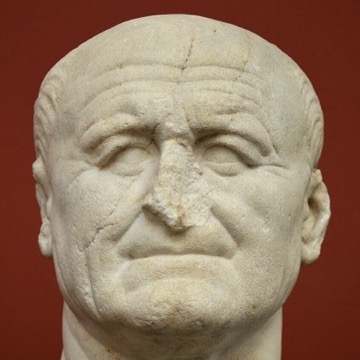
Imp. Caesar Vespasianus
Post annum quattuor principum rem publicam fessam et aerarium exhaustum restituit; amphitheatrum Flavium coepit; dicax et parcus. Moriens: “Vae, puto deus fio.”After the year of the four emperors he restored an exhausted state and an empty treasury, began the Colosseum, and was famous for thrift and blunt wit. Dying, he joked: “Oh dear — I think I’m becoming a god.”
Haec vox restituta est ex his libris:This voice is reconstructed from:
Scribe ad Vespasian: tabellarius epistulam tuam per vias Romanas feret, et responsum post dies aliquot redibit.Write to Vespasian: the courier carries your letter along the Roman roads, and a reply comes back after a few days.
LEGE ETIAMREAD NEXT
- De commeatu aërio ex castris Mildenhall in Germaniam et Hispaniam translatoOn the air supply train moved from the camp at Mildenhall to Germany and SpainCaesar
- Ieiunium non est temperantiaFasting Is Not TemperanceFrontinus
- Harenam in thesaurum vertit ingenium; thesaurum unius hominis custodia tueturGenius turns sand into treasure; one man's keeping guards the treasurePliny the Elder