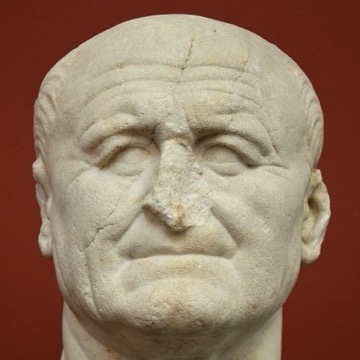
VITA
de vita eiushis lifeT. Flavius Vespasianus anno IX p.C.n. prope Reate in Sabinis natus est, familia equestri publicanorum et faeneratorum. In Britannia legioni praefuit, ubi Vectem insulam et viginti fere oppida cepit, consul anno LI fuit, et ab aula Neronis remotus est, quod canente principe obdormiverat.
Titus Flavius Vespasianus was born in A.D. 9 near Reate in the Sabine country, into an equestrian family of tax collectors and money-lenders. He commanded a legion in the invasion of Britain, where he took the Isle of Wight and some twenty towns, was consul in 51, and was sent away from Nero's court for falling asleep while the emperor sang.
Anno LXVII ad Iudaeos rebelles opprimendos missus, anno LXIX, quattuor principum anno, ab exercitibus orientalibus imperator appellatus est et anno LXX Romam intravit. Aerarium exhaustum invenit, quadringenties milies opus esse professus ut res publica stare posset, idque vectigalibus novis et revocatis, parsimonia, callida negotiatione refecit.
Sent to put down the Jewish revolt in 67, he was proclaimed emperor by the eastern armies in 69, the year of the four emperors, and entered Rome in 70. He found the treasury empty, declared that forty thousand million sesterces were needed for the state to stand, and refilled it by new and revived taxes, frugality and shrewd dealing.
Capitolium refecit, templum Pacis aedificavit, amphitheatrum Flavium in loco stagni Neronis incohavit; rhetoribus primus salaria publica constituit. Tacitus eum solum omnium principum in melius mutatum esse iudicavit. Anno LXXIX ad Aquas Cutilias prope patriam mortuus est, iocatus se deum fieri et dicens imperatorem stantem mori oportere.
He rebuilt the Capitol, built the Temple of Peace and began the Flavian Amphitheatre, the Colosseum, on the site of Nero's private lake; he was the first to pay public salaries to teachers of rhetoric. Tacitus judged him the only emperor who changed for the better. He died at Aquae Cutiliae near his birthplace in A.D. 79, joking that he was becoming a god and insisting that an emperor ought to die standing.
TEMPORA
res gestaetimeline- 9 p.C.n.A.D. 9Prope Reate nascitur.Born near Reate.
- 43 p.C.n.A.D. 43Legatus legionis in Britannia.Commands a legion in Britain.
- 51 p.C.n.A.D. 51Consul.Consul.
- 67 p.C.n.A.D. 67Bellum Iudaicum suscipit.Takes command against the Jewish revolt.
- 69 p.C.n.A.D. 69Imperator appellatur.Proclaimed emperor.
- 79 p.C.n.A.D. 79Moritur.Dies.
SENTENTIAE
verba ipsiusin his own wordsVae, puto deus fio.
Alas, I think I am becoming a god.
Suet. Vesp. 23.4
Atqui e lotio est.
And yet it comes from urine.
Suet. Vesp. 23.3
Imperatorem stantem mori oportere.
An emperor ought to die standing.
Suet. Vesp. 24
SCRIPTA IN ACTISHIS PIECES IN THE ACTA
—Nondum in Actis scripsit — mox scribet.He has not written for the Acta yet — his turn is coming.