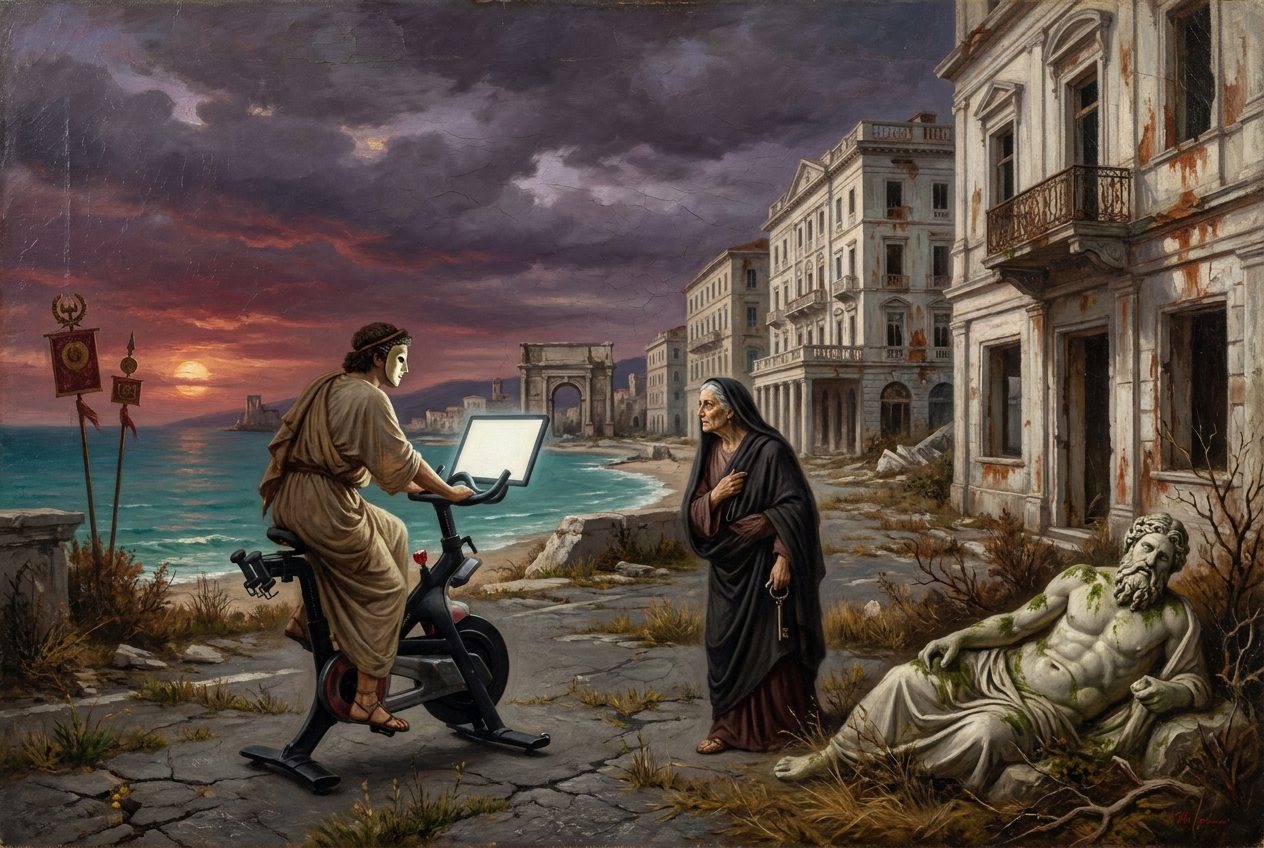
Tab. IUrbs Vacua, sive Exsules non Umbrae. Tabula Actis Mundi more veterum picta (a machina).The Empty City, or Exiles, Not Shades. Painted for Acta Mundi in the classical manner (AI-generated).
Fasti et Tristia · De Varosia inter larvas positaCalendar and Laments · On Varosha set among the ghosts
Non lemures sed exules: de urbe vacua quae ludo facta est
Not Ghosts but Exiles: On an Empty City Made into a Game
Societas Peloton, ut Breitbart nuntiat, cursum birotarum immobilium in festo umbrarum per Varosiam, urbem Cypriam iam duos et quinquaginta annos vacuam, duxit, deinde veniam petivit et sustulit. Poeta quaerit quae causa sit, et respondet: quorum domus deserta est, ii non mortui sunt sed exules, neque inter larvas numerandi.
The Peloton company, as Breitbart reports, ran a ride on its stationary bicycles through Varosha, a Cypriot city empty now for fifty-two years, for the festival of shades, then apologized and withdrew it. The poet asks the cause, and answers: those whose houses stand deserted are not dead but exiled, and are not to be counted among the ghosts.
Cur hoc legimusWhy we read this Quia urbis direptae ruinae in spectaculum ludicrum lemurum et rotarum vanitatem vertuntur.Because the ruins of a plundered city are turned into a playful spectacle of ghosts and the vanity of stationary wheels.
Pridie Kalendas Novembres scribo, quo die Americani trans Oceanum umbras et larvas festo tumultu celebrant, et pueri personati per vicos dulcia poscunt. Quaesivi ex Musa mea cur Lemuria sua non Maio mense, ut maiores nostri, sed autumno agerent. Illa, nondum respondens, tabellam mihi porrexit in qua novum prodigium scriptum erat. Ut enim Breitbart nuntiat, societas Peloton, quae birotas vendit quibus cives domi sudant nec usquam progrediuntur, ante diem V Kalendas Novembres cursum quindecim minutorum, nullo magistro duce, in festi umbrarum collectionem posuit; spectaculo autem fuit Varosia, suburbium Famagustae in Cypro, saepto clausum et iam duos et quinquaginta annos vacuum.
I write on the last day of October, when the Americans across the Ocean keep the festival of shades and spectres with great uproar, and masked children go from street to street demanding sweets. I asked my Muse why they hold their Lemuria in autumn and not in May, as our ancestors did. She did not answer yet, but handed me a tablet with a new prodigy written on it. For, as Breitbart reports, the Peloton company, which sells bicycles on which citizens sweat at home and never go anywhere, placed in its Halloween collection on October 28 a fifteen-minute ride with no instructor to lead it; and the spectacle was Varosha, a suburb of Famagusta in Cyprus, closed behind a fence and empty now for fifty-two years.
Die Iovis Endy Zemenides, qui Consilio Hellenico-Americano Chicagi praeest, querebatur, ut idem fons refert, cursum illum de urbe ludere quam milites Turcici anno MCMLXXIV vacuefecissent: familias in illis aedibus ante irruptionem habitasse, neque iis qui fugissent umquam redire licuisse; domos et deversoria deserta festi ornamenta non esse. Addidit ceteros cursus brevi praefatione incipere, in qua explicari potuisset cur nemo ibi habitaret, et alia loca Cypria suasit, Akamantem paeninsulam, montes Troodos, Paphum. Societas, ut Lena Argiri, diurnaria ERT et Kathimerini, scripsit, errorem fuisse respondit qui ab institutis suis abhorreret, cursum sustulit, veniam petivit, et diligentius se posthac quae proferret recognituram promisit.
On Thursday Endy Zemenides, who heads the Hellenic American Leadership Council in Chicago, complained, as the same source relates, that the ride made light of a city emptied by Turkish troops in 1974: families had lived in those buildings before the invasion, and those who fled had never been allowed back; the deserted homes and hotels were not festival decorations. He added that other rides open with a short introduction, in which it could have been explained why nobody lives there, and he proposed other places on Cyprus: the Akamas Peninsula, the Troodos Mountains, Paphos. The company, as Lena Argiri, correspondent for ERT and Kathimerini, wrote, replied that it had been an oversight at odds with its values; it withdrew the ride, apologized, and promised to review more carefully in future what it puts out.
Totum autem festum his verbis vendebatur: «Too good to ghost»; viginti et unum exercitia in undecim ultimos Octobris dies congesta erant, et qui unum quodlibet perfecisset insigne merebat. Alter quoque cursus, triginta minutorum, Bradleio Rose narrante, Varosiam in eodem orbe posuit cum castello Bran in Dacia, sepulcreto Savannae, insula carceris Goli Otok, metallo Coloradensi, tempestate marina. Hunc quoque sublatum esse fons non dicit.
The whole season was sold under the words "Too good to ghost": twenty-one workouts were crammed into the last eleven days of October, and anyone who finished any one of them earned a badge. A second ride, too, thirty minutes long and narrated by Bradley Rose, set Varosha in the same round with Bran Castle in Romania, a cemetery in Savannah, the prison island of Goli Otok, a Colorado mine and a storm at sea. The source does not say that this one was withdrawn as well.
Quaeramus igitur, more Fastorum, causas. Prima fortasse inscitia est: nemo in officina sciebat cur urbs vacaret. Altera quaestus: ruinae placent, et deversoria rubigine exesa pulchrius horrent quam nova. Tertia, quam ego veram puto: urbem vacuam pro urbe mortua habuerunt, et domos sine dominis pro domibus umbrarum.
Let us, then, in the manner of the Calendar, look for causes. The first may be ignorance: nobody in the workshop knew why the city stood empty. The second is profit: ruins please, and hotels eaten by rust make a lovelier shudder than new ones. The third, which I hold to be the true one: they took an empty city for a dead city, and houses without masters for houses of ghosts.
At Lemuria nostra aliter instituta sunt. Remi umbra, ut in Fastis narravi, cruenta Faustulo et Accae apparuit diemque sibi poposcit; Romulus Remuria dixit, quae postea Lemuria vocata sunt. Pater familias media nocte surgit nudis pedibus, manus fonte lavat, fabas nigras post tergum iacit, novies verba pronuntiat, aera pulsat, umbras paternas tecto exire iubet. Sed ille ritus mortuis nostris debetur, et eos e domo dimittit qui iam vivere desierunt.
But our Lemuria was founded otherwise. The ghost of Remus, as I told in the Fasti, appeared bloodied to Faustulus and Acca and demanded a day for himself; Romulus named it the Remuria, which was later called the Lemuria. The father of the house rises at midnight barefoot, washes his hands in spring water, throws black beans behind his back, says the words nine times, clashes bronze, and bids the ghosts of his fathers leave the roof. But that rite is owed to our dead, and it sends from the house those who have already ceased to live.
Varosiae domini non sunt lemures; exules sunt, et vivunt. Hoc ego, Tomis relegatus, melius quam ullus diurnarius scio: Romae me vivum numerabant, dum inter Getas hiemes frigidas ferebam. Urbs sine civibus non obsidetur umbris; exspectat. Qui eam inter larvas ponit, Lemuria invertit: nos fabis umbras e domo expellimus, hi vivos dominos in umbrarum numerum relegant. Interea, sicut olim cecini, «tempus edax rerum, tuque, invidiosa vetustas, / omnia destruitis», et tecta deversoriorum lente cadunt.
The owners of Varosha are not ghosts; they are exiles, and they are alive. I know this, banished to Tomis, better than any journalist: in Rome they counted me among the living while I bore cold winters among the Getae. A city without citizens is not haunted by ghosts; it waits. Whoever sets it among the spectres turns the Lemuria upside down: we drive ghosts out of the house with beans; these people banish living owners into the ranks of the ghosts. Meanwhile time, as I once sang, "Time, devourer of things, and you, envious age, / destroy all things," and the roofs of the hotels slowly fall.
Urbs sine civibus non obsidetur umbris; exspectat.
A city without citizens is not haunted by ghosts; it waits.
Neque res transacta est. Senatus Nationum Unitarum, ut Breitbart refert, duo decreta de ea fecit, DL anno MCMLXXXIV et DCCLXXXIX anno MCMXCII, et a quoquam praeter veteres incolas eam habitari non licere censuit. Nikos Christodoulides, Cypri praeses, saeptum Nationibus Unitis tradi vult, portu Famagustae sub Unionis Europaeae cura commercio aperto; Tufan Erhurman, Turcorum Cypriorum princeps, ante diem XII Kalendas Novembres id pactum ut iniquum se reiecisse confirmavit, rogans cur Varosiae traditio pretium alterius rei fieret; Christodoulides Erdoganum magnum impedimentum appellat. Quid Turci Cyprii de illo anno sentiant, fons praeter hanc recusationem tacet. Foedus magistratibus relinquo; hoc unum poeta censeo: nullus locus in calendario ponendus est cuius causa non narretur. Fasti sine causis sunt lusus, et lusus de alienis lacrimis turpis.
Nor is the matter settled. The United Nations Security Council, as Breitbart reports, has passed two resolutions on it, 550 in 1984 and 789 in 1992, and has declared it inadmissible for the place to be settled by anyone but its former inhabitants. Nikos Christodoulides, President of Cyprus, wants the fenced zone handed to the United Nations, with the port of Famagusta opened to trade under the supervision of the European Union; Tufan Erhurman, the Turkish Cypriot leader, confirmed on October 21 that he had rejected that package as unbalanced, asking why the handover of Varosha should be made the price of something else; Christodoulides calls Erdogan the great obstacle. What the Turkish Cypriots think of that year the source does not say, beyond this refusal. The treaty I leave to the magistrates; this one thing I, a poet, hold: no place should be set in the calendar whose cause goes untold. A Calendar without causes is a game, and a game played with other people's tears is shameful.
Ecce igitur imago nostri temporis perfecta: in Americis cives in birotis pedes movent nec progrediuntur, et Varosiae exules duos et quinquaginta annos nullum passum domum fecerunt. Lemures fabis pellimus; exules non pellimus, sed revocamus.
Here, then, is the perfect image of our age: in the Americas citizens pedal on bicycles and go nowhere, and the exiles of Varosha have not taken a single step toward home in fifty-two years. Ghosts we drive out with beans; exiles we do not drive out, we call them home.
FONTES ANTIQVIANCIENT SOURCES
- Ov. Met. XV.234–235tempus edax rerum, tuque, invidiosa vetustas, / omnia destruitis
FONTES HODIERNITODAY’S SOURCES
Res ex fontibus; sententia Romani.Facts from the sources; the opinion is the Roman’s.
Scribe ad Ovid: tabellarius epistulam tuam per vias Romanas feret, et responsum post dies aliquot redibit.Write to Ovid: the courier carries your letter along the Roman roads, and a reply comes back after a few days.
LEGE ETIAMREAD NEXT
- Hebdomas sine die Solis, annus sine feriisA Week without Sunday, a Year without HolidaysOvid
- De rege qui traiecit fretum ut saxum suum esse diceretOf a king who crossed the strait to say a rock was hisOvid
- De commeatu aërio ex castris Mildenhall in Germaniam et Hispaniam translatoOn the air supply train moved from the camp at Mildenhall to Germany and SpainCaesar
- Ieiunium non est temperantiaFasting Is Not TemperanceFrontinus
- Harenam in thesaurum vertit ingenium; thesaurum unius hominis custodia tueturGenius turns sand into treasure; one man's keeping guards the treasurePliny the Elder