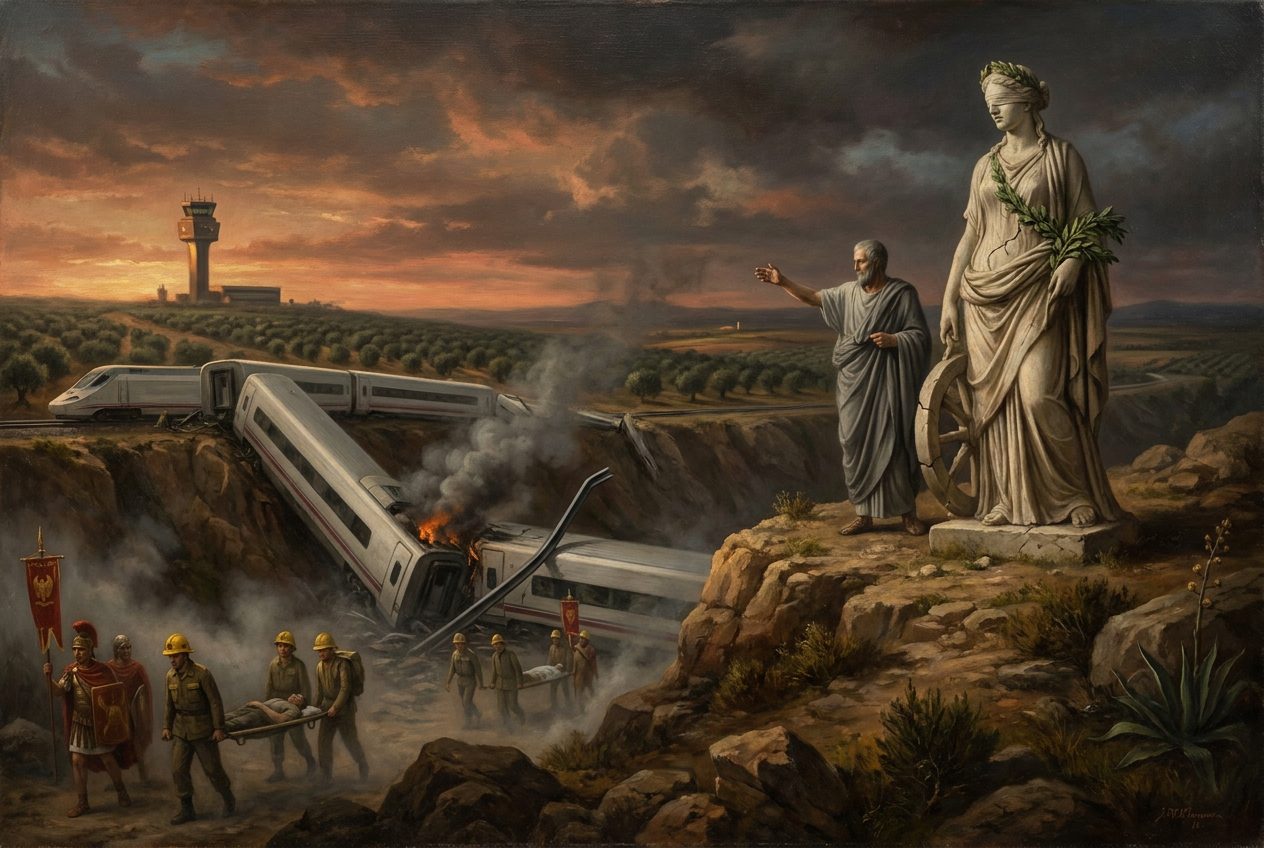
Tab. IIussum Caecum, sive Currus Ferrei in Planitie Toletana. Tabula Actis Mundi more veterum picta (a machina).The Blind Order, or The Iron Chariots on the Plain of Toledo. Painted for Acta Mundi in the classical manner (AI-generated).
Orbis Terrarum · De via ferrata HispalensiThe World Map · On the Seville Railway
Nihil inexplicabile: machina cessavit, homo caecus iussit
Nothing Inexplicable: the Machine Failed, a Blind Man Gave the Order
Die Mercurii, ante diem V Kalendas Novembres, in agro Toletano hamaxostichus societatis Renfe in hamaxostichum Iryo consistentem a tergo incurrit; ut BBC et The Guardian nuntiant, saltem LXVIII perierunt. Ego iudico in via celeri non machinam solam sed imperium a longinquo datum sine oculis homines occidisse.
On Wednesday, 28 October, in the district of Toledo, a Renfe train ran into the back of a stationary Iryo train; according to the BBC and The Guardian, at least 68 are dead. My judgment: on the high-speed line it was not the machine alone that killed, but an order given from far away, without eyes.
Cur hoc legimusWhy we read this Quia viae ferreae fractae et civium caedes fidem publicae curationis labefactant.Because ruined railways and the slaughter of citizens undermine trust in public administration.
Die Iovis, ante diem IV Kalendas Novembres. Heri, die Mercurii, paulo post horam nonam antemeridianam, in via ferrata celeri quae a Matrito Hispalim ducit, duo hamaxostichi eodem cursu euntes collisi sunt. Ut BBC nuntiat, res accidit inter municipia Mora et Orgaz, circiter centum quadraginta chiliometra a Matrito ad meridiem; Hungarian Conservative locum prope oppidum Urda ponit. Hamaxostichus societatis privatae Iryo, vectores CXLVII portans, in via steterat, quod computatrum defecerat. In eum a tergo incurrit hamaxostichus societatis publicae Renfe cum vectoribus CCCXCVII. Omnino DXLIV homines vehebantur.
Thursday, 29 October. Yesterday, Wednesday, shortly after nine in the morning, on the high-speed line that runs from Madrid to Seville, two trains travelling in the same direction collided. According to the BBC, it happened between the municipalities of Mora and Orgaz, about 140 kilometres south of Madrid; Hungarian Conservative places it near the town of Urda. A train of the private company Iryo, carrying 147 passengers, had stopped on the track because a computer had failed. A train of the state company Renfe, carrying 397 passengers, ran into it from behind. In all, 544 people were aboard.
Primi nuntii decem mortuos referebant; vespere The Guardian et BBC saltem LXVIII interfectos nuntiant, multos vulneratos, quindecim in summo periculo. Currus Iryo eversi per aggerem devoluti sunt; unus arsit; longa pars viae ferratae, ut imagines ostendunt, currum transfixit. Ut Hungarian Conservative refert, cohortes militares et vigiles missi sunt, valetudinaria Toleti et Alcazaris Sancti Ioannis curationes indictas distulerunt, iter inter Matritum et Hispalim interclusum est. Petrus Sánchez triduum luctus publici indixit. Haec est altera magna collisio in Hispania hoc anno, tertia gravissima in viis ferratis eius per quinquaginta annos.
The first reports gave ten dead; by evening The Guardian and the BBC reported at least 68 killed, many injured, fifteen in grave danger. The Iryo carriages overturned and rolled down the embankment; one caught fire; a long section of rail, as the pictures show, speared through a carriage. According to Hungarian Conservative, military emergency units and firefighters were sent, hospitals in Toledo and Alcázar de San Juan postponed scheduled operations, and the line between Madrid and Seville was closed. Pedro Sánchez declared three days of public mourning. This is Spain's second major collision this year, and the third deadliest on its railways in fifty years.
Causam Óscar Puente, minister viarum, sic exposuit: primum computatrum defecisse, deinde hominem errasse. Nam cum systema deficit, centrum moderandi Matriti, quod diu noctuque vigilat, imperium suscipit; id autem, ut minister dicit, consilio quod ipse inexplicabile appellavit hamaxostichos iterum moveri iussit, nulla celeritatis finitione imposita. Inter consistentiam et ictum septendecim minuta intercesserunt. Moderator ipse ab inquisitoribus interrogatus esse dicitur. Utrum custodiae automatae viae viguerint an cessaverint an superatae sint, nuntii non dicunt. Hoc primum quaerendum erat; adhuc tacetur.
Óscar Puente, the transport minister, set out the cause thus: first the computer failed, then a man erred. When the system fails, a control centre in Madrid that keeps watch day and night takes command; and that centre, the minister says, by a decision he himself called inexplicable, ordered the trains to move again, with no speed restriction imposed. Seventeen minutes passed between the halt and the impact. The controller himself is said to have been questioned by investigators. Whether the line's automatic safeguards were working, had failed, or had been overridden, the reports do not say. That was the first thing to ask; so far there is silence.
Nihil in opere inexplicabile est. Quaerendum est, ut Tacitus monet, «ut non modo casus eventusque rerum, qui plerumque fortuiti sunt, sed ratio etiam causaeque noscantur». Machinam deficere casus est; machinas deficere scimus. Sed defecta machina homo tardior fieri debet, non audacior. Hic contra factum est: oculi viae caecati sunt, et eo ipso tempore iussum est currere.
Nothing in a work is inexplicable. We must seek, as Tacitus advises, to know "not only the chances and outcomes of events, which are mostly fortuitous, but their reason and causes." A machine failing is chance; we know machines fail. But when the machine has failed, a man should grow slower, not bolder. Here the opposite was done: the eyes of the line were blinded, and at that very moment the order was given to run.
Sed defecta machina homo tardior fieri debet, non audacior.
But when the machine has failed, a man should grow slower, not bolder.
Nemo dux agmen per saltum ignotum citato gradu mittit, cum exploratores nihil renuntiaverunt. Moderator Matriti viam non videbat; tabulam videbat, et tabula erat muta. Ego in Portu Iulio remiges per totam hiemem exercui priusquam eos in hostem educerem; idem dico de istis qui in centro sedent: exercendi sunt in tempestate ficta, non in vera. Praeterea quaero, quod nuntii omittunt: cum in eadem via currant societas privata et publica, uno centro moderante, quis unus respondet? Opus duorum dominorum saepe nullius curatoris est.
No general sends a column at the double through an unknown pass when his scouts have reported nothing. The controller in Madrid did not see the line; he saw a board, and the board was mute. At the Portus Iulius I trained my rowers through a whole winter before I led them against the enemy; I say the same of those who sit in the centre: they must be drilled in a mock storm, not a real one. And I ask what the reports leave out: when a private company and a public one run on the same line, under one control centre, who alone answers for it? A work with two masters often has no keeper at all.
Quo celerior via, eo gravior custodia. Ego aquas in urbem perduxi, sed opus non perfeci cum perduxi; familiam ducentorum quadraginta peritorum ad aquas tuendas alui, quam moriens Augusto reliqui, et ille publicam fecit. Opus publicum numquam perficitur; cotidie servatur. Duae collisiones uno anno non Fortunae sunt, sed ordinis.
The faster the line, the heavier the watch. I brought water into the city, but I had not finished the work when I brought it in; I maintained a crew of 240 skilled men to guard the aqueducts, which I left to Augustus when I died, and he made it public. A public work is never finished; it is kept, every day. Two collisions in one year are not Fortune's doing, but the system's.
Remedium in promptu est neque novum. Primum: cum signa deficiunt, nullus hamaxostichus nisi lento gradu moveatur, donec via vacua visa sit. Deinde: unus magistratus viae praeficiatur, cum auctoritate et cum nomine, qui poenam ferat si erratur. Tum: minister viam pedibus perambulet, ut ego cloacas navigio percurri. Denique: inquisitio intra annum perficiatur et populo palam proponatur, non in comitiis disputetur. Factiones a petitione abstinuerunt, Vox perrexit; mortui autem non sunt rostra. Celeritas sine custodia non opus est, sed insidiae ex aere et ferro structae.
The remedy is at hand, and it is not new. First: when the signals fail, no train moves except at walking pace, until the line has been seen to be clear. Next: let one magistrate be set over the line, with authority and with a name, who bears the penalty when there is error. Then: let the minister walk the line on foot, as I went through the sewers by boat. Last: let the inquiry be finished within the year and posted openly for the people, not argued over at the elections. The parties suspended their canvass, Vox carried on; but the dead are not a speaker's platform. Speed without a watch is no public work, but a trap built of bronze and iron.
M · AGRIPPA · L · F · COS · TERTIVM · INSPEXIT
M · AGRIPPA, SON OF LUCIUS, THREE TIMES CONSUL, INSPECTED THIS
FONTES ANTIQVIANCIENT SOURCES
- Tac. Hist. 1.4ut non modo casus eventusque rerum, qui plerumque fortuiti sunt, sed ratio etiam causaeque noscantur
FONTES HODIERNITODAY’S SOURCES
- Hungarian ConservativeAt Least Ten Killed in High-Speed Train Collision in Spain
- The GuardianDeath toll rises to 68 with dozens injured after high-speed train collision in Spain – as it happened
- BBC WorldHigh-speed train crash kills at least 68 people in Spain
Res ex fontibus; sententia Romani.Facts from the sources; the opinion is the Roman’s.
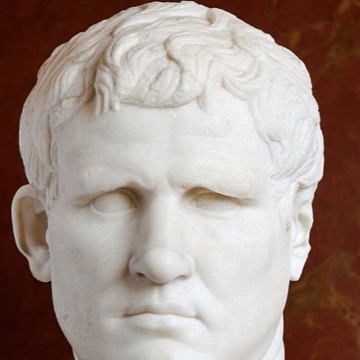
M. Vipsanius Agrippa
Victor apud Actium, aedificator Pantheonis et aquae Virginis, auctor orbis terrarum depicti. Aedilis cloacas navicula perlustravit. Verba non amat; opera amat.Victor at Actium, builder of the Pantheon and the Aqua Virgo, maker of the great map of the world. As aedile he inspected the sewers by rowing through them. He has no love for words; he loves works.
Haec vox restituta est ex his libris:This voice is reconstructed from:
Scribe ad Agrippa: tabellarius epistulam tuam per vias Romanas feret, et responsum post dies aliquot redibit.Write to Agrippa: the courier carries your letter along the Roman roads, and a reply comes back after a few days.
LEGE ETIAMREAD NEXT
- Prius iudicandum, deinde fodiendumFirst Judge, Then DigAgrippa
- Ubi terra movetur, ibi finis imperiiWhere the earth moves, there dominion endsAgrippa
- Naves Eorum Volant, Pontes RuuntTheir Ships Fly. Their Bridges Fall.Agrippa
- De commeatu aërio ex castris Mildenhall in Germaniam et Hispaniam translatoOn the air supply train moved from the camp at Mildenhall to Germany and SpainCaesar
- Ieiunium non est temperantiaFasting Is Not TemperanceFrontinus