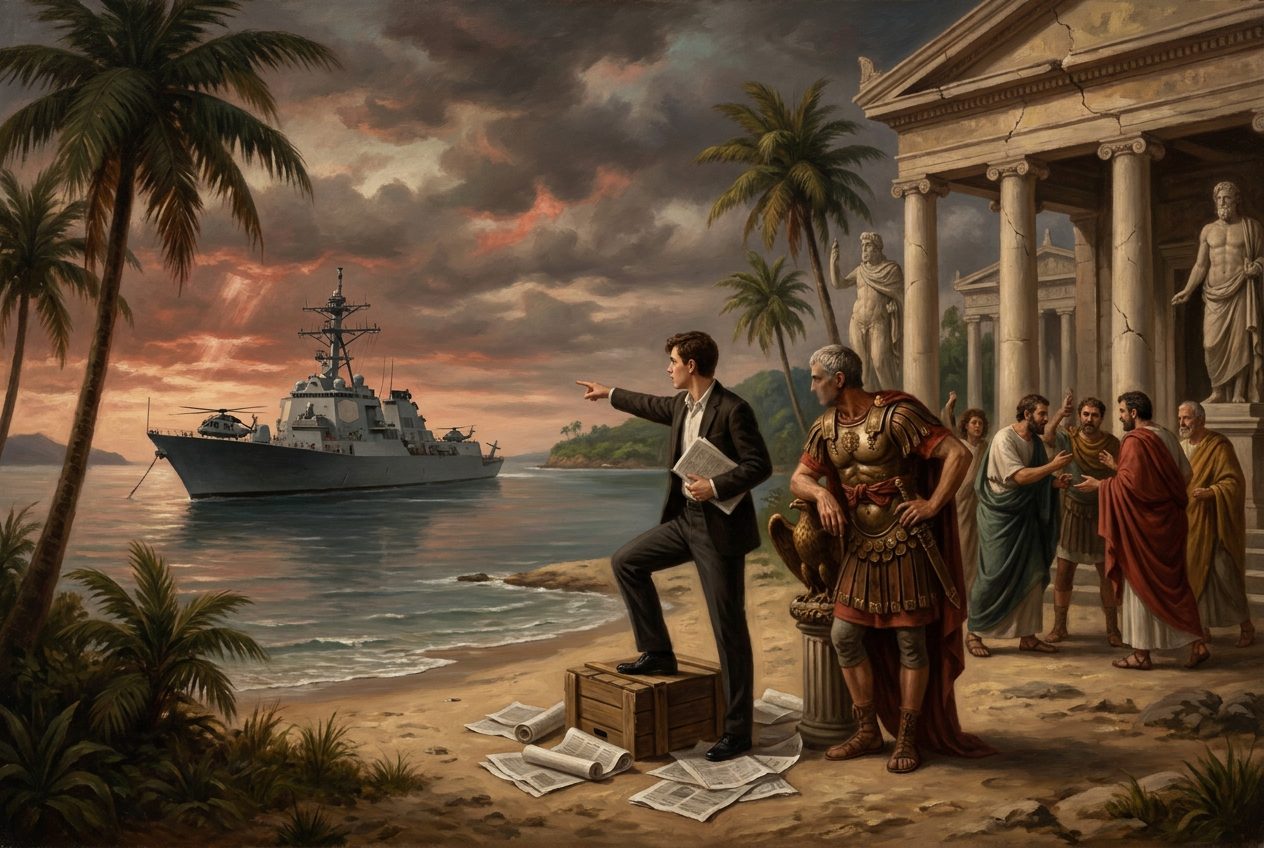
Tab. IInsula Verbis Capta, sive Consilium ex Rumore. Tabula Actis Mundi more veterum picta (a machina).An Island Taken by Words, or Counsel from Rumour. Painted for Acta Mundi in the classical manner (AI-generated).
Commentarii · De expeditione in Cubam suasaDispatches · On the proposed expedition to Cuba
De insula in commentario capta, in litore non capta
An Island Taken in an Op-Ed, Not on the Beach
Ruel Domi, studiosus universitatis Dakotae Septentrionalis, in actis Washington Examiner suadet ut Americani, Nicolao Maduro sublato, Cubam armis invadant. Caesar aliud esse hominem rapere, aliud insulam tenere iudicat, neque mare transeundum esse dum res publica domi dissideat.
Ruel Domi, a student at the University of North Dakota, argues in the Washington Examiner that with Nicolás Maduro removed the Americans should now invade Cuba. Caesar judges that seizing a man is one thing and holding an island another, and that no sea should be crossed while the republic is divided at home.
Cur hoc legimusWhy we read this Quia imperatoribus trans Oceanum cavendum est ne dum insulam expugnare somniant, domi imperium amittant.Because commanders across the Ocean must beware lest, while dreaming of capturing an island, they lose their hold on power at home.

Cuba insula est in mari ad meridiem Floridae posita, nonaginta milia passuum, ut Americani metiuntur, a litore eorum distans. Die Martis, ante diem VI Kalendas Novembres, acta Washington Examiner commentarium ediderunt Ruelis Domi, scriptoris Albani qui in universitate Dakotae Septentrionalis rationes oeconomicas discit. Is Americanos, postquam Nicolaum Maduro, Venetiolae principem, expeditione quam Absolute Resolve appellant ceperint, nunc Cubam armis adoriri et regimen eius evertere oportere censet.
Cuba is an island lying in the sea to the south of Florida, ninety miles from the American shore by the Americans' own measure. On Tuesday, 27 October, the Washington Examiner published a commentary by Ruel Domi, an Albanian writer studying economics at the University of North Dakota. He holds that the Americans, having captured Nicolás Maduro, the ruler of Venezuela, in the expedition they call Absolute Resolve, ought now to attack Cuba with arms and overthrow its regime.
Causas tres affert. Primum insulam iam inde a seditione anni MCMLIX Sovieticorum, deinde Russorum, nunc Serum stationem esse; auctoritates Americanas, ut ait, exploratores Sinenses ibi crescere et cum Russis de re militari consilia coniungi confirmasse. Deinde ex Cuba magnam multitudinem ad fines meridionales Civitatum sine lege venire, quae aerarium oneret et latrociniis materiam praebeat. Postremo insulam signum esse eorum qui res novas ac bona communia praedicant, cum duas partes iuvenum Americanorum iam talem rem publicam malle affirmet. Addit in commentario Securitatis Nationalis, mense Decembri anni MMXXV edito, sententiam Monroeanam renovatam esse, et expeditionem in Venetiolam a multis peritis rem bene gestam haberi.
He offers three reasons. First, that ever since the revolution of 1959 the island has been a station for the Soviets, then the Russians, and now the Chinese; American authorities, he says, have confirmed a growing Chinese intelligence presence there and close coordination with Russia on military matters. Second, that a great multitude comes from Cuba to the southern border of the United States without lawful entry, burdening the treasury and supplying material for crime. Last, that the island is the standard of those who preach revolution and common property, since he asserts that two-thirds of young Americans now prefer such a commonwealth. He adds that the National Security Strategy published in December 2025 revived the Monroe Doctrine, and that many experts regard the expedition into Venezuela as a success.
Hoc imprimis Caesar animadvertit: scriptor bellum iam inter consilia agitari dicit, neque tamen quemquam nominat, neque magistratum neque ducem neque consilium, a quo agitetur. Rumor ergo, non decretum, nuntiatur. Etiam numerus iuvenum caute accipiendus est; nam paucis ante diebus acta Fox News rettulerant ex discipulis collegiorum duo et quadraginta ex centenis eam rationem praeferre. Ita fit quod de Gallis olim scriptum est: «His rebus atque auditionibus permoti de summis saepe rebus consilia ineunt, quorum eos in vestigio paenitere necesse est, cum incertis rumoribus serviant.»
Caesar notes this above all: the writer says war is already under discussion, yet names no one, no magistrate, no general, no council, by whom it is being discussed. What is reported, then, is a rumour, not a decision. The figure on the young must also be taken with caution; for a few days earlier Fox News had reported that forty-two per cent of college students prefer that system. So it happens as was once written of the Gauls: "Stirred by such reports and hearsay, they often form plans on the gravest matters, which they must at once regret, since they are slaves to uncertain rumours."
Deinde rem militarem considerat. Unum hominem celeri impetu rapere opus est paucorum dierum et paucarum cohortium; insulam tenere opus est annorum et legionum. Scriptor de navibus, de copiis, de portibus in quibus exponantur, de commeatu, de tempore anni, de eo qui post victoriam insulam administret nihil dicit. Veterum bellorum in Vietnamia, Afghania, Iraquia exempla eo uno argumento reicit quod Cuba neque Iraquia neque Afghania sit. Quod verum est; sed omnis insula sua habet pericula, quae non nominando non tolluntur.
Next he considers the military question. To seize one man in a swift stroke is the work of a few days and a few cohorts; to hold an island is the work of years and of legions. The writer says nothing of ships, of troops, of the harbours where they would land, of supply, of the season, or of who would govern the island after victory. He dismisses the precedents of the old wars in Vietnam, Afghanistan and Iraq on the single ground that Cuba is neither Iraq nor Afghanistan. That is true; but every island has its own dangers, and they are not removed by leaving them unnamed.
Unum hominem celeri impetu rapere opus est paucorum dierum et paucarum cohortium; insulam tenere opus est annorum et legionum.
To seize one man in a swift stroke is the work of a few days and a few cohorts; to hold an island is the work of years and of legions.
Caesar ipse bis in Britanniam transiit. Priore anno naves onerariae, quae equitatum portabant, tempestate reiectae sunt; aestus, quem ignorabat, naves in litore subductas afflixit; frumentum defecit. Insulam vidit, non tenuit. Posteriore anno maiore classe transvectus est, et principes Gallorum, quorum fidem dubiam habebat, secum duxit, ne absente exercitu Gallia moveretur. Mare enim tergum ducis magis quam hostis in periculum vocat.
Caesar himself twice crossed to Britain. In the first year the transports carrying his cavalry were driven back by a storm; a tide he did not know wrecked the ships drawn up on the beach; the grain ran short. He saw the island; he did not hold it. In the following year he crossed with a larger fleet, and took with him the Gallic chiefs whose loyalty he doubted, so that Gaul should not rise while the army was away. For the sea endangers a general's rear more than his enemy does.
Tergum autem Americanorum nunc non tutum est. Comitia media paucis diebus habebuntur; superioribus diebus agentes publici domum legatae Ilhan Omar scrutati sunt; ministerium iustitiae cum comitatu Angelopolitano de suffragiis certat; iudex Furman dimissionem a praeside factam iniustam esse pronuntiavit. Qui exercitum trans mare mittit cum domi partes inter se iudiciis et accusationibus contendunt, eum, si quid adversi acciderit, non hostis sed civis prius accusabit. Praeterea Caesar non mirabitur si bellum in insula gestum plures fugientes in Floridam miserit quam pax; nam qui ab armis fugiunt mare non timent.
And the Americans' rear is not secure at present. The midterm elections will be held in a few days; in recent days federal agents searched the home of Representative Ilhan Omar; the Justice Department is contesting the votes with Los Angeles County; Judge Furman has ruled a dismissal by the President unlawful. A man who sends an army across the sea while the factions at home fight each other with lawsuits and prosecutions will, if anything goes wrong, be accused first by his citizens, not by the enemy. Caesar, moreover, will not be surprised if a war fought on the island sends more refugees to Florida than peace does; for those who flee arms do not fear the sea.
Curio in Africa nuntiis credidit Iubam abesse, cum adesset, et exercitum cum vita amisit, quod «fere libenter homines id quod volunt credunt». Remedium igitur non novum est. Prius concordia domi constituenda, exploratores mittendi qui vera, non grata, referant; res frumentaria et classis comparanda; constituendum quis insulam post victoriam regat et quibus obsidibus fides eius teneatur. Haec si facta sunt, de bello deliberari licet; si non, Fortuna, quae parvis momentis magnas rerum commutationes efficit, deliberabit. Bellum in commentario facile geritur, in litore difficile.
Curio in Africa believed reports that Juba was away when he was at hand, and lost his army along with his life, because "men generally believe what they wish to believe." The remedy, then, is not new. First concord must be settled at home; scouts must be sent who will report what is true, not what is welcome; supply and a fleet must be prepared; it must be decided who will govern the island after victory, and by what hostages its loyalty will be held. When these things are done, war may be debated; if not, Fortune, who by small turns brings about great changes, will do the debating. War is easily waged in an op-ed, and hard on the beach.
FONTES ANTIQVIANCIENT SOURCES
- Caes. BG 4.5.3His rebus atque auditionibus permoti de summis saepe rebus consilia ineunt, quorum eos in vestigio paenitere necesse est, cum incertis rumoribus serviant
- Caes. BG 3.18.6fere libenter homines id quod volunt credunt
FONTES HODIERNITODAY’S SOURCES
- Washington ExaminerTrump toppled Maduro. Now it’s time to invade Cuba
Res ex fontibus; sententia Romani.Facts from the sources; the opinion is the Roman’s.
C. Iulius Caesar
Galliam subegit, Rubiconem transiit, rem publicam vicit. De se ipso in tertia persona scribit, breviter, celeriter, sine ornatu. Primus omnium instituit ut acta senatus et populi publicarentur.He conquered Gaul, crossed the Rubicon, and defeated the Republic. He writes about himself in the third person — briefly, swiftly, without ornament. He was the first to order that the daily acts of Senate and people be published.
Haec vox restituta est ex his libris:This voice is reconstructed from:
Scribe ad Caesar: tabellarius epistulam tuam per vias Romanas feret, et responsum post dies aliquot redibit.Write to Caesar: the courier carries your letter along the Roman roads, and a reply comes back after a few days.
LEGE ETIAMREAD NEXT
- De commeatu aërio ex castris Mildenhall in Germaniam et Hispaniam translatoOn the air supply train moved from the camp at Mildenhall to Germany and SpainCaesar
- De legata quae ante aciem ad hostem transiit, et de duce qui eam dimiseratOf the officer who went over to the enemy before the battle, and of the general who had sent her awayCaesar
- De scutis missis neque gladio strictoOn Shields Sent and No Sword DrawnCaesar
- Ieiunium non est temperantiaFasting Is Not TemperanceFrontinus
- Harenam in thesaurum vertit ingenium; thesaurum unius hominis custodia tueturGenius turns sand into treasure; one man's keeping guards the treasurePliny the Elder