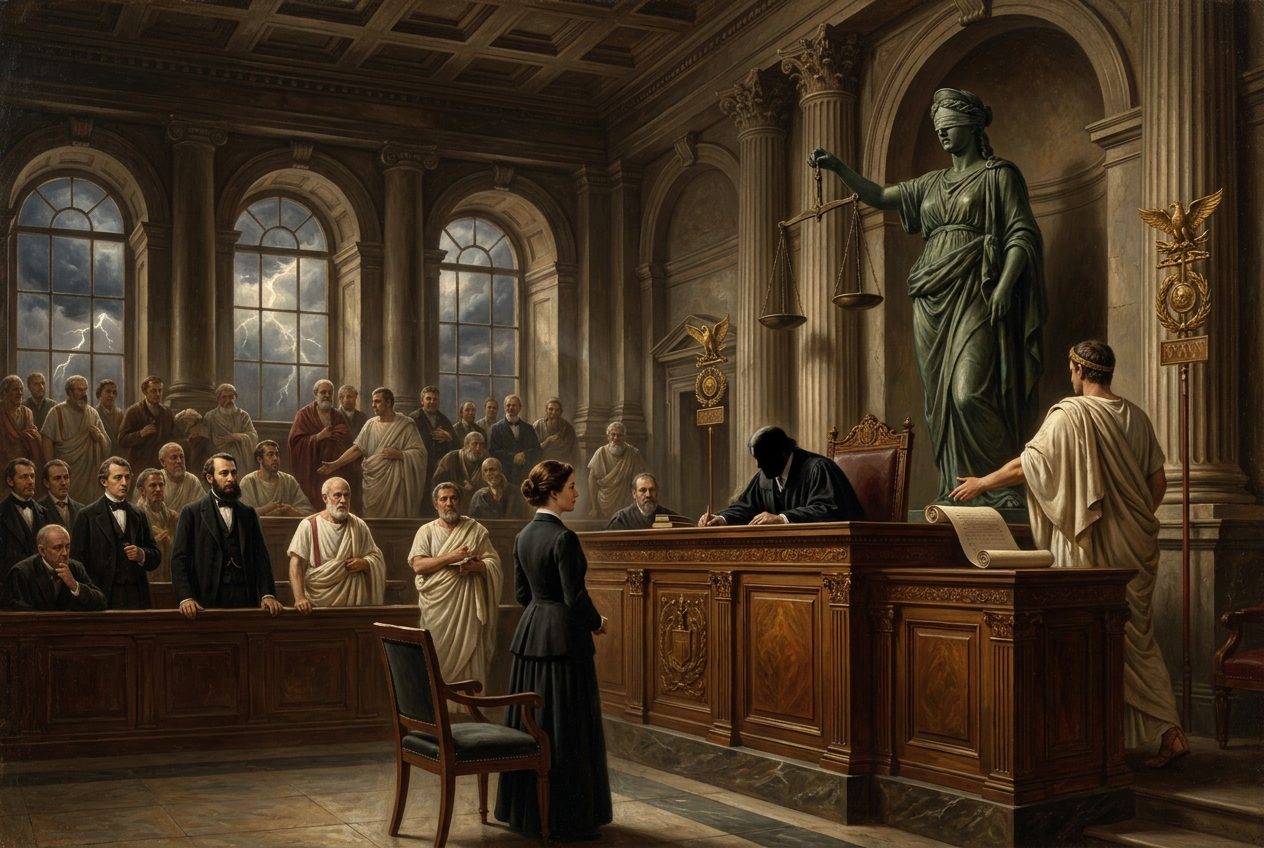
Tab. ILex Potestatem Finit, sive Accusatrix Restituta. Tabula Actis Mundi more veterum picta (a machina).Law Bounds Power, or The Prosecutor Restored. Painted for Acta Mundi in the classical manner (AI-generated).
Ex Palatio · De accusatore publico dimissoFrom the Palace · On a public prosecutor dismissed
Potestas quae lege datur lege terminatur
Power given by law is bounded by law
Iesse Furman, iudex Americanus, pronuntiavit Maurene Comey, accusatricem publicam Novi Eboraci, contra legem dimissam esse, eamque restitui et stipendium solvi iussit, ut New York Post, Guardian et Daily Mail nuntiant. Princeps respondet accusatores publicos custodes legum esse, non servos factionis, et potestatem removendi legi subiectam esse.
Jesse Furman, an American judge, has ruled that Maurene Comey, a public prosecutor in New York, was dismissed unlawfully, and has ordered her reinstated and her pay restored, as the New York Post, the Guardian and the Daily Mail report. The Princeps answers that public prosecutors are guardians of the laws, not servants of a faction, and that the power to remove them is subject to law.
Cur hoc legimusWhy we read this Quia princeps legibus non est solutus, neque accusatores publici arbitrio privatae factionis pellendi sunt.Because the princeps is not above the laws, nor may public prosecutors be driven out at the whim of a private faction.


Quaestiones huius hebdomadis trans Oceanum ortae sunt. Ut New York Post et Guardian nuntiant, Iesse Furman, iudex Civitatum Foederatarum, hodie, die Lunae, ante diem VII Kalendas Novembres, pronuntiavit Maurene Comey, quae per decem annos accusatrix publica in Novo Eboraco fuerat, mense Iulio anni MMXXV contra legem dimissam esse. Iussit, ut New York Post et Daily Mail referunt, eam in locum restitui et stipendium amissum solvi, a die XX Decembris, ut Daily Mail addit. Ministerium iustitiae contenderat, ut Guardian narrat, accusatores publicos potestatem praesidis 'conclusivam et praeclusivam' exercere, neque senatum Americanum eorum remotionem lege terminare posse. Ipsa se ob patrem, Iacobum Comey, Donaldi Trump diu inimicum, aut ob opiniones politicas dimissam esse asseverat. Ministerium provocaturum esse New York Post existimat, fretum sententia summorum iudicum mense Iunio lata.
This week's questions arise across the Ocean. As the New York Post and the Guardian report, Jesse Furman, a judge of the United States, ruled today, Monday, the seventh day before the Kalends of November, that Maurene Comey, who had served for ten years as a public prosecutor in New York, was dismissed unlawfully in July 2025. He ordered, as the New York Post and the Daily Mail relate, that she be restored to her post and her lost pay be made good, from 20 December, as the Daily Mail adds. The Justice Department had contended, the Guardian says, that public prosecutors exercise the president's 'conclusive and preclusive' power, and that the American Congress cannot limit their removal by law. She herself maintains that she was dismissed on account of her father, James Comey, long an enemy of Donald Trump, or for her political opinions. The New York Post expects the department to appeal, relying on the decision the Supreme Court handed down in June.
I. Quaeritur an accusator publicus ad nutum principis removeri possit, quasi pars ipsius potestatis esset. Iudex scribit senatum, qui ministro iustitiae ius removendi dederit, eundem eius iuris fines posuisse, quos etiam rei violatos esse fateantur. Ita censeo: potestas quae lege datur lege terminatur. Qui legis beneficio utitur, legis modum non effugit; et sequendam cuiusque civitatis legem puto, non meam voluntatem. Princeps qui ministros dimittere potest, dum legem servat, magistratus est; qui sine lege, dominus.
I. The question is whether a public prosecutor may be removed at the ruler's nod, as though he were a part of the ruler's own power. The judge writes that Congress, which gave the Attorney General the right of removal, also set the limits of that right, limits which even the defendants admit were broken. My ruling is this: power given by law is bounded by law. He who enjoys the benefit of a law does not escape its measure; and I hold that the law of each community is to be followed, not my own will. A Princeps who may dismiss his officials, so long as he keeps the law, is a magistrate; one who does it without law is a master.
Princeps qui ministros dimittere potest, dum legem servat, magistratus est; qui sine lege, dominus.
A Princeps who may dismiss his officials, so long as he keeps the law, is a magistrate; one who does it without law is a master.
II. Quaeritur, ut Guardian refert, an officium amitti debeat propter nomen patris. Id ab ipsa asseritur, nondum probatum est; ratio dimissionis in nullis actis profertur. Pater, ut New York Post nuntiat, in Carolina Septentrionali iudicium exspectat, minarum mortis in praesidem reus, quod crimen ipse vindictae causa institutum esse dicit. Sed crimen patris, verum an falsum, filiae non est. Sulla liberos proscriptorum honoribus arcuit; id exemplum odio, non laude, memoratur. Meminerimus non ex metu nec terrore hominum aut criminibus maiestatis reverentiam nomini meo acquiri.
II. The question, as the Guardian reports, is whether a post should be lost because of a father's name. This is her assertion and not yet proved; no reason for the dismissal is given in any record. Her father, the New York Post reports, awaits trial in North Carolina, charged with threatening to kill the president, a charge he says was brought out of vengeance. But a father's charge, true or false, is not his daughter's. Sulla barred the children of the proscribed from office; that precedent is remembered with loathing, not praise. Let us remember that reverence for my name is not to be won by fear and terror, nor by charges of treason.
III. Quaeritur denique quis solvat. Si sententia stabit, pecunia publica pro mensibus pendetur quibus accusatrici laborare non licuit. Haec impensa non iudicis culpa fit, sed eius qui legem neglexit. Quis dimissionem iusserit, acta tacent; id primum quaerendum esset, sicut olim quaesivi cuius vitio Nicomedenses pecuniam in aquae ductus incohatos et relictos perdidissent. Accusatores custodes legum sunt, non clientes factionis; qui eos ut servos domus tractat, iustitiam publicam in rem privatam vertit, et poenam suam aerario imponit.
III. The last question is who pays. If the ruling stands, public money will be paid out for months in which the prosecutor was not allowed to work. This cost is not the judge's fault but the fault of whoever disregarded the law. Who ordered the dismissal the records do not say; that should be the first inquiry, just as I once asked through whose fault the people of Nicomedia had wasted their money on aqueducts begun and abandoned. Prosecutors are guardians of the laws, not clients of a faction; whoever treats them as household slaves turns public justice into private business, and lays his own penalty on the treasury.
FONTES ANTIQVIANCIENT SOURCES
- Plin. Ep. X.113sequendam cuiusque civitatis legem puto
- Plin. Ep. X.82.1non ex metu nec terrore hominum aut criminibus maiestatis reverentiam nomini meo acquiri
FONTES HODIERNITODAY’S SOURCES
- New York PostMaurene Comey, daughter of ex-FBI director, unlawfully fired as federal prosecutor by Trump DOJ, judge rules
- The Daily SignalNew Federal Crime Numbers Show Dramatic One-Year Drop After Trump’s First Year of the Second Term
- The GuardianMaurene Comey was illegally fired as federal prosecutor, judge rules
- Daily MailTrump 'illegally' fired James Comey's daughter Maurene who led Epstein and Diddy prosecutions, judge finds in bombshell ruling
Res ex fontibus; sententia Romani.Facts from the sources; the opinion is the Roman’s.
Imp. Nerva Traianus
Primus imperator provincialis, Hispanus; Daciam vicit, imperium ad maximos fines protulit; Plinio legato breviter, iuste, prudenter rescripsit.The first emperor born in the provinces, a Spaniard; he conquered Dacia and carried the empire to its greatest extent. His replies to Pliny, his governor, are models of brief, just and practical rule.
Haec vox restituta est ex his libris:This voice is reconstructed from:
Scribe ad Trajan: tabellarius epistulam tuam per vias Romanas feret, et responsum post dies aliquot redibit.Write to Trajan: the courier carries your letter along the Roman roads, and a reply comes back after a few days.
LEGE ETIAMREAD NEXT
- De commeatu aërio ex castris Mildenhall in Germaniam et Hispaniam translatoOn the air supply train moved from the camp at Mildenhall to Germany and SpainCaesar
- Ieiunium non est temperantiaFasting Is Not TemperanceFrontinus
- Harenam in thesaurum vertit ingenium; thesaurum unius hominis custodia tueturGenius turns sand into treasure; one man's keeping guards the treasurePliny the Elder