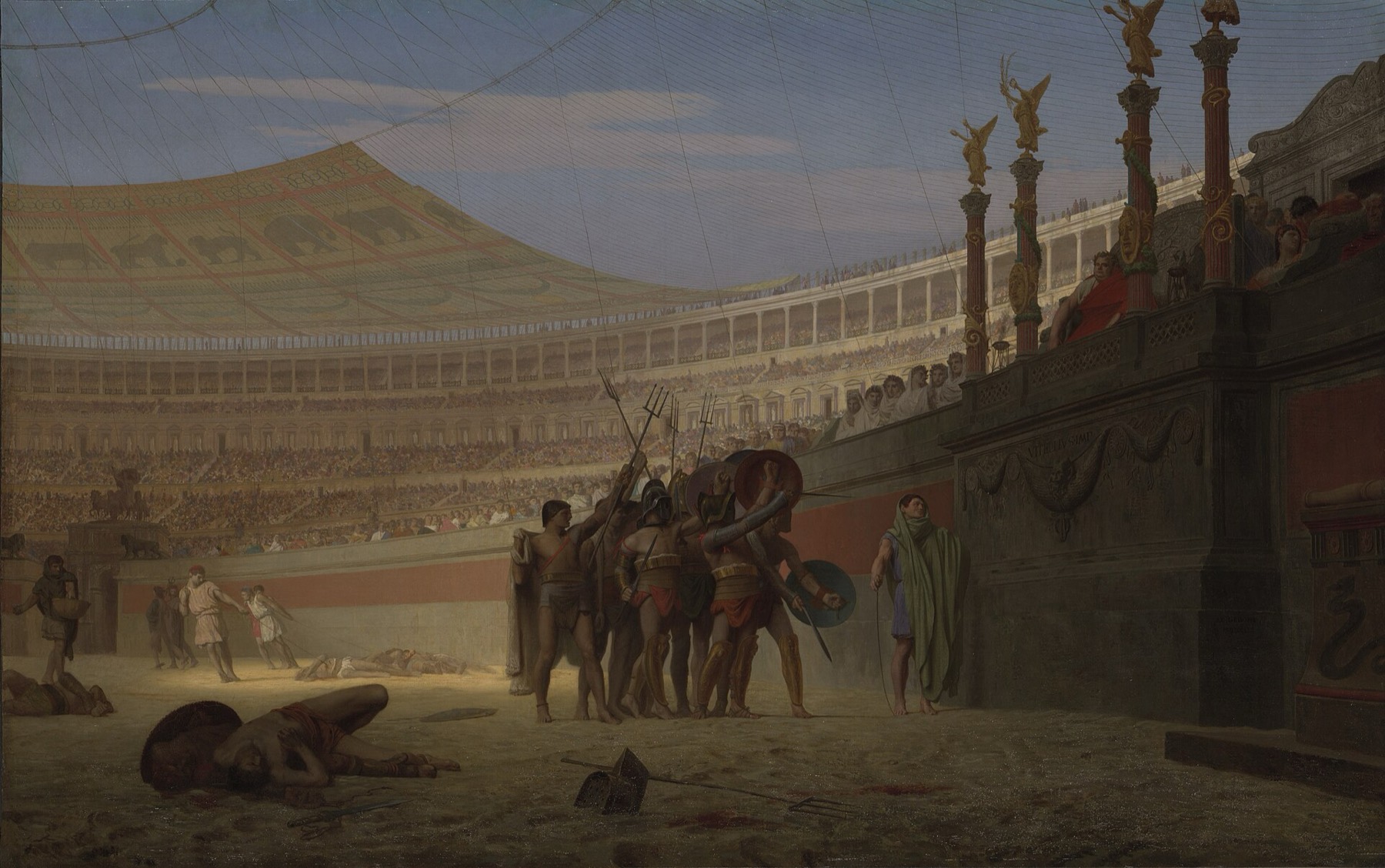
Tab. IIo. Leo Gérôme, Ave Caesar, morituri te salutant (MDCCCLIX).Jean-Léon Gérôme, Ave Caesar! Morituri te salutant (1859).
De Aquis et Strategematis · De nave bombardaria in venatricem versaWaters and Stratagems · On a bomber turned fighter
Quod non mensum est, nondum probatum est
What has not been measured has not yet been proved
Ut RedState nuntiat, Militia Aëria Americana commentarium de ordine aëroplanorum pugnatoriorum senatui suo tradidit. In eo quaeritur num B-21, navis ad pyrobolos penitus in hostium terras ferendos facta, etiam ad hostium aëronaves ex insidiis aggrediendas adhiberi possit. Consilium sollertis ducis probo; sed commentarium nemo publice legit, et machinam nondum mensam laudare nolo.
As RedState reports, the United States Air Force has handed its senate a report on the structure of its fighter force. It asks whether the B-21, an aircraft built to carry bombs deep into enemy country, might also be used to ambush enemy aircraft. I approve the thinking of a shrewd commander; but no one has read the report in public, and I will not praise a machine that has not yet been measured.
Cur hoc legimusWhy we read this Quia nova belli machinatio et caeli insidiae ad artem stratagematum revocandae sunt.Because a new machine of war and aerial ambush must be measured against the art of stratagems.
Die Veneris, ante diem X Kalendas Novembres, anno urbis conditae MMDCCLXXIX. Commentarium scribo de re quae ad aquas non pertinet, sed ad eam artem quam in Strategematis collegi. Ut RedState nuntiat, Militia Aëria Civitatum Foederatarum superiore hebdomade senatui suo, quem Congressum vocant, commentarium longi temporis de ordine aëroplanorum pugnatoriorum tradidit. In eo quaeritur num naves bombardariae, praecipue nova B-21 quam Raider appellant, ad pugnam in aëre contra hostium aëronaves adhiberi possint, fortasse una cum fucis quos Collaborative Combat Aircraft vocant. Hoc primi narraverunt diurnarii Aviation Week, qui exemplar adepti erant. Die Martis, ante diem XIII Kalendas Novembres, legatus David Tabor, qui consiliis et rationibus militiae praeest, diurnarios in colloquium admisit; ipsum commentarium, quamquam nihil secreti continere dicitur, eis non tradidit.
Friday, the tenth day before the Kalends of November, in the year 2779 from the founding of the City. I write a report on a matter that has nothing to do with the waters, and everything to do with the art I collected in my Stratagems. As RedState reports, the Air Force of the United States last week handed its senate, which they call Congress, a long-term report on the structure of its fighter force. It asks whether bombers, and above all the new B-21 they call the Raider, could be used to fight enemy aircraft in the air, perhaps together with the drones they call Collaborative Combat Aircraft. The first to tell the story were the journalists of Aviation Week, who had obtained a copy. On Tuesday, the thirteenth day before the Kalends of November, Lieutenant General David Tabor, who is in charge of the service's plans and programs, received the journalists at a roundtable; the report itself, though it is said to contain nothing secret, he did not give them.
Res digna est quae consideretur. Naves bombardarias Americanas numquam in aëre pugnavisse nisi ut se defenderent scribit RedState. In bello per Germaniam gesto centenae naves B-17 et B-24, singulae tormentis usque ad tredecim armatae, hostium venatores per imbrem glandium ire cogebant. Nunc navem ad pyrobolos ferendos fabricatam in venatricem verti posse putant. Quae in ea laudantur, ut acta TWZ iam pridem exposuerunt, haec sunt: magnitudo, longissimum iter, altitudo ad quam ascendit, quod oculis et radiis hostium paene non conspicitur, sensus acerrimi. Fucos autem ferre eam in consilio non esse, cum eis tamen una agere posse, ut aiunt.
The matter deserves consideration. RedState writes that American bombers have never fought in the air except to defend themselves. In the war waged over Germany, B-17s and B-24s by the hundred, each armed with as many as thirteen guns, forced enemy fighters to fly through a hailstorm of bullets. Now they think an aircraft built to carry bombs can be turned into a hunter. Its merits, as TWZ has long set out, are these: its size, its very great range, the height to which it climbs, the fact that enemy eyes and radars can scarcely see it, and its keen senses. It is not planned to carry drones, they say, but it can work alongside them.
Hoc genus consilii novum non est; in libris meis de instrumento ad alium usum converso multa collegi. Duilius apud Mylas, cum Poeni arte navali praestarent, corvos navibus imposuit, ut hostium naves prehensae pugnam navalem in terrestrem verterent. Ita Romanus, qui mari impar erat, eo genere pugnae vicit quo par erat. Agrippa harpagonem, ferrum uncatum tormento emissum, ad naves Sexti Pompeii trahendas adhibuit. Neutra res nova machina fuit, sed vetus instrumentum novo usui accommodatum. Idem sentio de nave quae, quia alte et occulte volat et magnum onus missilium ferre potest, venatores hostium inopinantes aggredi possit. Ars enim imperatoria est hostem eo loco ferire unde se peti non exspectat.
This kind of thinking is not new; in my books I gathered many cases of an instrument turned to another use. Duilius at Mylae, when the Carthaginians were the better seamen, fitted his ships with the corvus, so that the enemy's ships, once grappled, turned a sea fight into a land fight. So the Roman, no match at sea, won by the kind of fighting in which he was a match. Agrippa used the harpax, a hooked iron shot from a catapult, to drag in the ships of Sextus Pompeius. Neither was a new machine; each was an old tool fitted to a new use. I think the same of an aircraft which, because it flies high and unseen and can carry a great load of missiles, could fall upon enemy fighters unawares. For the art of command is to strike the enemy from the quarter whence he does not expect attack.
Sed curator aquarum fui, non poeta, et nihil laudo quod non mensus sum. Quaero igitur id quod nemo adhuc nuntiavit. Quae missilia navis feret? Quae radiorum instrumenta mutanda erunt? Quanti constabit? Num propterea numerus venatorum proprie dictorum, quos sextae aetatis vocant, minuetur? Haec omnia in actis desunt. Ipse RedState fatetur nondum liquere quo modo B-21 ad hunc usum accommodari possit, militiamque navem adhuc probare. Neque oblivisci licet, quod idem monet, Garii Powers, cuius navis altissime volans tamen de caelo deiecta est: hostes quoque artes suas parant.
But I was curator of the waters, not a poet, and I praise nothing I have not measured. So I ask what no one has yet reported. What missiles will the aircraft carry? What radars will have to be changed? What will it cost? Will the number of fighters properly so called, the ones they call sixth-generation, be reduced on that account? All this is missing from the reports. RedState itself admits that it is not yet clear how the B-21 could be adapted to this use, and that the service is still evaluating the aircraft. Nor may we forget, as the same outlet warns, Gary Powers, whose aircraft, flying at a great height, was brought down from the sky all the same: the enemy too is preparing his arts.
Cui bono? Militiae Aëriae in primis, quae, si navem suam pluribus officiis aptam esse ostenderit, firmiorem causam apud senatum habebit cum de pecunia agetur. Neque id ei crimini do: dux qui instrumentum suum defendit officio fungitur. Iam anno MMXIX legatus militiae Scott Pleus dixisse fertur angustius cogitare eos qui novam navem venatricem tantum appellarent. Sed quo saepius idem consilium proponitur, eo magis mensura desideratur. Commentarium enim quod nihil secreti continet, si diurnariis tamen non traditur, a paucis legitur et a multis laudatur. Id in aquis meis expertus sum, ubi aliud tabulae, aliud fistulae ostendebant.
Who gains? The Air Force first of all, which, if it can show that its aircraft is fit for more duties, will have a stronger case before the senate when money is discussed. I do not hold that against it: a commander who defends his instrument is doing his duty. As long ago as 2019 Major General Scott Pleus is said to have declared that those who called the new aircraft merely a fighter were thinking too narrowly. But the more often the same idea is put forward, the more a measurement is wanted. A report that contains nothing secret, and is still not handed to journalists, is read by few and praised by many. I learned this in my waters, where the ledgers showed one thing and the pipes another.
Senatores Americanos admoneo id quod de me ipso scripsi: «nihil enim aeque indecorum tolerabili viro puto quam delegatum officium ex adiutorum agere praeceptis». Non satis est commentarium per diurnarios, per colloquia, per eos qui exemplar adepti sunt cognoscere. Remedium in promptu est, neque novum: commentarium totum publicetur, cum nihil secreti contineat; numeri missilium, impensarum, navium in tabulas referantur; navis ipsa in caelo probetur antequam in orationibus vincat.
I remind the American senators of what I wrote of myself: "I think nothing so unbecoming to a man of any worth as to carry out a delegated duty on the instructions of his assistants." It is not enough to learn of a report through journalists, through roundtables, through those who have obtained a copy. The remedy is at hand, and not new: let the whole report be published, since it contains nothing secret; let the numbers of missiles, of costs, of aircraft be entered in the ledgers; let the aircraft itself be tested in the sky before it wins in speeches.
Stratagema optimum est quod hostem fallit, non quod aerarium. Navem bombardariam venatricem fieri posse credo; an ita futurum sit, iudicabo cum mensuras ediderint.
The best stratagem is the one that deceives the enemy, not the treasury. I believe a bomber can become a hunter; whether it will, I shall judge when they publish the measurements.
Stratagema optimum est quod hostem fallit, non quod aerarium.
The best stratagem is the one that deceives the enemy, not the treasury.
FONTES ANTIQVIANCIENT SOURCES
- Front. Aq. 2nihil enim aeque indecorum tolerabili viro puto quam delegatum officium ex adiutorum agere praeceptis
FONTES HODIERNITODAY’S SOURCES
Res ex fontibus; sententia Romani.Facts from the sources; the opinion is the Roman’s.
Scribe ad Frontinus: tabellarius epistulam tuam per vias Romanas feret, et responsum post dies aliquot redibit.Write to Frontinus: the courier carries your letter along the Roman roads, and a reply comes back after a few days.
LEGE ETIAMREAD NEXT
- Ieiunium non est temperantiaFasting Is Not TemperanceFrontinus
- Clipeus in commentario scriptus nullum telum excipitA shield written in a ledger stops no spearFrontinus
- Caput fluit, ductus deficitThe source flows; the conduit failsFrontinus
- De commeatu aërio ex castris Mildenhall in Germaniam et Hispaniam translatoOn the air supply train moved from the camp at Mildenhall to Germany and SpainCaesar
- Harenam in thesaurum vertit ingenium; thesaurum unius hominis custodia tueturGenius turns sand into treasure; one man's keeping guards the treasurePliny the Elder