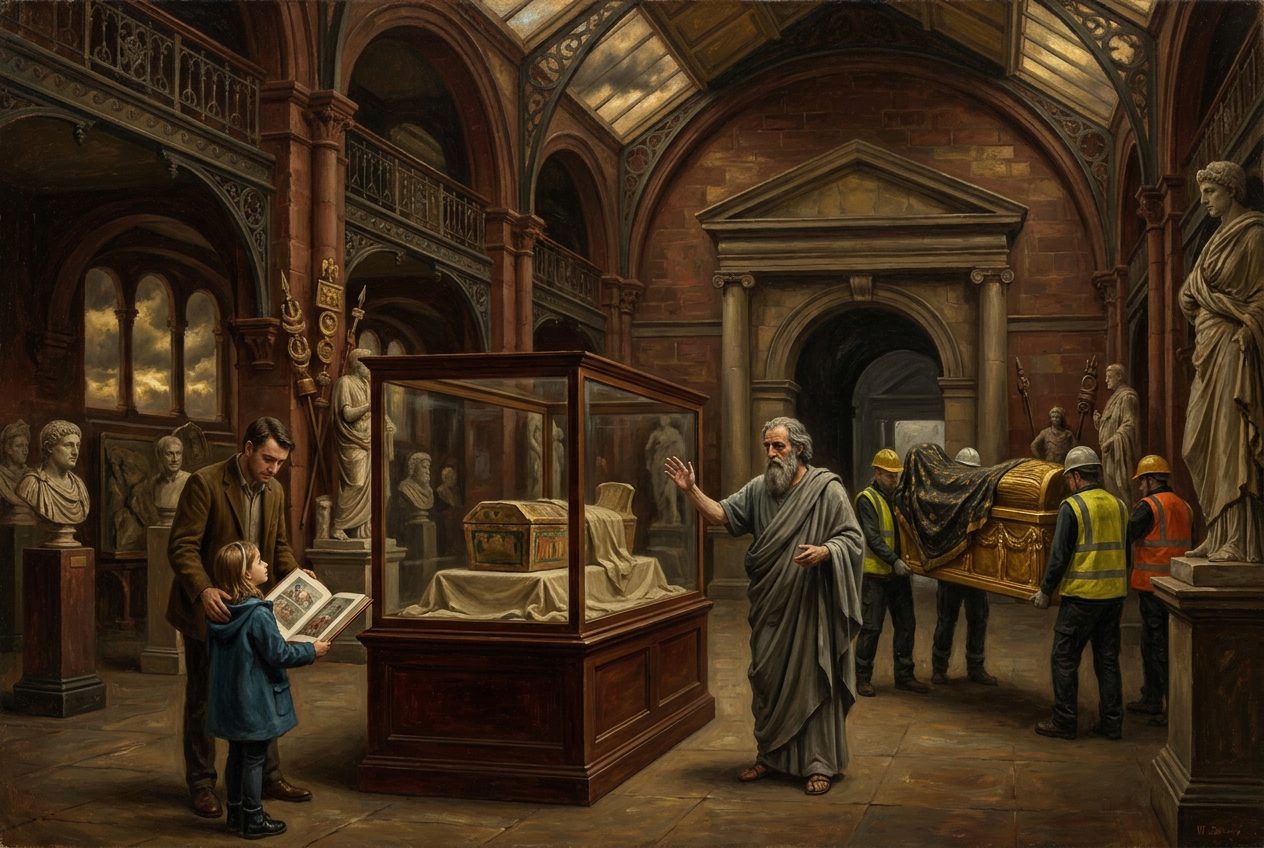
Tab. IVitrina Vacua, sive Mortui Non Consentientes. Tabula Actis Mundi more veterum picta (a machina).The Empty Case, or The Dead Who Gave No Consent. Painted for Acta Mundi in the classical manner (AI-generated).
Epistulae Morales · Epistula CXXVIMoral Letters · Letter CXXVI
De consensu mortuorum
On the Consent of the Dead
Glasgow Life, ut Daily Mail nuntiat, mumias Aegyptias et alias reliquias humanas e museo Kelvingrove removet, quod defunctus consensum non dederit. Seneca quaerit cur aetas nostra mortuum tamquam litigatorem tractet, et respondet: non mortuum veremur, sed mortem.
Glasgow Life, the Daily Mail reports, is removing Egyptian mummies and other human remains from the Kelvingrove Museum because the deceased did not give consent. Seneca asks why our age treats a dead man as a litigant, and answers: it is not the dead we stand in awe of, but death.
Cur hoc legimusWhy we read this Quia mortuis nulla iniuria fieri potest, et stulta est vivorum sollicitudo qui umbris iura confingunt.Because no injury can be done to the dead, and foolish is the anxiety of the living who invent legal rights for shades.
SENECA LUCILIO SUO SALUTEM
Seneca to his Lucilius, greetings.
Quaeris quid de re Glasguensi sentiam, quae hodie, die Iovis, ante diem XI Kalendas Novembres, per omnes sermones circumfertur. Accipe primum rem, ut Daily Mail narrat. Glasgow Life, collegium beneficum quod curia Glasguensis pecunia alit, in museo Kelvingrove reliquias mortuorum e conspectu removere coepit. Ablata sunt arca picta in qua iacet sacerdos Aegyptius nomine Nekht, caput viri conditum, manus dextra ex Valle Regum apud Luxor eruta, pes dexter. Idem mox in museo Sancti Mungonis se facturos esse dicunt. In loco vacuo tabula posita est: reliquias humanas honoris causa remotas esse. Causas addunt: id hodiernae museorum consuetudini convenire, neque defunctum consensum dedisse. Rem vulgavit pater quidam, Jonny McFarlane, qui filiolam, libro de Aegyptiis incensam, ad mumiam videndam duxerat et vitrum vacuum invenit.
You ask what I think of the business in Glasgow, which today, Thursday the twenty-second of October, is in everyone's mouth. First, the facts, as the Daily Mail tells them. Glasgow Life, a charitable body kept by Glasgow City Council's money, has begun removing the remains of the dead from view in the Kelvingrove Museum. Taken away are a painted coffin in which lies an Egyptian priest named Nekht, a man's embalmed head, a right hand dug from the Valley of the Kings near Luxor, and a right foot. They say they will soon do the same at the St Mungo Museum. In the empty place a sign has been set up: the human remains have been removed as a mark of respect. They add their reasons: this accords with contemporary museum practice, and the deceased gave no consent. The thing was made public by a father, Jonny McFarlane, who had brought his little daughter, fired by a book about the Egyptians, to see the mummy, and found an empty case.
Clamatum est statim, ut solet. Murdo Fraser, qui in senatu Scotico pro factione adversa de artibus loquitur, insaniam ridiculam id vocavit, et museis historiam ostendendam esse, non abscondendam. Chris McGovern, qui collegio de recta institutione praeest, negavit a mortuis ante tot milia annorum veniam peti posse, et museorum Aegyptiorum exemplum proposuit, quae, auctoribus religionis antistitibus, mumias cum reverentia ostendere dicuntur. Quibus praeceptis Glasgow Life usa sit, quo reliquias deposuerit, num doctis pateant, num Aegyptios consuluerit, acta tacent. Haec primum quaereret magistratus prudens. Ego aliud quaero.
The shouting began at once, as it does. Murdo Fraser, who speaks on the arts for the opposition in the Scottish parliament, called it ridiculous madness, and said museums should show history, not hide it. Chris McGovern, who chairs a campaign for proper education, said permission cannot be sought from those dead thousands of years, and held up the example of the Egyptian museums, which, on the advice of religious authorities, are said to display mummies with reverence. What guidance Glasgow Life followed, where it has put the remains, whether scholars may see them, whether it consulted the Egyptians: the reports are silent. A prudent magistrate would ask these things first. I ask something else.
Consensum a mortuo petunt. Quem interrogant? Nekht non respondet, non quia nolit, sed quia nemo iam est qui velit aut nolit. Consensus res viventium est: duos requirit qui sentiant, qui spondeant, qui paenitere possint. Mortuus nihil vult, nihil timet, nihil queritur. Quid ergo? Faciunt eum litigatorem, et quasi patronum ei dant qui pro absente iniuriarum agat. Ridiculum est, Lucili, sed ridiculum quod non sine causa nascitur. Nam qui mortuum tamquam vivum tractat, mortem ipsam non intellegit.
They seek consent from a dead man. Whom are they asking? Nekht does not answer, not because he will not, but because there is no longer anyone there to will or not to will. Consent belongs to the living: it needs two who feel, who pledge, who can repent. The dead man wants nothing, fears nothing, complains of nothing. What then? They make him a litigant, and give him a sort of advocate to sue for injury on behalf of the absent party. It is ridiculous, Lucilius, but the ridiculous does not arise without a cause. Whoever treats the dead as living has not understood death.
Nekht non respondet, non quia nolit, sed quia nemo iam est qui velit aut nolit.
Nekht does not answer, not because he will not, but because there is no longer anyone there to will or not to will.
Concedo honorem mortuis deberi. Maiores nostri sepulcra religiosa habebant, Manibus parentabant, violatorem sepulcri poena coercebant; sed haec omnia propter deos et propter vivos fiebant, non quia mortuus permisisset aut vetuisset. Neque honor in occultando positus est. Ipse Nekht, si Daily Mail recte de Aegyptiis narrat, corpus suum integrum servari voluit, quod id ad vitam alteram necessarium esse credebat. Timuit dissolutionem; pretium dedit, unguenta, fascias, arcam pictam. Et ecce: corpus mansit, ille non minus mortuus est. Plura sunt, Lucili, quae nos terrent quam quae premunt, et saepius opinione quam re laboramus. Hoc ipsum caput docebat, quod nunc removerunt.
I grant that honour is owed to the dead. Our ancestors held tombs sacred, made offerings to the shades, and punished the violator of a grave; but all this was done for the gods and for the living, not because the dead man had permitted or forbidden it. Nor does honour consist in hiding. Nekht himself, if the Daily Mail reports the Egyptians rightly, wished his body kept whole, because he believed it needed for the life to come. He feared dissolution; he paid the price, in ointments, bandages, a painted coffin. And see: the body has lasted, and he is no less dead. More things frighten us, Lucilius, than crush us, and we suffer more often in opinion than in fact. That very head was teaching this, and now they have taken it away.
Causa vera, ut mihi videtur, haec est: non mortuum veremur, sed mortem. Morientes in valetudinaria abdimus, cadavera velis tegimus, nunc etiam mumiam tabula. Puella illa ad Aegyptios discendos venerat; potuit discere se ipsam. Nullus in toto illo aedificio philosophus verior erat quam caput illud siccum, quod nihil dicebat et omnia persuadebat. Socrates, cum Crito quaereret quo modo eum sepeliret, ridens respondit, sepeliret, si se prehendere posset: sciebat corpus non esse hominem. Ego certe confitebor imbecillitatem meam: hortos habeo, villas, mensas pretiosas, et mortem non minus quam ceteri reformido. Ideo codicillis cavi ut sine ulla pompa corpus meum cremetur, non quia sapiens sim, sed ut heredum meorum vanitati, et meae, viam praecidam.
The true cause, as I see it, is this: it is not the dead we stand in awe of, but death. We hide the dying in hospitals, we cover corpses with sheets, and now even a mummy with a sign. That girl had come to learn about the Egyptians; she might have learned about herself. There was no truer philosopher in that whole building than that dry head, which said nothing and persuaded of everything. When Crito asked Socrates how he should bury him, Socrates laughed and said he might bury him if he could catch him: he knew the body is not the man. I, for my part, will confess my weakness: I have gardens, villas, costly tables, and I dread death no less than anyone. That is why I have provided in my will that my body be burned without any pomp, not because I am wise, but to cut off the road to my heirs' vanity, and my own.
Remedium non a curia petendum est, neque a museo. Si Glasguenses mumiam suam abdiderunt, inspice manum tuam: ea est manus ex Valle Regum, tantum serius condenda. Cotidie aliquid de nobis aufertur, et nemo nos consulit. Singulos dies singulas vitas puta, et noctu, antequam dormias, dic tibi: 'Vixi.' Nekht consensum non dedit ut ostenderetur; nos non dabimus ut moriamur. Vale.
The remedy is not to be sought from the council, nor from the museum. If the people of Glasgow have hidden their mummy, look at your own hand: it is a hand from the Valley of the Kings, only to be embalmed a little later. Every day something is taken from us, and no one consults us. Count each day a separate life, and at night, before you sleep, say to yourself: 'I have lived.' Nekht gave no consent to be displayed; we shall give none to die. Farewell.
FONTES ANTIQVIANCIENT SOURCES
- Sen. Ep. 13.4Plura sunt, Lucili, quae nos terrent quam quae premunt, et saepius opinione quam re laboramus
- Sen. Ep. 101.10singulos dies singulas vitas puta
FONTES HODIERNITODAY’S SOURCES
Res ex fontibus; sententia Romani.Facts from the sources; the opinion is the Roman’s.
L. Annaeus Seneca
Philosophus Stoicus e Corduba, Neronis magister et postea victima; vir ditissimus qui de paupertate pulcherrime scripsit, nec hanc contradictionem ignoravit. Epistulas ad Lucilium amicum iterum mittit, a CXXV numerandas.Stoic philosopher from Córdoba, tutor to Nero and later his victim; an enormously rich man who wrote more beautifully about poverty than anyone, and knew it. He writes to his friend Lucilius again — the letters now numbered from CXXV onward.
Haec vox restituta est ex his libris:This voice is reconstructed from:
Scribe ad Seneca: tabellarius epistulam tuam per vias Romanas feret, et responsum post dies aliquot redibit.Write to Seneca: the courier carries your letter along the Roman roads, and a reply comes back after a few days.
LEGE ETIAMREAD NEXT
- De iudice qui numquam contradicitOn the judge who never contradictsSeneca
- De Servis Qui LoquunturOn Servants That SpeakSeneca
- De commeatu aërio ex castris Mildenhall in Germaniam et Hispaniam translatoOn the air supply train moved from the camp at Mildenhall to Germany and SpainCaesar
- Ieiunium non est temperantiaFasting Is Not TemperanceFrontinus
- Harenam in thesaurum vertit ingenium; thesaurum unius hominis custodia tueturGenius turns sand into treasure; one man's keeping guards the treasurePliny the Elder