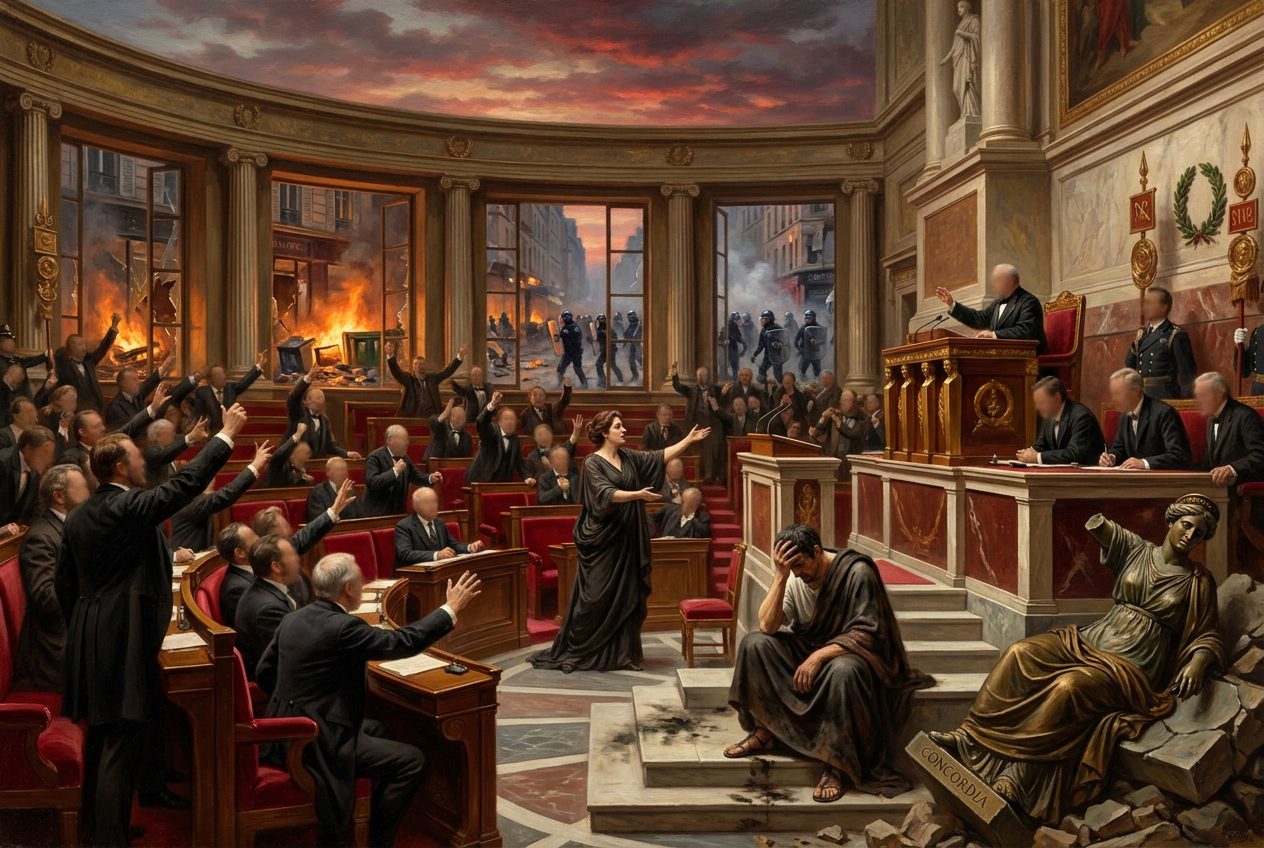
Tab. IUrbs Ardet, Curia Plaudit, sive Factionum Mercatus. Tabula Actis Mundi more veterum picta (a machina).The City Burns, the Chamber Applauds, or The Marketplace of Factions. Painted for Acta Mundi in the classical manner (AI-generated).
De Coniuratione et Avaritia · De incendio Gallico et curia clamosaOn Conspiracy and Greed · On the Gaulish fire and the clamorous Curia
Urbs ardet, curia plaudit
The City Burns, the Chamber Applauds
Ut Le Figaro nuntiat, in curia Borbonia Mathilde Panot, factionis LFI princeps, crimen turbarum quae post agmina contra caritatem annonae ortae sunt in ministros retorsit, dum alii factionem eius incusant. Duae partes de culpa certant; de remedio nemo.
According to Le Figaro, in the Palais Bourbon Mathilde Panot, leader of the LFI faction, turned the charge for the riots that followed the marches against the high cost of living back on the ministers, while others blamed her faction. Both sides contend over the blame; over the remedy, no one.
Cur hoc legimusWhy we read this Quia dum urbes flagrant, factiones in curia de culpa tantum dimicant, non de salute rei publicae.Because while the cities burn, the factions in the senate fight only over blame, not over the salvation of the commonwealth.
Omnis res publica quae diu stetit non tam hostium armis quam civium studiis labefactatur. Nam ubi metus externus abest, animi ad contentionem vertuntur, neque iam quaeritur quid patriae, sed quid partibus conducat. Ita incendium, quod boni omnes restinguere debebant, factiones pro foro habent, ubi gratiam aucupentur. Neque haec res mihi ignota. Ego ipse tribunus plebis fui eo anno quo curia rogo Clodii conflagravit, neque contionibus meis flammam minui. Quare de his rebus scribo non ut innocens, sed ut peritus.
Every commonwealth that has stood long is shaken less by the arms of enemies than by the passions of its citizens. For when fear from without is gone, minds turn to contention, and men no longer ask what serves the fatherland, only what serves the faction. So a fire that all good men ought to put out becomes, for the factions, a marketplace in which to hunt for favour. Nor is this unknown to me. I was myself tribune of the plebs in the year the Curia burned as Clodius' pyre, and my harangues did nothing to lower the flame. I write of these things, therefore, not as an innocent, but as one who knows.
Die Saturni, ante diem XVI Kalendas Novembres, per Galliam contra caritatem annonae in vias itum est: centum et decem agmina fuisse, quingenta quinquaginta milia hominum ut ministerium rerum internarum aestimat, octingenta milia ut collegium CGT affirmat, Le Figaro tradit. In margine agminum, ut et Le Figaro et Le JDD narrant, per plures urbes tabernae direptae, receptacula purgamentorum incensa, viae vastatae. Lutetiae, ut Le JDD scribit, cohors vigilum quae CRS 8 appellatur, ducentorum hominum, toto biduo in regionibus Halles et Madeleine adversus praedatores pugnavit. Laurens Nuñez, rerum internarum minister, magistratu se abdicare voluit; praeses Emmanuel Macron recusavit, continuitatem imperii vigilum causatus, eumque iussit, ut Le Figaro refert, defectus providentiae et indiciorum qui turbas pepererint palam facere.
On Saturday, the seventeenth of October, people took to the streets across Gaul against the high cost of living: a hundred and ten marches, Le Figaro reports, with five hundred and fifty thousand marchers by the Interior Ministry's estimate, eight hundred thousand by the CGT's claim. On the margins of the marches, as both Le Figaro and Le JDD relate, shops were looted in several cities, bins set on fire, streets wrecked. In Paris, Le JDD writes, the police company called CRS 8, two hundred strong, fought the looters for two whole days in the districts of Les Halles and the Madeleine. Laurent Nuñez, Minister of the Interior, wished to resign; President Emmanuel Macron refused, pleading continuity in the command of the police, and ordered him, as Le Figaro reports, to lay open the failures of foresight and intelligence that bred the violence.
Hodie, hora post meridiem quarta et dimidia, ut idem Le Figaro narrat, in curia ingens strepitus. Surgit Mathilde Panot; et cum alii motum eius turbarum auctorem arguerent, crimen retorquet: ministrorum imperitia cladem factam, ius conveniendi ab iis non tutum; se vim reprobare; ministros, factionem suam incusando, sibi parcere ne quod ex re consequeretur ipsi subirent. Plaudunt sui. Quis eam primus incusaverit, quid ministri responderint, acta non produnt, quippe quorum pars maior abscisa est. Hoc primum quaesisset Romanus magistratus.
Today, at half past four in the afternoon, the same Le Figaro relates, an immense uproar filled the chamber. Mathilde Panot rises; and since others accused her movement of authoring the riots, she throws the charge back: the ministers' incompetence made the disaster, they failed to protect the right to assemble; she condemns violence; by accusing her faction the ministers spare themselves from drawing the political consequences. Her own side applauds. Who accused her first, what the ministers answered, the report does not disclose, since the greater part of it is cut off. A Roman magistrate would have asked that first.
Videte igitur quid actum sit. Duae partes, quarum altera imperium, altera contionem tenet, de una re consentiunt: incendium utile esse. Ministris prodest turbas in factionem conferre, ne de vigiliis neglectis rationem reddant; factioni prodest ministros incusare, ne quis quaerat quid suae voces ardori addiderint. Interea tabernarius cuius merx direpta est neutri curae; neque civis cui pretia crescunt quicquam remedii audit. Recte apud nos Cato: «iam pridem equidem nos vera vocabula rerum amisimus». Nunc minister qui deficit retinetur, idque continuitas vocatur; factio quae clamat, defensio libertatis.
See, then, what has been done. Two parties, one holding power, the other the platform, agree on a single thing: the fire is useful. It profits the ministers to lay the riots at the faction's door, so that they need not account for neglected watch; it profits the faction to accuse the ministers, so that no one asks what its own words added to the blaze. Meanwhile the shopkeeper whose goods were plundered concerns neither; and the citizen whose prices climb hears no remedy at all. Cato put it rightly among us: "we have long since lost the true names of things." Now a minister who fails is kept on, and this is called continuity; a faction that shouts, the defence of liberty.
At maiores nostri, coniuratione Catilinae deprehensa, in senatu dissenserunt quidem, Caesar clementiam, Cato severitatem suadens; sed de poena, non de culpa certabant, et post disceptationem res acta est. Hic contra de culpa lis sine fine, de poena silentium. Accedit quod, ut Le Figaro monet, eodem tempore lex de aerario anni proximi in curia, quae iam inde ab anno MMXXIV nullam maiorem partem habet, agitur. Ita fit quod semper fit ubi partes regnant: «concordia parvae res crescunt, discordia maximae dilabuntur».
Our ancestors, when Catiline's conspiracy was uncovered, did indeed disagree in the senate, Caesar urging clemency, Cato severity; but they contended over the penalty, not the blame, and after the debate the thing was done. Here, by contrast: on blame, a suit without end; on penalty, silence. Add to this that, as Le Figaro observes, the budget for next year is at this very moment before a chamber that has had no majority since 2024. So there comes to pass what always comes to pass where factions rule: "by concord small states grow great; by discord the greatest fall apart."
Remedium vetus est neque obscurum. Praedatores lege et iudicio coerceantur, non contionibus. Ministri rationes de indiciis neglectis non intra domum, sed coram curia reddant; et si culpa reperta est, qui deliquit abeat, quamvis invitus princeps. Factiones, si rem publicam amant, prius de annona quam de invidia disputent. Sed vereor ne lubido gloriandi maior sit quam cura servandi. Nam ubi omnes accusant, nemo iudicat; ubi nemo iudicat, ignis ipse sententiam dicit.
The remedy is old and not obscure. Let looters be restrained by law and the courts, not by speeches. Let the ministers render account of the neglected intelligence not behind closed doors but before the chamber; and if fault is found, let the guilty man go, however unwilling his chief. Let the factions, if they love the commonwealth, argue about the price of bread before they argue about spite. But I fear the lust for glory is greater than the care for preservation. For when all accuse, no one judges; and when no one judges, the fire itself pronounces sentence.
Nam ubi omnes accusant, nemo iudicat; ubi nemo iudicat, ignis ipse sententiam dicit.
For when all accuse, no one judges; and when no one judges, the fire itself pronounces sentence.
FONTES ANTIQVIANCIENT SOURCES
- Sall. Cat. 52.11iam pridem equidem nos vera vocabula rerum amisimus: quia bona aliena largiri liberalitas, malarum rerum audacia fortitudo vocatur
- Sall. Iug. 10.6concordia parvae res crescunt, discordia maximae dilabuntur
FONTES HODIERNITODAY’S SOURCES
- Le Figaro« C’est un ping-pong permanent » : à l’Assemblée, LFI et le gouvernement s’accusent mutuellement de la responsabilité des violences urbaines
- Le JDDViolences urbaines : qu’est-ce que l’unité spécialisée CRS 8 ?
Res ex fontibus; sententia Romani.Facts from the sources; the opinion is the Roman’s.
Scribe ad Sallust: tabellarius epistulam tuam per vias Romanas feret, et responsum post dies aliquot redibit.Write to Sallust: the courier carries your letter along the Roman roads, and a reply comes back after a few days.
LEGE ETIAMREAD NEXT
- Urbs VenalisA City for SaleSallust
- De volucribus sine nido: Praedatores in caelo Hispaniae se exercentOn Birds Without a Nest: Predators Exercise in the Skies of HispaniaPliny the Elder
- Prorogatio aerarii: tributum quod nemo rogavitThe Prorogued Treasury: A Tax Nobody ProposedHortensia
- Curam annonae suscipe, dictaturam recusaTake the care of the grain supply; refuse the dictatorshipAugustus