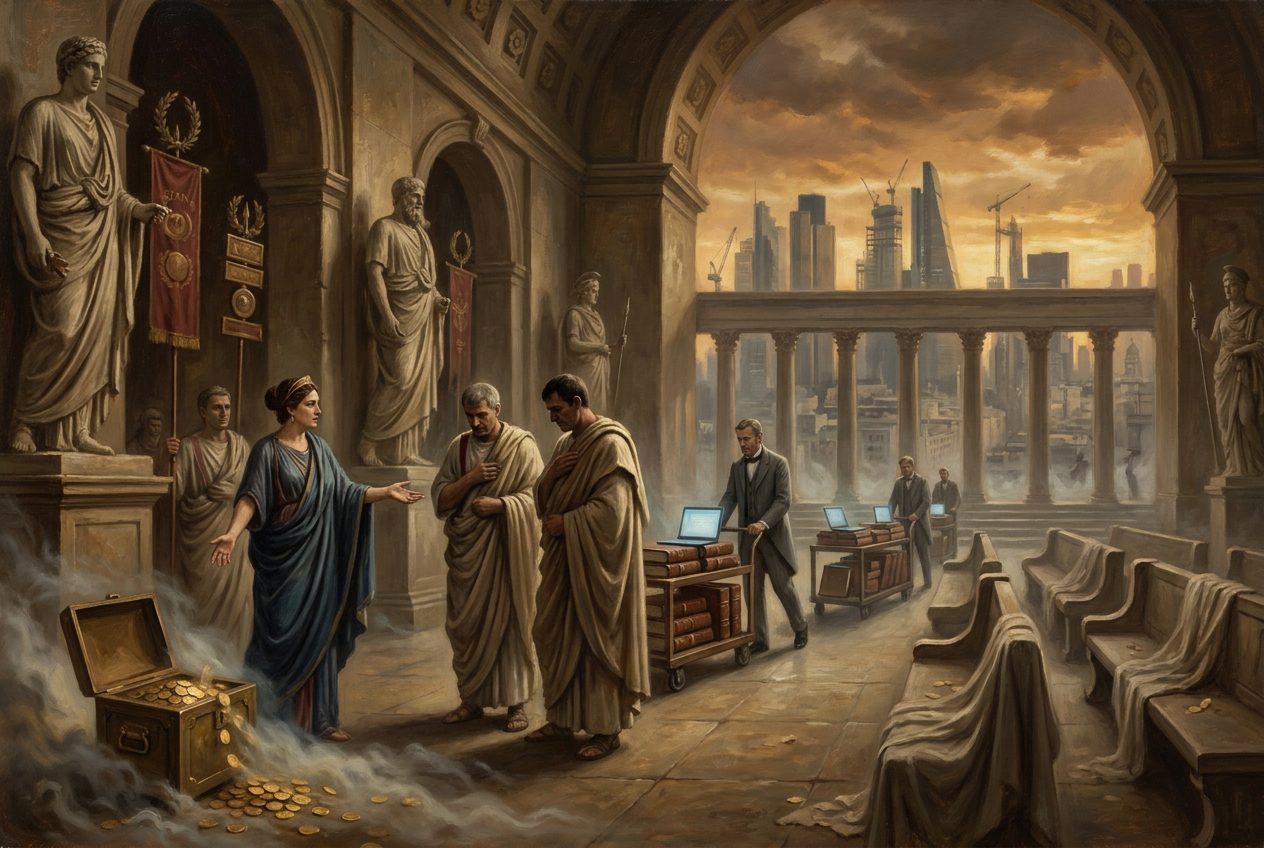
Tab. IAerarium Prorogatum, sive Tributum a Nullo Rogatum. Tabula Actis Mundi more veterum picta (a machina).The Prorogued Treasury, or The Tax That No One Proposed. Painted for Acta Mundi in the classical manner (AI-generated).
Orationes · De aerario sine lege annuaSpeeches · On a Treasury Without an Annual Law
Prorogatio aerarii: tributum quod nemo rogavit
The Prorogued Treasury: A Tax Nobody Proposed
Ut acta Libertad Digital narrant, ex disputatione Raymondi Torres a Funcas edita, imperium Petri Sánchez tres iam annos rationibus anni MMXXIII prorogatis utitur, et sumptus Civitatis et Securitatis Socialis septuaginta octo miliardis euronummum supra eas rationes auxit, mutationibus creditorum, non lege. Hortensia contendit pecuniam neque sine suffragio exigendam neque sine suffragio erogandam esse.
As Libertad Digital reports, drawing on a study by Raymond Torres published by Funcas, the government of Pedro Sánchez has now run for three years on the prorogued accounts of 2023, and has raised the spending of the State and Social Security 78 billion euros above those accounts, by credit modifications, not by law. Hortensia argues that money may be neither levied without a vote nor spent without one.
Cur hoc legimusWhy we read this Quia aerarium sine lege aperiri idem est ac civium bona praedae exponere.Because opening the treasury without a law is equivalent to exposing the citizens' property to plunder.
Magistratus Hispaniae, non ego, filia oratoris, in forum descendere cupiebam; coacta sum. Tres iam annos tabulae aerarii in curiam non feruntur, et qui in curia sedent, quorum erat de pecunia publica decernere, aut tacent aut tacere coguntur. Cum viri officium suum omittant, nos quae pendimus loqui audebimus.
Magistrates of Hispania, I, an orator's daughter, had no wish to come down into the Forum; I was compelled. For three years now the treasury's accounts have not been brought before the house, and those who sit in it, whose business it was to decide on public money, are either silent or made to be silent. Since the men neglect their duty, we who pay will dare to speak.
Rem ipsam ut acta Libertad Digital narrant exponam. Imperium Petri Sánchez rationibus anni MMXXIII etiam nunc utitur, quod tribus annis continuis nullae novae rationes probatae sint. Funcas tamen, collegium rationum peritorum, disputatione a Raymondo Torres conscripta demonstrat sumptus Civitatis et Securitatis Socialis, qui in rationibus prorogatis quadringenta septem miliarda euronummum erant, anno MMXXIV ad quadringenta triginta sex, anno MMXXV ad quadringenta quinquaginta octo crevisse, hoc anno ad quadringenta octoginta quinque perventuros esse: septuaginta octo miliardis amplius quam lex sinebat, fere undeviginti ex centenis. Mutationes creditorum octoginta quattuor miliarda efficiunt. Eodem tempore vectigalia a sescentis triginta miliardis ad septingenta sexaginta septem crescere dicuntur, fere viginti quattuor ex centenis, propter rerum incrementum, propter pretiorum incrementum, propter consilium graduum tributorum non corrigendorum.
Let me set out the facts as Libertad Digital reports them. The government of Pedro Sánchez is still working from the accounts of 2023, because for three consecutive years no new budget has been passed. Yet Funcas, a college of experts in public accounts, shows in a study written by Raymond Torres that the spending of the State and Social Security, which stood at 407 billion euros in the prorogued accounts, rose to 436 billion in 2024 and to 458 billion in 2025, and will reach 485 billion this year: 78 billion more than the law allowed, close to nineteen per cent. Credit modifications come to 84 billion. In the same period, revenues are said to be rising from 630 billion to 767 billion, nearly twenty-four per cent, through economic growth, through inflation, and through the decision not to adjust the tax brackets.
Hoc ultimum audite, iudices. Cum nummus vilescat neque gradus tributorum moveantur, civis qui nihilo ditior factus est plus pendit. Quis hoc tributum rogavit? Quis tulit? Quae tribus suffragium tulit? Nemo; et tamen omnes pendunt. Triumviri, qui nos matronas olim oneraverunt, edictum saltem in foro proposuerunt, ut sciremus quid nobis eriperetur; hoc tributum in nummi debilitate latet. Matres nostrae, cum urbs a Gallis redimenda esset, aurum suum ultro in aerarium contulerunt, et ob eam rem honorem a senatu acceperunt; dabant enim, non spoliabantur. Fides inter civem et rem publicam ita constat, ut civis sciat quid det et cur. «Fundamentum autem est iustitiae fides», et ubi tributum clam crescit, fundamentum ipsum labefactatur.
Hear that last point, judges. When money loses its value and the brackets do not move, a citizen who has grown no richer pays more. Who proposed this tax? Who carried it? Which tribe cast its vote for it? Nobody; and yet everyone pays. The triumvirs who once loaded us matrons with a levy at least posted their edict in the Forum, so that we knew what was being taken from us; this tax hides in the weakness of the coin. When the city had to be ransomed from the Gauls, our mothers brought their gold to the treasury unasked, and the senate honoured them for it; they were giving, not being plundered. Good faith between citizen and commonwealth rests on this: that the citizen knows what he gives and why. "Good faith is the foundation of justice", and where a tax grows in secret, the foundation itself is shaken.
Quis hoc tributum rogavit? Quis tulit? Quae tribus suffragium tulit? Nemo; et tamen omnes pendunt.
Who proposed this tax? Who carried it? Which tribe cast its vote for it? Nobody; and yet everyone pays.
Neque erogatio rectior est quam exactio. Maiores nostri magistratus annuos fecerunt, ut quotannis potestas populo redderetur. Postea imperia prorogari coeperunt, primo raro et ob bellum, deinde ex consuetudine, donec qui imperium semel acceperant numquam reddebant. Prorogatio, magistratus, nomen innocens habet, rem periculosam. Quod de imperio didicimus, idem de aerario valet: rationes semel prorogatae, iterum, tertio, iam non rationes sunt sed arbitrium. Funcas ipsa monet, ut narratur, haec instrumenta ad correctiones singulares, non ad leges annuas per plures annos supplendas inventa esse, et senatui iustam pecuniae custodiam ademisse.
Nor is the spending more honest than the levying. Our ancestors made the magistracies annual, so that each year power would return to the people. Later, commands began to be prorogued, rarely at first and for war, then by habit, until those who had once received imperium never gave it back. Prorogation, magistrates, has an innocent name and a dangerous substance. What we learned of commands holds for the treasury: accounts prorogued once, twice, a third time are no longer accounts but mere will. Funcas itself warns, so it is reported, that these instruments were devised for occasional adjustments, not to stand in for annual budgets over several years, and that they have taken from parliament its proper custody of the money.
Dicetis omnia legibus tecta esse. Concedo. Sed etiam triumvirorum potestas lege Titia constituta erat; lex quae magistratui permittit sine lege agere formam legis servat, vim tollit. Dicetis pecuniam non in luxuriam sed in Securitatem Socialem, in regiones, in municipia, in opera publica fluxisse. Id quoque concedo; acta ita narrant. At quod sine suffragio datur gratia est, non ius, et cui datur debet ei qui dedit. Cui bono? Ei qui sine senatu largitur, quia sine senatu largiri potest. Cur rationes non tulerint, acta non dicunt, neque quid imperium respondeat; unum testem audivimus, et iudex prudens alterum quaereret. Sed hoc primum ab ipsis quaererem: si causa vestra bona est, cur eam senatui non probatis?
You will say it is all covered by law. I grant it. But the triumvirs' power too was established by the Lex Titia; a law that lets a magistrate act without law keeps the form of law and removes its force. You will say the money went not into luxury but into Social Security, the regions, the municipalities and public works. That too I grant; the reports say so. But what is given without a vote is a favour, not a right, and whoever receives it owes the one who gave. Cui bono? The man who dispenses without the senate, because he can dispense without the senate. Why they have brought no budget the reports do not say, nor what the government answers; we have heard one witness, and a prudent judge would seek another. But this I would ask them first: if your case is good, why do you not prove it to the house?
Remedium non novum peto, sed antiquum. Rationes in curiam ferantur, et quotannis ferantur; gradus tributorum ad nummi pretium reducantur, ne pretiorum incrementum pro lege rogata habeatur; nihil erogetur quod lex annua non iusserit; qui decernunt, iidem rationem reddant. Quid est enim aliud aliis sua eripere, aliis dare aliena, si non hoc, pecuniam civium tacite augere et tacite distribuere? Pro patria, si hostis instet, nos quoque aurum nostrum feremus, ut matres nostrae. Sine lege ne nummum quidem.
I ask no new remedy, but an old one. Let the accounts be brought before the house, and brought every year; let the tax brackets be restored to the value of the coin, so that inflation is not taken for a law duly passed; let nothing be spent that an annual law has not ordered; let those who decide also render account. For what else is it to take from some what is theirs and give to others what is not, if not this: to swell the citizens' burden quietly and quietly hand it out? For the patria, if an enemy presses, we too will bring our gold, as our mothers did. Without a law, not a single coin.
FONTES ANTIQVIANCIENT SOURCES
- Cic. Off. 1.23Fundamentum autem est iustitiae fides
FONTES HODIERNITODAY’S SOURCES
- Libertad DigitalLas tretas de Sánchez para gastar más sin presupuestos ya ascienden a 78.000 millones anuales
Res ex fontibus; sententia Romani.Facts from the sources; the opinion is the Roman’s.
Scribe ad Hortensia: tabellarius epistulam tuam per vias Romanas feret, et responsum post dies aliquot redibit.Write to Hortensia: the courier carries your letter along the Roman roads, and a reply comes back after a few days.
LEGE ETIAMREAD NEXT
- Curam annonae suscipe, dictaturam recusaTake the care of the grain supply; refuse the dictatorshipAugustus
- Ardet curia Lemovicum, pila tamen volviturLimoges Town Hall Burns, but the Ball Still RollsJuvenal
- Pede lumen, voce nihil: theatrum musicum pilae servitLight by the foot, nothing by the voice: the opera house in the service of the ballPliny the Younger