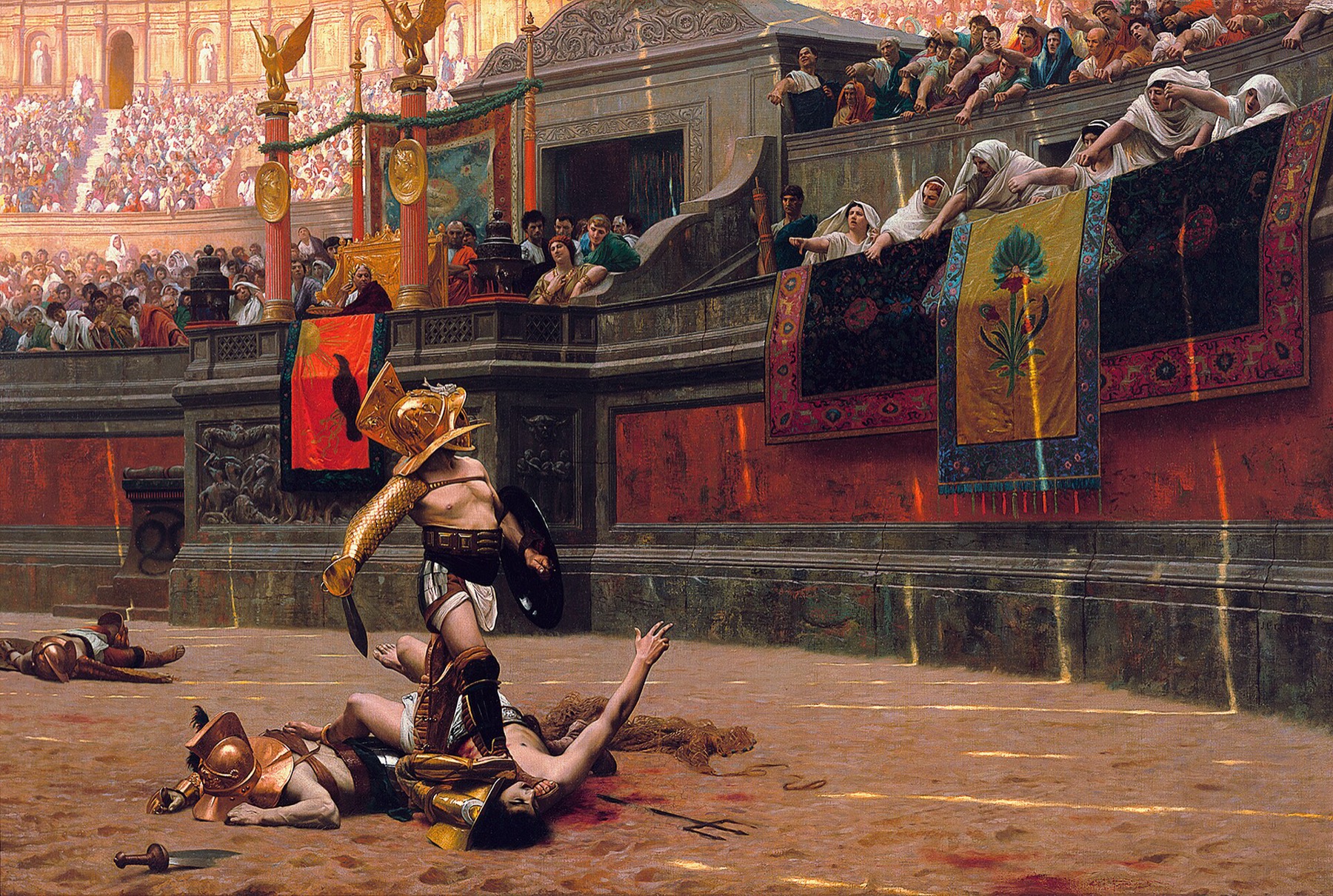
Tab. IIo. Leo Gérôme, Pollice verso (MDCCCLXXII).Jean-Léon Gérôme, Pollice Verso (1872).
Saturae · De harena inter ruinasSatires · On the Arena Among the Ruins
Ardet curia Lemovicum, pila tamen volvitur
Limoges Town Hall Burns, but the Ball Still Rolls
Post tumultus diei Saturni, ut Le JDD et Euronews nuntiant, praeses Macron ministri Nuñez abdicationem recusavit et defuisse providentiam confessus est; idem Nuñez, ut Le Figaro refert, ludos pediludii nullo modo revocari pronuntiavit. Habet res publica, quod tueatur, harenam; tabernas non habet.
After Saturday's riots, as Le JDD and Euronews report, President Macron refused Interior Minister Nuñez's resignation and confessed that foresight had failed; the same Nuñez, as Le Figaro reports, declared that the football matches would on no account be called off. The state has something it can protect: the arena. The shops it cannot.
Cur hoc legimusWhy we read this Quia urbe ardente ludi circenses solos praestare possunt magistratus ne plebs furore concitetur.Because while the city burns, the magistrates can guarantee only circus games lest the rabble be provoked.
Die Saturni, ante diem XVI Kalendas Novembres, Gallia contra caritatem annonae in vias descendit. Quot homines, ne ipsi quidem consentiunt: quingenta quinquaginta milia numeravit ministerium rerum internarum, octingenta milia auctores pompae. Ardebant deinde tabernae, diripiebantur merces, et curia Lemovicum incendio vastata est. Ut Le JDD ex actis ministerii refert, mille fere et quingenti mercatores damnum acceperunt, ex vigilibus et militibus urbanis nongenti nonaginta septem vulnerati sunt, septem graviter, duo milia trecenti nonaginta septem homines comprehensi. Die Solis Lutetiae rursus spoliatae tabernae, effracta ianua insulae in regione decima, trecenti quinquaginta unus abducti.
On Saturday, the sixteenth day before the Kalends of November, Gaul went down into the streets against the cost of living. How many went? Not even the counters agree. Then the shops burned, the goods were carried off, and the town hall of Limoges was gutted by fire. As Le JDD reports from the ministry's figures, some fifteen hundred shopkeepers suffered damage; of the police and gendarmes, nine hundred and ninety-seven were wounded, seven seriously; two thousand three hundred and ninety-seven people were arrested. On Sunday Paris was plundered again: shops looted, the front door of a tenement smashed in the 10th arrondissement, three hundred and fifty-one hauled away.
Quid magistratus? Laurentius Nuñez, rerum internarum minister, ut Le JDD et Euronews narrant, magistratum deponere voluit; Emmanuel Macron recusavit, quod continuum in vigiles imperium his temporibus necessarium esse diceret, iussitque novos agendi modos contra populatores quam celerrime in vias inferri. Idem fassus est providentiam et exploratores defecisse. Postridie idem Nuñez, adstante Sebastiano Lecornu, primo ministro, ut Le Figaro refert, pronuntiavit de certamine quod die Martis Lutetiae inter Parisienses et Barcinonenses committeretur, deque ceteris Europaei poculi ludis, Insulis quoque, nihil esse dubii: ludos non revocari. Praeses interea in Arabiam proficiscitur, Kuvaitum, Emiratus, Bahrainum, Quatarum, ut Euronews docet, oleum et gasolium quaesiturus ut pretia minuantur.
And the magistrates? Laurent Nuñez, minister of the interior, wished to lay down his office, as Le JDD and Euronews tell it; Emmanuel Macron refused, saying that continuous command of the police was needed in times like these, and ordered new methods of action against the rioters to be put on the streets as fast as possible. He also confessed that foresight and intelligence had failed. The next day the same Nuñez, with Sébastien Lecornu, the prime minister, at his side, declared, as Le Figaro reports, that for Tuesday's match in Paris between Paris Saint-Germain and Barcelona, and for the other European Cup fixtures, Lille's among them, the question does not arise: the matches are not called off. Meanwhile the President sets out for Arabia, for Kuwait, the Emirates, Bahrain and Qatar, as Euronews informs us, to hunt for oil and diesel and bring the prices down.
Memini Domitianum, cum piscator rhombum ingentem attulisset, amicos suos in Albanum convocasse, graves viros, pallidos, ut sententias dicerent quo modo tanta belua coqueretur. Ridebamus tum: imperium orbis terrarum, concilium principis, et de patina deliberatur! Nunc consilium rerum adversarum indicitur, primus minister sedet, tabernae fumant; et quid primum prodit in vulgus ex aedibus magistratus? De pila. Ibi saltem piscis novus erat et rarus; hic res cottidiana, globus coriaceus viginti duobus calcibus pulsatus.
I remember Domitian: a fisherman brought him an enormous turbot, and he summoned his friends to the Alban villa, grave men, pale men, to give their opinions on how such a monster should be cooked. We laughed at the time. The empire of the world, the council of the prince, and the agenda is a casserole! Now a crisis cell is convened, the prime minister takes his seat, the shops are smoking; and what is the first thing to come out of the minister's house to the public? The ball. Domitian at least had a fish that was new and rare; here it is the everyday article, a leather sphere kicked about by twenty-two feet.
Novi formulam veterem, quam olim ipse de populo nostro scripsi: «duas tantum res anxius optat, / panem et circenses». Sed aspice quam diligenter nostri magistratus eam dimidiaverint. Panem plebs postulavit, hoc est annonam vilem, ignem tolerabilem in lucernis et curribus; panis ille in Arabia quaeritur, apud reges alienos, et emendus est. Circenses autem domi parati, gratuiti, certi, nulla seditione revocandi. Quod petitur, peregre mendicatur; quod non petitur, domi largiter praestatur.
I know the old formula; I wrote it myself, long ago, about our own people: the anxious crowd longs for two things only, bread and circuses. But observe how carefully our magistrates have cut it in half. The people asked for bread, that is, a cheap annona, fuel they can afford for their lamps and their cars; that bread is being sought in Arabia, from foreign kings, and it has to be paid for. The circuses, on the other hand, are ready at home, free, guaranteed, proof against any riot. What is asked for is begged abroad; what nobody asked for is lavished at home.
Quod petitur, peregre mendicatur; quod non petitur, domi largiter praestatur.
What is asked for is begged abroad; what nobody asked for is lavished at home.
Neque tamen ignibus istis plaudo. Qui curiam incendit, panem non quaerit; qui tabernam spoliat, pretia non minuit, sed auget. Finge tabernarium aliquem, qui viginti annos ante lucem surrexit, qui fenus solvit, qui tributa pependit: is mane vitra fracta numerat et scopis cinerem verrit, dum iuvenis cum calceis furto ablatis domum ridens redit. Ecce pauper rursus pauperem spoliatum videt, et utrumque divitum fastidium nescit. Vigiles autem, quorum mille fere vulnerati iacent, die Martis harenam custodient; tabernam quis custodiet?
Not that I applaud those fires. The man who burns a town hall is not looking for bread; the man who loots a shop does not lower prices, he raises them. Imagine some shopkeeper who has risen before dawn for twenty years, paid his interest, paid his taxes: in the morning he counts his broken glass and sweeps up the ash with a broom, while a youth strolls home laughing in stolen trainers. So the poor man watches the poor man robbed again, and neither of them ever sees the disdain of the rich. And the police, nearly a thousand of whom lie wounded, will guard the arena on Tuesday. Who will guard the shop?
De abdicatione quid dicam? Obtulit minister poenam, praeses veniam dedit antequam culpa quaereretur; fabula acta est, plausus nullus. Defuisse exploratores fatentur, quasi tempestas inopinata e caelo cecidisset, cum per totam provinciam centum et decem pompae palam indictae essent. Scilicet in harena omnia praevidentur: hora, porta, sedes, numerus fautorum; in viis nihil.
What shall I say of the resignation? The minister offered his punishment, the President granted pardon before anyone had looked for the fault; the play was performed, and nobody clapped. Intelligence failed, they confess, as though some unforeseen storm had dropped from the sky, when the marches had been announced openly across the whole province. Naturally, in the arena everything is foreseen: the hour, the gate, the seat, the number of fans. In the streets, nothing.
Remedium non philosophi sed patris familias est. Prius vias, deinde stadium; prius annonam, deinde poculum; prius tabernarium, deinde fautorem. Magistratus qui forum tenere non potest, harena ne glorietur. Dum haec non fiunt, hoc unum titulo inscribatur in curia Lemovicum, si quis paries supererit: Hic ardebat res publica; ludi tamen suo die acti sunt.
The remedy belongs not to a philosopher but to any head of a household. First the streets, then the stadium; first the annona, then the cup; first the shopkeeper, then the fan. A magistrate who cannot hold the forum should not boast of the arena. Until this is done, let one inscription be cut on the town hall of Limoges, if any wall is left standing: Here the Republic burned; the games, however, were played on schedule.
FONTES ANTIQVIANCIENT SOURCES
- Juv. 10.80–81duas tantum res anxius optat, / panem et circenses
FONTES HODIERNITODAY’S SOURCES
- Le FigaroViolences du 17 octobre : Laurent Nuñez exclut une remise en cause de la tenue des prochains matchs de football
- Le JDDÉmeutes du 17 octobre : Emmanuel Macron a refusé la démission de Laurent Nuñez et demande de déployer «de nouveaux modes d'action contre les casseurs»
- EuronewsEmmanuel Macron rejects resignation of interior minister Laurent Nuñez
Res ex fontibus; sententia Romani.Facts from the sources; the opinion is the Roman’s.
Scribe ad Juvenal: tabellarius epistulam tuam per vias Romanas feret, et responsum post dies aliquot redibit.Write to Juvenal: the courier carries your letter along the Roman roads, and a reply comes back after a few days.
LEGE ETIAMREAD NEXT
- Panem et Circenses, Nunc Domum AllataBread and Circuses — Now Delivered to Your DoorJuvenal
- Pede lumen, voce nihil: theatrum musicum pilae servitLight by the foot, nothing by the voice: the opera house in the service of the ballPliny the Younger
- De stationeOf the postMarcus Aurelius
- Persona detracta, vox eademThe Mask Removed, the Voice UnchangedTacitus