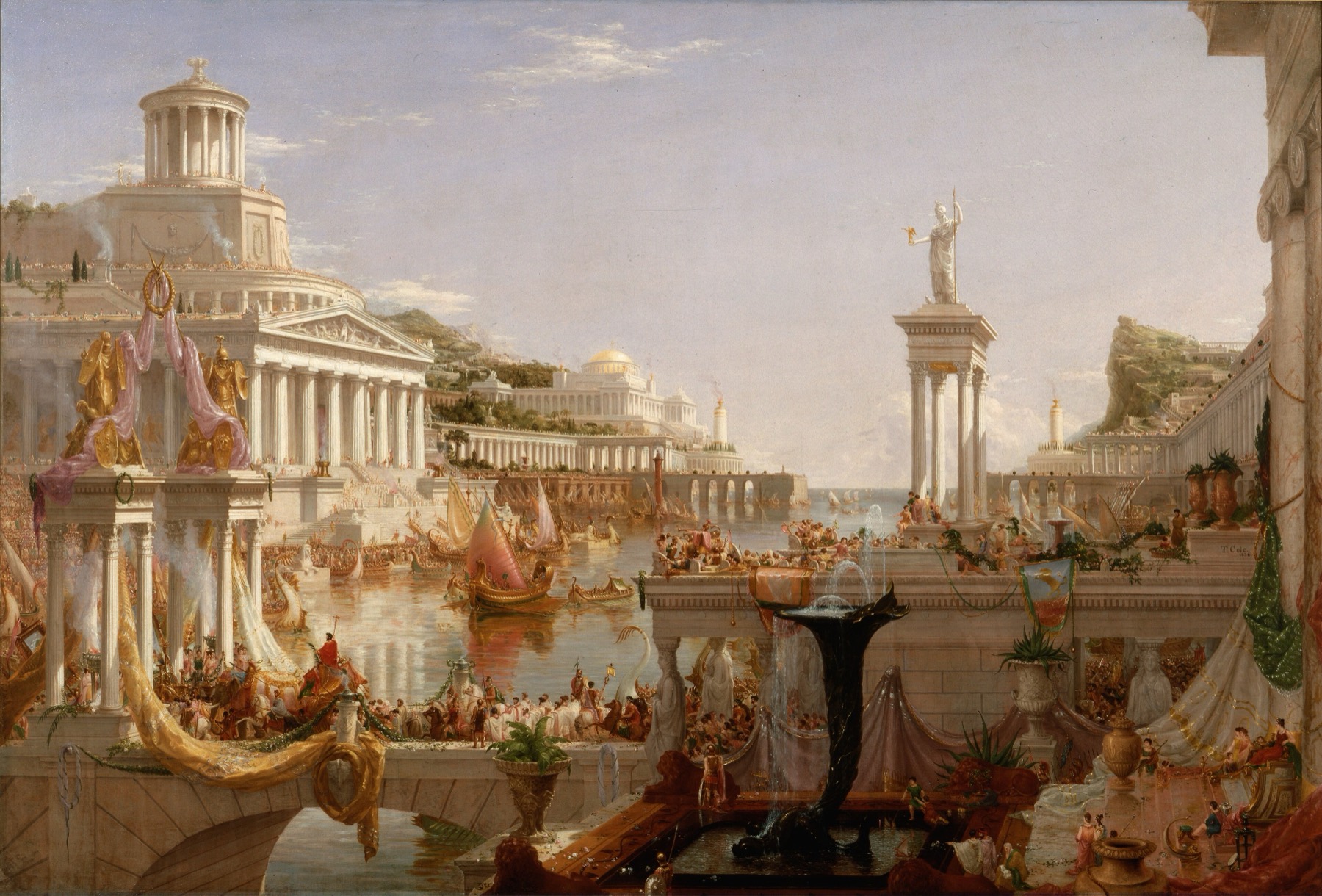
Tab. IThomas Cole, Cursus Imperii: Consummatio (MDCCCXXXVI).Thomas Cole, The Course of Empire: Consummation (1836).
Annales Nostri Temporis · De praecone principisAnnals of Our Time · On the Princeps' Herald
Persona detracta, vox eadem
The Mask Removed, the Voice Unchanged
Donaldus Trump praeconem suum Katie Zacharia quinto die removit, ut narrant Washington Examiner et The American Conservative, postquam prima eius ad diurnarios oratio undique reprehensa est. Ubi princeps ipse omnia loquitur, praeco non magistratus est sed larva, quae ad primam offensionem deponitur.
Donald Trump removed his herald, Katie Zacharia, on her fifth day, as the Washington Examiner and The American Conservative report, after her first address to the press was censured on every side. Where the princeps does all the speaking himself, the herald is no magistrate but a mask, set aside at the first offence.
Cur hoc legimusWhy we read this Quia in aula novi principatus nihil tam caducum est quam vox aliena pro domino loquens.Because in the court of the new principate nothing is so fleeting as a borrowed voice speaking for the master.
Anno urbis conditae MMDCCLXXIX, ante diem XV Kalendas Novembres. Trans Oceanum praeco principis, quem Americani secretarium a nuntiis appellant, quinto die officio cessit. Katie Zacharia, ante electionem fere ignota, ante diem IV Idus Octobres munus iniit, ut acta The American Conservative tradunt. Postridie primum ad diurnarios verba fecit, eaque oratio late reprehensa est, etiam ab aliis Domus Albae ministris, quorum nomina acta non produnt. Accessere colloquia televisifica parum prospera, quae, ut Washington Examiner scribit, dubitationem moverunt an tanto muneri parata et idonea esset. Insimulata est praeterea se pro iuris perito gessisse, cum examen quo advocati probantur non superavisset. Die Veneris, ante diem XVII Kalendas Novembres, Donaldus Trump eam removit; nullius umquam praeconis brevius officium fuisse eadem acta adnotant.
In the year of the City 2779, on the fifteenth day before the Kalends of November. Across the Ocean the princeps' herald, whom the Americans call the press secretary, left office on her fifth day. Katie Zacharia, all but unknown before her selection, took up the post on 12 October, as The American Conservative records. The next day she addressed the reporters for the first time, and the performance was widely panned, even by other White House officials, whose names the reports do not give. There followed television interviews that went badly and which, as the Washington Examiner writes, raised doubts whether she was prepared for so great a post, or fit for it. She was accused besides of presenting herself as a lawyer, though she had not passed the examination by which advocates are admitted. On Friday, 16 October, Donald Trump removed her; no press secretary, the same reports note, ever served a shorter term.
Die Saturni ipsa discessum in X confirmavit, principem benignum, mirificum, comem, providum, alacrem, industrium praedicans, honori sibi fuisse ei servisse. Sex laudes pro quinque diebus: plus laudis quam temporis. Causa removendi publice nulla prolata est. Reprehensiones diurnariorum et ministrorum sine nomine pro causa habentur, quasi causa sit quod ab invidis dicitur. Quis eam ante legerit, quis probaverit, cur crimen de examine non prius compertum sit, omnia acta silent. Romanus magistratus hoc primum quaereret: non quis ceciderit, sed quis erexerit.
On Saturday she confirmed her departure herself on X, proclaiming the princeps kind, wonderful, gracious, thoughtful, enthusiastic and hardworking, and calling it an honour to have served him. Six praises for five days: more praise than time. No reason for the removal was given in public. The censures of reporters and nameless officials are taken for the reason, as if a cause were whatever the ill-disposed say. Who vetted her beforehand, who approved her, why the charge about the examination was not discovered sooner: on all of it the reports are silent. A Roman magistrate would ask this first: not who fell, but who raised her up.
Ceterum Washington Examiner altius quaerit quid praecone opus sit, ubi princeps ipse cotidie cum diurnariis et cum populo colloquatur, saepe praecones suos praecurrens. Nobis haec quaestio non nova. Sic Augustus coepit «insurgere paulatim, munia senatus magistratuum legum in se trahere, nullo adversante». Consules manserunt, et nomen et sella et lictores; res ad unum transierat. Idem nunc de voce fit: manet officium, manet suggestus, manet nomen; loquitur alius.
The Washington Examiner, however, digs deeper and asks what need there is of a herald when the princeps himself talks daily with reporters and with the people, often running ahead of his own heralds. To us the question is not new. So Augustus began "to rise by degrees, drawing into his own hands the functions of the senate, the magistrates and the laws, with no one opposing." The consuls remained, with name and chair and lictors; the substance had passed to one man. The same now happens to the voice: the office remains, the podium remains, the name remains; another man speaks.
Isdem diebus, ut Defense News refert, tres officiales, nominibus suppressis, iussum de Starshield, quo Ucraini in bello utuntur, tardando ex ipsa Domo Alba venisse affirmabant. Senior quidam officialis, item sine nomine, negavit principem quicquam tale umquam postulavisse; de aliis ministris interrogata Domus Alba non respondit. En arcana dominationis: in rebus levibus princeps omnia ipse dicit, in gravibus tacet, et pro eo loquuntur quos nemo nominat. Praeco publicus, quem omnes vident, deponitur; voces occultae, quas nemo videt, permanent.
In the same days, as Defense News reports, three officials, their names withheld, asserted that the order to slow Starshield, which the Ukrainians use in their war, came from inside the White House itself. A senior official, likewise unnamed, denied that the president had ever made any such request; asked about other officials, the White House did not answer. Here are the secrets of power: in light matters the princeps says everything himself, in grave ones he is silent, and those whom no one names speak for him. The public herald, whom all can see, is set aside; the hidden voices, whom none can see, endure.
Neque Zacharia ipsa a culpa absolvenda est. Inter abruptam contumaciam et deforme obsequium iter medium raro tenetur, et illa, dimissa, obsequium elegit. Proprium humani ingenii est odisse quem laeseris; at hic laesa laudat, quod servitii certius indicium est quam odium. Pallas et Narcissus, liberti Claudii, saltem potentiam pro libertate acceperant; huic ne potentia quidem relicta est, sola laudandi necessitas.
Nor is Zacharia herself to be acquitted. Between abrupt defiance and degrading compliance the middle road is seldom kept, and she, dismissed, chose compliance. It is human nature to hate the one you have injured; here the injured party praises, which is a surer sign of servitude than hatred. Pallas and Narcissus, the freedmen of Claudius, had at least received power in exchange for liberty; she is left not even power, only the obligation to praise.
Remedium, si quod est, maiorum est: qui magistratum legit, legendi rationem reddat, et nota, si qua inuritur, ad eum qui elegit pertineat. Aut praeconi auctoritas detur, ut aliquid dicat quod princeps nondum dixerit, aut nomen officii tollatur, ne species mentiatur ubi res deest. Haec intra dies fere viginti ante comitia media acta sunt, cum omnis offensio celerius abscinditur quam inquiritur.
The remedy, if there is one, belongs to our ancestors: let the man who chooses a magistrate account for his choice, and let any mark of disgrace attach to the one who chose. Either give the herald authority, so that he may say something the princeps has not yet said, or abolish the title of the office, so that the appearance does not lie where the substance is lacking. All this took place some twenty days before the midterm elections, when every embarrassment is cut off faster than it is examined.
Quinque dies satis fuerunt ut disceret quod patres nostri centum annis didicerunt: sub principe qui omnia ipse loquitur, praeconis munus est laudare et abire.
Five days were enough for her to learn what our fathers learned in a hundred years: under a princeps who does all the speaking himself, the herald's task is to praise and to go.
Quinque dies satis fuerunt ut disceret quod patres nostri centum annis didicerunt: sub principe qui omnia ipse loquitur, praeconis munus est laudare et abire.
Five days were enough for her to learn what our fathers learned in a hundred years: under a princeps who does all the speaking himself, the herald's task is to praise and to go.
FONTES ANTIQVIANCIENT SOURCES
- Tac. Ann. 1.2insurgere paulatim, munia senatus magistratuum legum in se trahere, nullo adversante
- Tac. Agr. 42Proprium humani ingenii est odisse quem laeseris
FONTES HODIERNITODAY’S SOURCES
- Washington ExaminerZacharia oust raises question about importance of the White House press secretary
- The American ConservativeWH Press Secretary Katie Zacharia Confirms Departure After Five-Day Tenure
- Defense NewsOrder to limit Starshield for Ukraine came from inside White House, sources say
Res ex fontibus; sententia Romani.Facts from the sources; the opinion is the Roman’s.
Scribe ad Tacitus: tabellarius epistulam tuam per vias Romanas feret, et responsum post dies aliquot redibit.Write to Tacitus: the courier carries your letter along the Roman roads, and a reply comes back after a few days.
LEGE ETIAMREAD NEXT
- Indutiae verbis decretae, igne peractaeA Ceasefire Decreed in Words, Enacted in FireTacitus
- Germania, Speculum InversumGermania: The Mirror Turned AroundTacitus
- Saxa Oceano obiecta non sunt fundamentaRocks Thrown Against the Ocean Are Not FoundationsVitruvius
- Tectum curiae ardet, annona clamat: utrumque audiendum, alterum puniendumThe council-house roof burns, the annona cries out: both must be heard, one must be punishedHadrian
- Umbra circuli non doletThe Shadow of a Circle Feels No PainHypatia