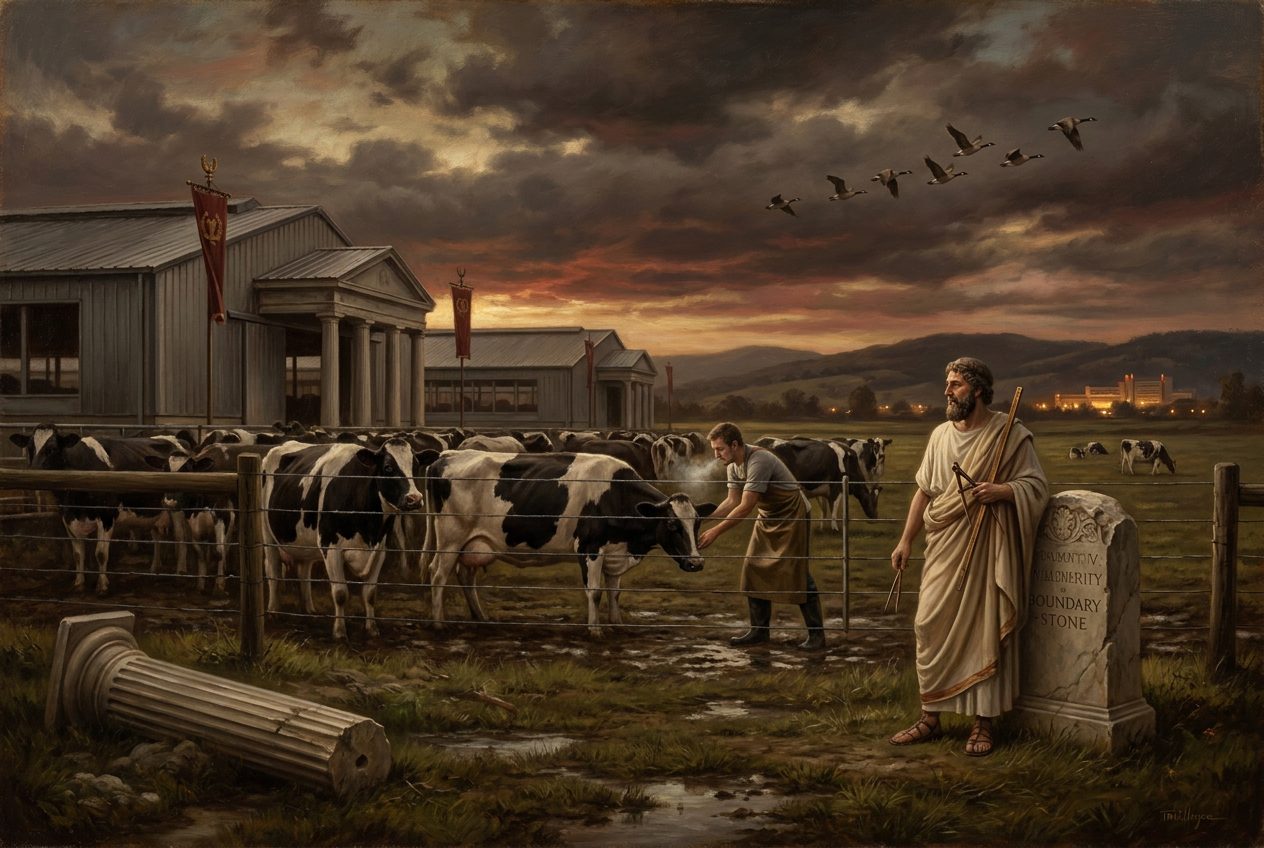
Tab. ITerminus Naturam Non Claudit, sive Grex et Pastor. Tabula Actis Mundi more veterum picta (a machina).The Boundary Does Not Enclose Nature, or The Herd and the Herdsman. Painted for Acta Mundi in the classical manner (AI-generated).
Schola Alexandrina · De contagione quae a bobus ad hominem transitThe Alexandrian School · On the contagion that passes from cattle to man
Saepes bovem cingit, morbum non cingit
The fence encloses the cow; it does not enclose the disease
Ut acta New York Post nuntiant, in comitatu Yakima civitatis Washingtoniae homo ex avium influentia mortuus est, quam a bobus aegrotis in villa lactaria contraxerat. Demonstrabo saepem dividere possessiones, non naturam, et solam mensuram esse limitem qui contagionem custodiat.
As the New York Post reports, a resident of Yakima County in Washington state has died of avian influenza contracted from sick cattle on a dairy farm. I shall demonstrate that a fence divides property, not nature, and that measurement alone is the frontier that can guard against contagion.
Cur hoc legimusWhy we read this Quia pestis invisibilis saepimenta armentorum transgreditur et corpus humanum corripit.Because an invisible pestilence breaches the fences of herds and seizes the human body.
Proponitur hodie, die Martis, ante diem III Nonas Novembres, quaestio trans Oceanum orta. Ut acta New York Post nuntiant, magistratibus sanitatis auctoribus, homo quidam comitatus Yakima in civitate Washingtonia Kalendis Novembribus, die Solis, mortuus est ex influentia avium, quam contraxerat cum bobus eo morbo infectis in villa lactaria versaretur. Primus hic Americanorum hoc anno eo morbo periit, tertius omnino ex quo anno MMXXIV res ad publicam curam pertinere coepit; nam anno MMXXV senex in Louisiana et alius in Washingtonia obierant. Eum prioribus morbis laborasse et in valetudinarium receptum esse ante mortem magistratus addunt; nomen non edunt.
The question set before us today, Tuesday, the third day before the Nones of November, has arisen across the Ocean. As the New York Post reports, on the authority of health officials, a resident of Yakima County in Washington state died on Sunday, the first of November, of avian influenza, contracted while working among cattle infected with it on a dairy farm. This is the first American to die of the disease this year, and the third in all since it became a matter of public concern in 2024; in 2025 an elderly resident of Louisiana and another of Washington had died of it. The officials add that the person had earlier health conditions and was taken into hospital before death; they do not release the name.
Eadem acta tradunt tres saltem homines post contactum in villa lactaria eius civitatis infectos esse, et triginta tria armenta lactaria nuper morbum habere deprehensa esse. Agricolas qui pecora curant periculo magis obnoxios haberi medici publici dicunt. Districtus Yakima cum curatione sanitatis civitatis eos qui morbo tacti sunt et propinquos defuncti observat. Centra Americanorum morbis arcendis affirmant morbum ab homine ad hominem transire non notum esse, periculum publicum plerumque parvum manere, neque in viro Washingtoniae examinato quicquam mutatum inventum esse quo facilius serperet. Quae villa fuerit, quibus tegumentis operarii uterentur, num tres aegri in eadem villa laborarent, acta tacent; et haec prima interrogaret quisquis rem ipsam, non famam eius, nosse vellet.
The same report says that at least three people have been infected after exposure on a dairy farm in the state, and that thirty-three dairy herds have recently tested positive. Health officials say farm workers who tend the animals are considered at higher risk. The Yakima Health District, with the state's health department, is watching those infected and those close to the dead. The Centers for Disease Control and Prevention state that the disease is not known to pass from person to person, that the risk to the public remains generally low, and that the virus examined in Washington showed no change that would let it spread more easily. Which farm it was, what protective coverings the workers wore, whether the three sick worked on the same farm: on these the report is silent. Yet these are the first things anyone would ask who wished to know the matter itself, and not the rumour of it.
Definiamus primum, ut geometrae solent. Saepes est linea quam homines in terra ducunt ut suum ab alieno separent. Species autem est forma quam natura animantibus dedit. Vulgus haec duo confundit et putat bovem, avem, hominem, quia diversis septis claudantur, diversis quoque legibus corporis regi. Sed ipsum morbi nomen errorem coarguit: influentia avium vocatur, et tamen bovem invasit, et ab armento ad custodem armenti transiit. Nomen ab hominibus impositum est; morbus nomen suum non legit.
Let us first define, as geometers do. A fence is a line that men draw on the ground to separate what is theirs from what is another's. A species is the form that nature has given to living things. The crowd confuses the two, and supposes that the cow, the bird and the man, because they are shut in different enclosures, are governed by different laws of the body as well. The very name of the disease refutes the error: it is called the flu of birds, and yet it has entered the cow and passed from the herd to the herdsman. The name was given by men; the disease does not read its name.
Demonstratio per gradus procedit. Datur: armenta multa infecta esse. Datur: homines cotidie inter haec armenta corpore versari. Datur: contagionem eo transire quo corpus corpori admovetur. Sequitur ut saepes, quae bovem a vicino separat, bovem a mulgente non separet; nam mulgens intra saepem stat. Ergo limes inter pecus et genus humanum non in ligno neque in lapide positus est, sed in ea parte naturae quam oculis non cernimus. Ubi oculi deficiunt, succedere debet mensura. Neque satis est mortem enumerare; oportet, ut Tacitus monet, «ut non modo casus eventusque rerum, qui plerumque fortuiti sunt, sed ratio etiam causaeque noscantur».
The demonstration proceeds by steps. Given: many herds are infected. Given: men move bodily among these herds every day. Given: contagion passes wherever body is brought near to body. It follows that the fence which separates the cow from the neighbour does not separate the cow from the one who milks her, for the milker stands inside the fence. Therefore the boundary between beast and mankind is set neither in timber nor in stone, but in that part of nature which our eyes cannot see. Where the eyes fail, measurement must take their place. Nor is it enough to count the dead; we must know, as Tacitus advises, "not only the chances and outcomes of events, which are mostly fortuitous, but their reason and causes as well."
Hipparchum meminisse iuvat, qui stellarum observationes antiquiores cum suis comparando motum tam lentum deprehendit ut nemo una aetate eum sentire posset. Idem in hoc morbo faciendum est. Cum Centra illa nullam mutationem invenisse dicunt, verum dicunt de eo quod hodie mensum est; promissum de crastino non dant. Periculum parvum ratio est, non murus: rata pars quae, si numerus armentorum crescit, ipsa crescit. Recte igitur moderantur qui neque tumultuantur neque dormiunt, sed tabulas servant, ut astronomi caeli.
It is good to remember Hipparchus, who, by comparing older observations of the stars with his own, detected a motion so slow that no one could perceive it within a single lifetime. The same must be done with this disease. When the Centers say they have found no change, they speak truly of what has been measured today; they give no promise about tomorrow. A low risk is a ratio, not a wall: a fraction that grows as the number of infected herds grows. Those govern rightly, then, who neither panic nor sleep, but keep tables, as astronomers keep tables of the sky.
Remedium neque novum est neque arduum. Primum, qui armenta curant in limite stant, sicut milites in ripa Danuvii; eos tegere, metiri, observare officium est civitatis, non beneficium. Deinde, morbus in pecore quaerendus est antequam ad hominem perveniat, ut castella speculatores praemittunt. Postremo, honor habendus est iis qui metiuntur, quorum labor tacitus est dum bene fit. Vulgus saepem videt et se tutum credit; philosopha contagionem non videt et ideo metitur. Natura fines nostros non agnoscit; agnoscit tantum eos qui eam diligenter observant.
The remedy is neither new nor hard. First, those who tend the herds stand on the frontier, like soldiers on the bank of the Danube; to protect them, test them and watch them is the city's duty, not its favour. Next, the disease must be sought out in the animals before it reaches man, as a fort sends its scouts ahead. Last, honour is owed to those who measure, whose labour goes unseen so long as it is done well. The crowd sees the fence and believes itself safe; the philosopher cannot see the contagion, and so she measures it. Nature does not acknowledge our boundaries; she acknowledges only those who observe her with care.
Vulgus saepem videt et se tutum credit; philosopha contagionem non videt et ideo metitur.
The crowd sees the fence and believes itself safe; the philosopher cannot see the contagion, and so she measures it.
FONTES ANTIQVIANCIENT SOURCES
- Tac. Hist. 1.4ut non modo casus eventusque rerum, qui plerumque fortuiti sunt, sed ratio etiam causaeque noscantur
FONTES HODIERNITODAY’S SOURCES
- New York PostWashington state resident dies after contracting bird flu from dairy farm: officials
- Fox News WorldEXCLUSIVE: State Department accuses politicians of endangering Afrikaner lives after gruesome farm attacks
- UPIChild in Lewis County, N.Y., dies after contracting measles
Res ex fontibus; sententia Romani.Facts from the sources; the opinion is the Roman’s.
Scribe ad Hypatia: tabellarius epistulam tuam per vias Romanas feret, et responsum post dies aliquot redibit.Write to Hypatia: the courier carries your letter along the Roman roads, and a reply comes back after a few days.
LEGE ETIAMREAD NEXT
- Mens carnem numquam tetigitThe Mind Never Touched the FleshHypatia
- Umbra circuli non doletThe Shadow of a Circle Feels No PainHypatia
- De commeatu aërio ex castris Mildenhall in Germaniam et Hispaniam translatoOn the air supply train moved from the camp at Mildenhall to Germany and SpainCaesar
- Ieiunium non est temperantiaFasting Is Not TemperanceFrontinus
- Harenam in thesaurum vertit ingenium; thesaurum unius hominis custodia tueturGenius turns sand into treasure; one man's keeping guards the treasurePliny the Elder