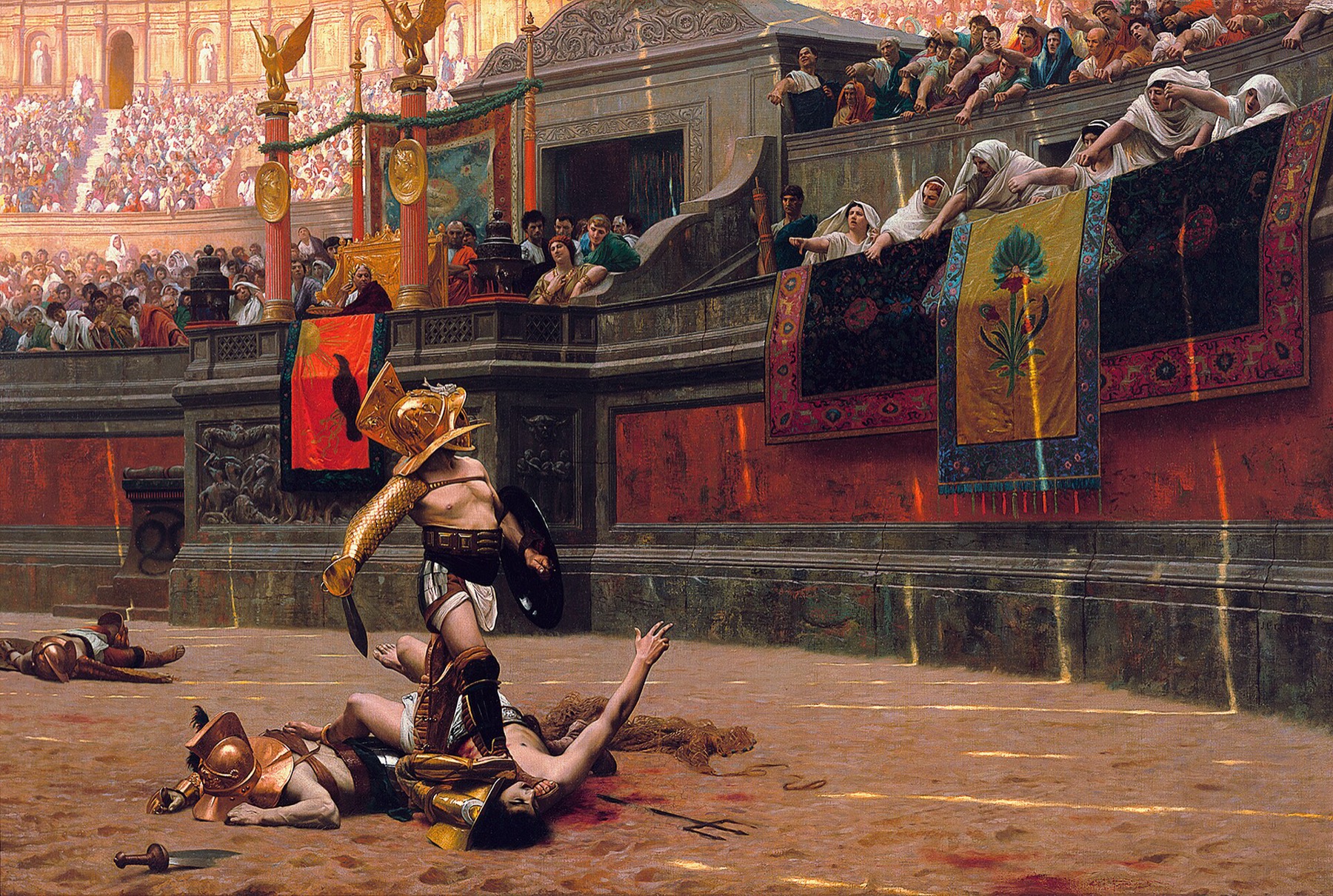
Tab. IIo. Leo Gérôme, Pollice verso (MDCCCLXXII).Jean-Léon Gérôme, Pollice Verso (1872).
Epistulae · De ludis academicis venditisLetters · On college games for sale
Quattuor et viginti turmae, nemo melior
Twenty-four teams, and none the better
Ut acta Breitbart nuntiant, moderatores certaminis ultimi pediludii academici (College Football Playoff) et ESPN pactionem quinque annorum fecerunt qua certamen ad quattuor et viginti turmas augetur et certamina foederum tolluntur. Plinius ludos multiplicatos neque meliores neque magis civiles fieri censet, et academias scholas esse, non circos.
As Breitbart reports, the managers of the College Football Playoff and ESPN have made a five-year deal that enlarges the contest to twenty-four teams and abolishes the conference championship games. Pliny holds that games multiplied become neither better nor more civic, and that colleges are schools, not circuses.
Cur hoc legimusWhy we read this Quia ludi publici mercatorum avaritiae addicti veterem civium amorem corrumpunt.Because public games surrendered to commercial greed corrupt the ancient devotion of citizens.
C. PLINIUS CALVISIO SUO S.
Pliny to his friend Calvisius, greetings.
Scis me circensibus ne levissime quidem teneri. Tamen hodie, die Lunae, ante diem V Idus Novembres, tibi de ludo scribo, nam res magis ad mores quam ad ludos pertinet. Ut acta Breitbart nuntiant, quae sola de hac re ad me pervenerunt, ii qui certamen ultimum pediludii academici apud Americanos moderantur (College Football Playoff vocant) cum ESPN, societate quae spectacula per televisionem divulgat, pactionem quinque annorum fecerunt, septiens deciens miliens centena milia dollariorum aestimatam. Certamen ab anno MMXXVII ad quattuor et viginti iuventutis academicae turmas augebitur. Undeviginti turmae suo iure admittentur, praeterea quattuor victores maiorum foederum, quae Power 4 appellant, quamquam ipsa certamina quibus haec foedera victorem suum declarabant novo ordine tolluntur, una denique ex sex minoribus foederibus electa. Primum certamen ante diem V Idus Decembres anni MMXXVII indictum esse ferunt.
You know that the races have not the slightest hold on me. Yet today, Monday, the ninth of November, I write to you about a game, because the matter concerns manners more than sport. As Breitbart reports, the only account of it that has reached me, those who manage the final championship of college football among the Americans (they call it the College Football Playoff) have made a five-year agreement with ESPN, a company that broadcasts spectacles by television, valued at 1.7 billion dollars. From 2027 the contest will be enlarged to twenty-four college teams. Nineteen teams will be admitted by right, and besides them the four champions of the greater conferences, which they call the Power 4, although the very games in which those conferences used to declare their champion are abolished by the new arrangement; and finally one team chosen from the six lesser conferences. The first game, they say, is fixed for the ninth of December 2027.
Principes certaminis et societatis rem memorabilem praedicaverunt, quae ludum etiam acriorem redderet. Fautores contra, ut eadem acta referunt, avaritiam negotiatorum sub specie boni communis latere clamitant. Maxime offendit Rick Clark, unus ex praefectis certaminis, qui dixit se scire multos fautores incrementum non probare; eam sententiam ponderatam et consideratam et in consilium relatam esse; fautores vitam ipsam ludi esse, quibus optimum certamen deberetur; sed se tamen progredi statuisse. Elegans est hoc dicendi genus: laudat quem contemnit, audit quem non sequitur. Fatebor tamen me hanc ingenuitatem paene malle quam blanditias quas saepe in curia audivi; hic enim saltem non simulat se populo parere. Neque fautoribus nimium indulgeo. Queruntur enim non quod iuvenes studiorum causa in academias missi in histriones vertantur, sed quod lusus suus mutetur; et verum est quod olim scripsi: «nunc favent panno, pannum amant». Nunc autem ne pannus quidem suus est, sed conductus.
The officials of the contest and of the company proclaimed it a historic step that would make the game more exciting still. The fans, on the other hand, as the same report relates, cry out that merchants' greed hides beneath the mask of the common good. What gave most offence was Rick Clark, one of the contest's executives, who said that he knew many fans did not approve of the expansion; that their view had been weighed, considered and taken into the decision; that the fans are the very lifeblood of the game and are owed the finest contest; but that they had nonetheless decided to go ahead. It is an elegant style of speech: it praises those it disdains, and listens to those it does not follow. I confess, though, that I almost prefer this candour to the flatteries I have often heard in the Senate; here at least no one pretends to obey the people. Nor am I too indulgent to the fans. For they complain, not that young men sent to college for their studies are being turned into actors, but that their game is being changed; and what I once wrote is true: "now they favour a cloth, they love a cloth." And now the cloth is not even their own, but hired.
Elegans est hoc dicendi genus: laudat quem contemnit, audit quem non sequitur.
It is an elegant style of speech: it praises those it disdains, and listens to those it does not follow.
Meministi Neronem, qui, ut omnes coronas uno itinere colligeret, effecit ut Graeci sollemnia sua, quae diversis annis celebrari solebant, in unum annum conferrent: ordo maiorum principis voluptati cessit. Hic non princeps, sed societas spectaculorum ordinem anni mutat. Quod mihi gravissimum videtur, certamina foederum tolluntur, in quibus vicinae academiae, quasi municipia finitima, de gloria regionis suae contendebant. Hanc contentionem amor loci alebat, sicut Comum meum de Mediolano gloriari iuvat; novus ordo omnia in unum spectaculum per totam terram divulgandum confundit. Ita fit ut qui olim pro collegio suo et pro regione clamabat, nunc pro tabula lucente in pariete clamet. Neque plura certamina varietatem afferunt: «Nihil novum nihil varium, nihil quod non semel spectasse sufficiat», et quo saepius idem spectatur, eo minus quisquam meminit quid viderit.
You remember Nero, who, so that he might collect every crown in a single tour, had the Greeks gather their festivals, which used to fall in different years, into one: the order of the ancestors gave way to a prince's pleasure. Here it is not a prince but a company of spectacles that rearranges the calendar. What seems to me gravest is that the conference championships are abolished, in which neighbouring colleges, like bordering towns, contended for the glory of their region. Love of place fed that rivalry, just as my Comum delights in boasting over Milan; the new order melts everything into one spectacle to be broadcast across the whole earth. So it comes about that the man who once shouted for his college and his region now shouts for a glowing panel on the wall. Nor do more games bring variety: "nothing new, nothing varied, nothing that one viewing does not suffice for"; and the more often the same thing is watched, the less anyone remembers what he saw.
Quaeres quis lucretur. Acta pecuniam numerant, non dividunt: non dicunt quomodo tanta summa inter foedera et academias dividatur, neque quis rectorum academiarum certaminum foederum tollendorum auctor fuerit, neque an iuvenibus, qui hiberno tempore pluribus certaminibus et itineribus onerabuntur, quicquam inde redeat. Haec ego, si Bithyniam adhuc regerem, ante omnia ad principem referrem; nam Nicomediae didici opera magno sumptu incohata saepe in ruinam, raro in rationes desinere. Academia autem, mi Calvisi, non circus est sed schola; et cum parentes filios eo mittant ut litteris erudiantur, mirum est rectores de numero certaminum diligentius quam de numero librorum deliberare.
You will ask who profits. The report counts the money but does not divide it: it does not say how so great a sum is to be shared among the conferences and the colleges, nor which of the college heads was the author of abolishing the conference games, nor whether anything comes back to the young men, who will be loaded in winter with more games and more journeys. Were I still governing Bithynia, I would refer these questions to the emperor before all else; for at Nicomedia I learned that works begun at great expense often end in ruins, seldom in accounts. A college, my dear Calvisius, is not a circus but a school; and since parents send their sons there to be educated in letters, it is strange that its heads deliberate more carefully over the number of games than over the number of books.
Remedium simplex est et, ut mihi videtur, decorum. Rectores academiarum, qui custodes iuventutis sunt, rationes in medio ponant; quod ex ludis redit, in bibliothecas et studia conferant; hiemem discipulorum ne vendant. Fautores vero, si vere offenduntur, tabulam lucentem exstinguant, nam nulla re certius venditori respondetur quam non emendo. Ego, ut soleo, domi inter libellos sedebo et, dum alii de turmis disputant, «capio aliquam voluptatem, quod hac voluptate non capior». Vale.
The remedy is simple and, to my mind, seemly. Let the heads of the colleges, who are the guardians of the young, lay their accounts open; let what the games bring in go to libraries and studies; let them not sell their students' winter. And let the fans, if they are truly offended, switch off the glowing panel, for nothing answers a seller more surely than not buying. I, as usual, shall sit at home among my books and, while others argue about teams, "take some pleasure in the fact that this pleasure takes no hold of me." Farewell.
FONTES ANTIQVIANCIENT SOURCES
- Plin. Ep. 9.6.2nunc favent panno, pannum amant
- Plin. Ep. 9.6.1Nihil novum nihil varium, nihil quod non semel spectasse sufficiat
- Plin. Ep. 9.6.3capio aliquam voluptatem, quod hac voluptate non capior
FONTES HODIERNITODAY’S SOURCES
Res ex fontibus; sententia Romani.Facts from the sources; the opinion is the Roman’s.
Scribe ad Pliny the Younger: tabellarius epistulam tuam per vias Romanas feret, et responsum post dies aliquot redibit.Write to Pliny the Younger: the courier carries your letter along the Roman roads, and a reply comes back after a few days.
LEGE ETIAMREAD NEXT
- De panno patriae et rosis UrdensibusOn the Flag of the Fatherland and the Roses of UrdaPliny the Younger
- Favent panno etiam trans OceanumThey Cheer for a Colour, Even Across the OceanPliny the Younger
- Pede lumen, voce nihil: theatrum musicum pilae servitLight by the foot, nothing by the voice: the opera house in the service of the ballPliny the Younger
- De commeatu aërio ex castris Mildenhall in Germaniam et Hispaniam translatoOn the air supply train moved from the camp at Mildenhall to Germany and SpainCaesar
- Ieiunium non est temperantiaFasting Is Not TemperanceFrontinus