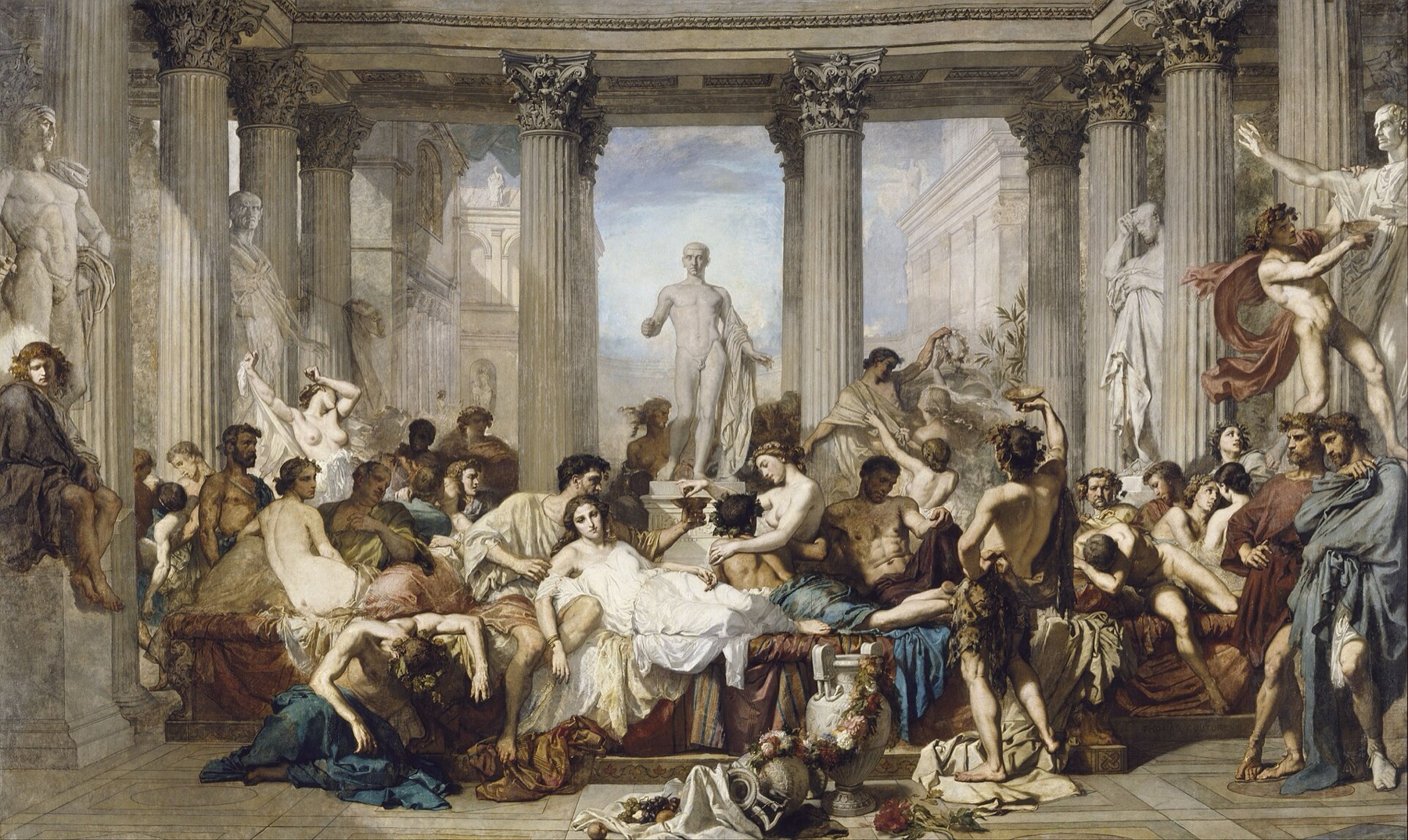
Tab. IThomas Couture, Romani aetatis corruptae (MDCCCXLVII).Thomas Couture, Romans of the Decadence (1847).
Nota Censoria · De villa natanteThe Censor's Mark · On the Floating Villa
Domus quae oleo vehitur oleo deficiente perit
A House That Runs on Oil Dies When the Oil Runs Out
Ut BBC et GB News nuntiant, societas Villa Vie Residences navem Villa Vie Odyssey post dies plus septingentos quinquaginta sistit et vectores circiter ducentos Sihanoukvillae in Cambodia exponit, pretium olei causata. Censor societatem sine arca, deinde morem domus natantis notat.
As the BBC and GB News report, the company Villa Vie Residences has halted its ship, the Villa Vie Odyssey, after more than seven hundred and fifty days, and put some two hundred passengers ashore at Sihanoukville in Cambodia, blaming the price of fuel. The Censor marks first a company with no treasury, then the habit of the floating house.
Cur hoc legimusWhy we read this Quia cives ignavi patriam deserentes ut in navi deliciarum aeternum vagarentur, deficiente oleo, stultitiae suae poenas pendunt.Because idle citizens who abandoned their homeland to wander forever on a ship of luxuries are now paying for their folly when the fuel ran dry.
Die Martis, ante diem VI Kalendas Novembres, societas Americana Villa Vie Residences navem suam Villa Vie Odyssey stare iussit. Ita BBC et GB News nuntiant. Navis ducentos fere metros longa est, sescentos quinquaginta vectores capit. Belfasto mense Octobri anni MMXXIV solverat, navigationem perpetuam circa orbem terrarum pollicita: tres annos et dimidium, prope centum quinquaginta terras. Post dies plus septingentos quinquaginta, in portu Cambodiae Sihanoukvillae, vectores circiter ducenti exire iussi sunt. Coniuges Lanette Canen et Iohannes Bodin BBC narrant praefectum societatis hora sexta matutina edixisse ut ante horam secundam post meridiem navem relinquerent.
On Tuesday, 27 October, the American company Villa Vie Residences ordered its ship, the Villa Vie Odyssey, to stop. So the BBC and GB News report. The ship is nearly two hundred metres long and carries six hundred and fifty passengers. It sailed from Belfast in October 2024, promising a continuous voyage around the world: three and a half years, nearly a hundred and fifty countries. After more than seven hundred and fifty days, in the Cambodian port of Sihanoukville, some two hundred passengers were ordered off. A married pair, Lanette Canen and Johan Bodin, tell the BBC that the company's chief told them at six in the morning to leave the ship by two in the afternoon.
Causam societas affert oleum. Impensam olei menstruam in singula cubicula a mille trecentis quinquaginta libris ad sex milia librarum crevisse dicit, ut GB News refert; BBC a mille octingentis dollariis ad octo milia scribit. Pretia post bellum Iranicum creverunt. Cursum se tardasse, diutius in portubus moratam esse societas affirmat; neque id satis fuisse. Nunc sexaginta dies rebus restituendis et pecuniae novae quaerendae dat. Nullum exitum certum esse ipsa fatetur.
The company blames fuel. It says the monthly fuel cost per cabin rose from £1,350 to £6,000, as GB News reports; the BBC writes from $1,800 to $8,000. Prices rose after the Iran war. The company says it slowed its course and lingered longer in port, and that this was not enough. Now it gives itself sixty days to restructure and find new money. It admits itself that no outcome is certain.
Primum crimen, societatis. Oleum causa non est, sed occasio. Nam BBC docet iam Belfasti, refectione navis tardata, multa deciens centena milia librarum periisse. Pecuniae sponsor navem conscenderat, rationes inspexerat, abierat. Vectores pretium additicium pro oleo solvere rogati erant; cursus graviter decurtatus erat. Coniuges ipsi fatentur se diu scivisse societatem laborare. Qui navem sine arca solvit, is non navigat; a Fortuna pecuniam mutuam sumit. Et cum Fortuna rationem poscit, octo horas dat creditoribus suis. Ego bovem venditurus plus temporis emptori do.
First charge: against the company. Fuel is not the cause. It is the occasion. The BBC tells us that back in Belfast, with the repairs dragging on, millions of pounds were lost. An investor came aboard, inspected the books, and left. The passengers had been asked to pay a fuel surcharge; the itinerary had been cut hard. The couple themselves admit they knew for a long time that the company was in trouble. A man who puts to sea without a treasury is not sailing. He is borrowing from Fortune. And when Fortune calls in the loan, he gives his creditors eight hours. When I sell an ox, I give the buyer more time than that.
Alterum crimen, moris. Homines agrum, focum, patriam relinquunt et 'residentes' se in navi vocant. Domicilium habent quod ventis et pretio olei paret. Maiores nostri aliter iudicabant: «Et virum bonum quom laudabant, ita laudabant: bonum agricolam bonumque colonum». Curius rapas ad focum suum torrebat et aurum Samnitium spernebat. Focum habebat. Hi focum non habent, sed cubiculum conductum quod maria trahunt.
Second charge: against the custom. Men leave their fields, their hearths, their fatherland, and call themselves 'residents' of a ship. Their home obeys the winds and the price of oil. Our ancestors judged otherwise: "When they praised a good man, they praised him thus: a good farmer and a good husbandman." Curius roasted turnips at his own hearth and spurned the gold of the Samnites. He had a hearth. These people have none. They have a rented cabin, dragged about by the seas.
Tertium crimen, sumptus. Ego consul equum meum in Hispania reliqui, ne res publica naulum eius penderet. Hi non equum sed domum totam per maria vehunt, et naulum cottidie crescit. Domus quae oleo vehitur oleo deficiente perit. Ager non ardet in fornace; vinea non bibit oleum Persicum; ovis domum tuam non transfert in alienum portum.
Third charge: against the expense. When I was consul I left my horse behind in Spain so the state would not pay its passage. These people carry not a horse but a whole house across the seas, and the fare grows every day. A house that runs on oil dies when the oil runs out. A field does not burn in a furnace. A vine does not drink Persian oil. A sheep does not move your house to a foreign port.
Domus quae oleo vehitur oleo deficiente perit.
A house that runs on oil dies when the oil runs out.
Lacrimas tamen non rideo. Veras esse credo; dolorem non noto, sed consilium. Quaero autem quod acta tacent: quis pro deversoriis Sihanoukvillae solvit? Quid vectoribus pro pecunia data redditur? Quid nautis fit? Haec nemo nuntiat; censor primum rogaret. Remedium dico. Societas nota censoria notetur, navis vendatur, aes alienum solvatur. Nam «Patrem familias vendacem, non emacem esse oportet». Vectores domum redeant, agellum emant, vites serant. Terra non deficit sub pedibus colentis.
Still, I do not laugh at their tears. I believe them real. I mark not the grief but the judgment. And I ask what the reports leave out. Who pays for the hotels in Sihanoukville? What do the passengers get back for the money they paid? What becomes of the crew? Nobody reports it. A censor would ask it first. Here is the remedy. Let the company receive the censor's mark. Sell the ship. Pay the debts. For "the master of a house should be a seller, not a buyer." Let the passengers go home, buy a small plot, plant vines. The ground does not give way under the man who works it.
Ceterum censeo villas natantes esse delendas.
Furthermore, I hold that floating villas must be destroyed.
FONTES ANTIQVIANCIENT SOURCES
- Cato, Agr. praef. 2Et virum bonum quom laudabant, ita laudabant: bonum agricolam bonumque colonum
- Cato, Agr. 2.7Patrem familias vendacem, non emacem esse oportet
- Cato, Agr. praef. 2Virum bonum quom laudabant, ita laudabant: bonum agricolam bonumque colonum
FONTES HODIERNITODAY’S SOURCES
- GB NewsPassengers left stranded in Cambodia as luxury cruise suspends operations due to soaring fuel costs
- BBC WorldLuxury cruise passengers stranded in Cambodia due to soaring fuel costs
Res ex fontibus; sententia Romani.Facts from the sources; the opinion is the Roman’s.
Scribe ad Cato: tabellarius epistulam tuam per vias Romanas feret, et responsum post dies aliquot redibit.Write to Cato: the courier carries your letter along the Roman roads, and a reply comes back after a few days.
LEGE ETIAMREAD NEXT
- Sexaginta septem laudant, quadraginta octo sequunturSixty-Seven Praise Him, Forty-Eight FollowCato
- Verbum verbo refellitur, non fusteA word is answered with a word, not a clubCato
- Furem Dupli, Feneratorem QuadrupliThe Thief Paid Double; the Usurer, FourfoldCato
- De commeatu aërio ex castris Mildenhall in Germaniam et Hispaniam translatoOn the air supply train moved from the camp at Mildenhall to Germany and SpainCaesar
- Ieiunium non est temperantiaFasting Is Not TemperanceFrontinus