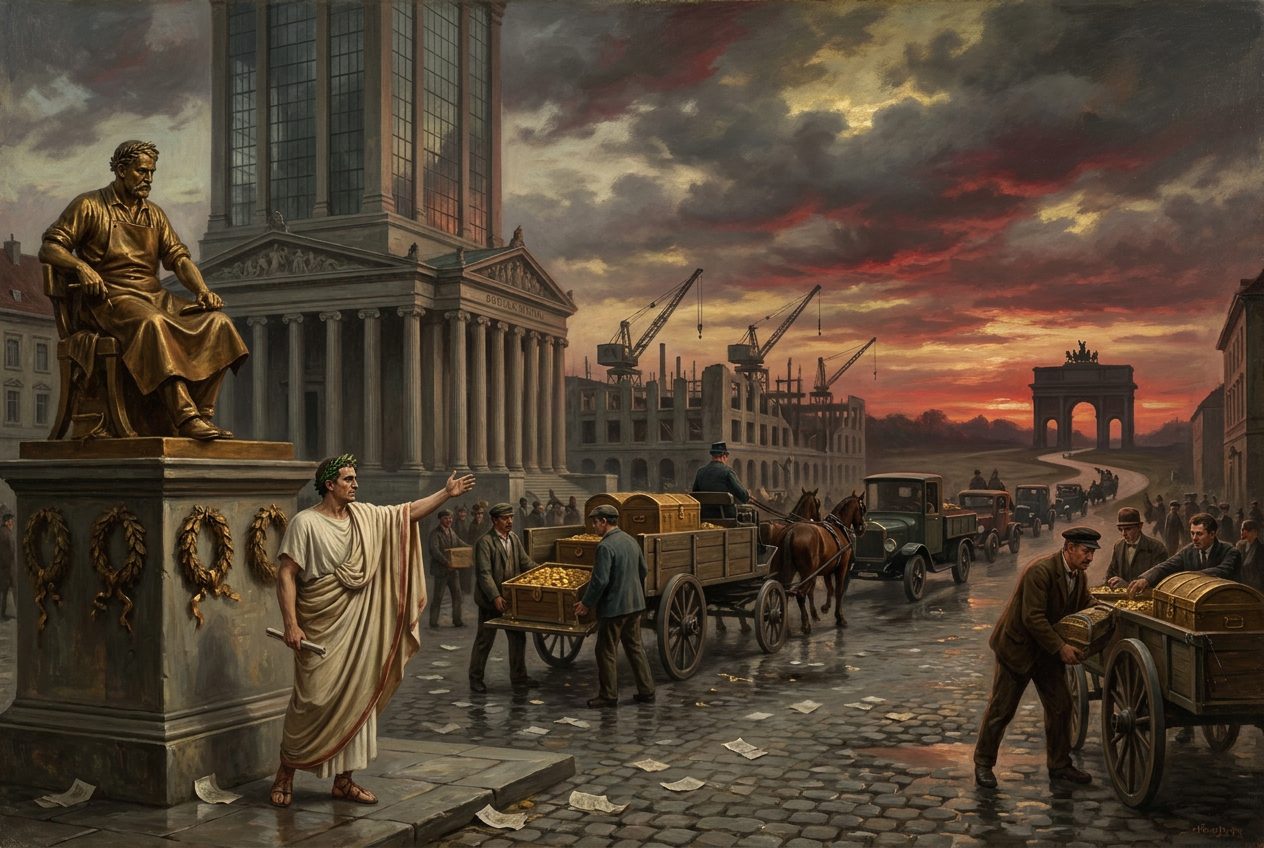
Tab. ILaudes Vacuae, sive Pecunia Trans Limitem Fugiens. Tabula Actis Mundi more veterum picta (a machina).Empty Praises, or Money Fleeing Beyond the Frontier. Painted for Acta Mundi in the classical manner (AI-generated).
Pro Re Publica · De pecunia Germanorum peregrinanteFor the Republic · On German money gone abroad
In laudatores qui dorsum laudant et onus augent
Against the Eulogists Who Praise the Backbone and Add to the Load
Acta quae Tichys Einblick inscribuntur narrant argentariam publicam Germanorum, quam KfW appellant, indicare medias Germaniae officinas pecuniam suam libentius extra fines quam domi collocare. Ego contendo pecuniam non laudationibus sed fide retineri, et magistratus qui verbis tantum mercatores ornant iam funus eorum parare.
The paper Tichys Einblick reports that the Germans' public bank, which they call KfW, finds that Germany's middling firms would rather invest their money beyond the frontier than at home. I argue that money is kept not by praise but by good faith, and that magistrates who honour the merchants with words alone are already preparing their funeral.
Cur hoc legimusWhy we read this Quia inanibus magistratuum laudibus non retinetur pecunia, sed aequitate legum.Because capital is not retained by the empty praise of magistrates, but by the justice of laws.

Quamquam, patres conscripti, nihil in contionibus magistratuum Germaniae tritius auditur quam illud dictum, medias opificum mercatorumque officinas dorsum esse totius rei familiaris gentis, tamen hodie, die Veneris, ante diem X Kalendas Novembres, res nuntiata est quae istam laudationem in risum convertat. Acta enim quae Tichys Einblick inscribuntur narrant argentariam publicam Germanorum, quam KfW appellant, indicare eas ipsas officinas, quas tantopere laudant, pecuniam suam libentius extra fines quam domi collocare.
Although, Conscript Fathers, nothing is heard more threadbare in the speeches of Germany's magistrates than the saying that the middling workshops of craftsmen and traders are the backbone of the whole national household, yet today, on Friday, the tenth day before the Kalends of November, news has come that turns that praise into a joke. For the paper called Tichys Einblick reports that the Germans' public bank, which they call KfW, finds that those very firms, so lavishly praised, would rather place their money beyond the frontier than at home.
Eadem acta ea quae in orationibus diebus Solis habitis recitari solent breviter et non sine irrisione enumerant: fere dimidiam partem omnium qui mercede operantur in parvis mediisque officinis laborare; magnam partem eorum quae gignuntur ibi nasci; easdem officinas municipiis praecipua vectigalia pendere et arcas publicas alere, quibus aegrotis senibusque consulitur. Haec non nego, immo vero libenter confiteor; sed eo gravius quaero, cur tam utiles cives domum suam relinquere malint.
The same paper lists, briefly and not without mockery, the things usually recited in Sunday speeches: that nearly half of all who work for wages labour in small and middling firms; that a great part of what is produced is made there; that these same firms pay the towns their chief revenues and feed the public chests from which the sick and the old are provided for. I do not deny this; on the contrary, I gladly grant it; but all the more gravely do I ask why citizens so useful should prefer to leave their home.
Neque tamen dissimulabo id quod diligens iudex statim animadverteret. Acta nullas tabulas, nullum numerum, nullam argentariae quaestionem proferunt; non dicunt quanta pars pecuniae exeat, quo terrarum, in quas artes, crescatne an minuatur. Accusatorem qui sine tabulis agit ego ipse in iudiciis saepe refutavi, et rationes postulari iubeo antequam sententia feratur. At si res ita se habet, et argentaria quae publica est non solet magistratus suos temere arguere, gravior est causa quam quae silentio praeteriri possit.
Nor will I hide what a careful judge would notice at once. The paper produces no accounts, no figure, no inquiry of the bank; it does not say how great a share of money leaves, for what lands, for what trades, or whether it grows or shrinks. A prosecutor who pleads without accounts I have myself often refuted in the courts, and I order the books produced before sentence is passed. But if the matter stands so, and a bank that is public does not lightly accuse its own magistrates, the case is too grave to be passed over in silence.
Memini, patres conscripti, quo tempore Mithridates Asiam occupavit, Romae in foro fidem concidisse, cum multi pecunias in Asia collocatas amisissent; ita enim cohaeret ratio pecuniarum quae in foro versatur cum ea quae in provinciis, ut altera sine altera stare non possit. Memini etiam consulatum meum, cum perditi homines tabulas novas flagitarent et creditores pecuniam abderent; neque edictis neque minis credita restitui, sed eo quod constanter negarem rem publicam fidem violaturam esse. «Nec enim ulla res vehementius rem publicam continet quam fides.»
I remember, Conscript Fathers, how, when Mithridates seized Asia, credit collapsed in the Forum at Rome, because many had lost the money they had placed in Asia; for the reckoning of money in the Forum is so bound up with that in the provinces that the one cannot stand without the other. I remember too my consulship, when desperate men were clamouring for new account books and creditors were hiding their money; credit was restored not by edicts nor by threats, but because I steadily refused to let the Republic break faith. "For nothing holds a state together more powerfully than good faith."
Pecunia, mihi credite, clientis similis est: patronum quaerit qui defendat, non qui in contione laudet. Quae causae hanc pecuniam foras pellant, acta non dicunt, et ego quod nescio non affirmabo. Quaero tamen, ut senator debet: num leges in dies mutantur, ut nemo sciat quid sibi post annum liceat? num onera ita augentur ut qui domi aedificat stultus videatur? num magistratus officinas laudant dum tributis, impensis, praescriptis eas conterunt? Quicquid responderint, illud certum est: pecunia, quae suffragium in comitiis non habet, pedibus suffragium fert, et hoc suffragium nulla oratione rescinditur.
Money, believe me, is like a client: it seeks a patron who will defend it, not one who will praise it in a public meeting. What causes are driving this money abroad the paper does not say, and what I do not know I will not assert. Yet I ask, as a senator should: are the laws changed from day to day, so that no one knows what he will be allowed a year from now? Are the burdens so increased that the man who builds at home looks a fool? Do the magistrates praise the firms while grinding them down with taxes, costs and regulations? Whatever they answer, this much is certain: money, which has no vote in the assembly, votes with its feet, and no speech can annul that vote.
Laudationes enim, patres conscripti, apud nos mortuis dicuntur. Qui de vivo cive tamquam de mortuo loquitur, eum vereor ne iam funus eius apparet. Nam qui rem publicam gerit non sibi gerit, sed eis qui sibi commissi sunt: «Ut enim tutela, sic procuratio rei publicae ad eorum utilitatem, qui commissi sunt, non ad eorum, quibus commissa est, gerenda est.» Is autem qui laudem sibi quaerit ex eorum nomine quos interim deserit, non tutor est sed praedo verbis ornatus.
For among us, Conscript Fathers, eulogies are spoken over the dead. When a man speaks of a living citizen as though of a dead one, I fear he is already arranging the funeral. For he who governs the state governs not for himself but for those entrusted to him: "For the administration of the state, like a guardianship, must be conducted for the benefit of those entrusted to it, not of those to whom it is entrusted." But the man who seeks glory for himself in the name of those he meanwhile abandons is no guardian; he is a robber dressed in fine words.
Laudationes enim, patres conscripti, apud nos mortuis dicuntur.
For among us, Conscript Fathers, eulogies are spoken over the dead.
Quid igitur censeo? Non edictum quo pecunia domi retineatur; frustra enim senatus noster saepe, me quoque consule, aurum exportari vetuit, nam aurum decreta non audit. Censeo potius ut senatus Germanorum argentariae publicae rationes palam inspiciat, causas fugae quaerat, leges stabiles reddat, onera levet, fidem denique restituat, quae una cives et pecunias domi continet. Hoc si fecerint, laudationibus non egebunt; si non fecerint, laudationes funebres erunt. Qui dorsum laudat et onus auget, is non patronus sed portitor est.
What, then, do I propose? No edict to keep money at home; our own senate often forbade, in my consulship too, the export of gold, and in vain, for gold does not listen to decrees. I propose rather that the German senate examine the public bank's accounts openly, seek the causes of this flight, make the laws stable, lighten the burdens, and in short restore good faith, which alone keeps citizens and their money at home. If they do this, they will need no eulogies; if they do not, the eulogies will be funeral ones. The man who praises the backbone and adds to the load is no patron; he is a customs-collector.
FONTES ANTIQVIANCIENT SOURCES
- Cic. Off. 2.84Nec enim ulla res vehementius rem publicam continet quam fides
- Cic. Off. 1.85Ut enim tutela, sic procuratio rei publicae ad eorum utilitatem, qui commissi sunt, non ad eorum, quibus commissa est, gerenda est
FONTES HODIERNITODAY’S SOURCES
- Tichys EinblickKfW: Deutscher Mittelstand investiert lieber im Ausland
Res ex fontibus; sententia Romani.Facts from the sources; the opinion is the Roman’s.
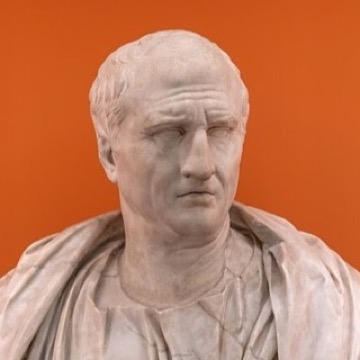
M. Tullius Cicero
Orator, consul, pater patriae — ut ipse non desinit commemorare. Catilinae coniurationem oppressit, rem publicam defendit dum potuit, et Antonii iussu occisus est. Nemo Romanus diligentius res novas ad leges maiorum exegit.Orator, consul, Father of his Country — as he never tires of reminding you. He crushed Catiline’s conspiracy, defended the Republic as long as it could be defended, and was murdered on Antony’s orders. No Roman measured new things against the ancestral constitution more relentlessly.
Haec vox restituta est ex his libris:This voice is reconstructed from:
Scribe ad Cicero: tabellarius epistulam tuam per vias Romanas feret, et responsum post dies aliquot redibit.Write to Cicero: the courier carries your letter along the Roman roads, and a reply comes back after a few days.
LEGE ETIAMREAD NEXT
- De ianitore post clademOn the Doorkeeper after DefeatCicero
- De iure iurando: animum iurantis non suffragio factionis iudicariOn the Oath: The Swearer's Heart Is Not to Be Judged by a Faction's VoteCicero
- De civitate non ad arbitrium factionis eripiendaThat Citizenship Must Not Be Snatched Away at a Faction's PleasureCicero
- De commeatu aërio ex castris Mildenhall in Germaniam et Hispaniam translatoOn the air supply train moved from the camp at Mildenhall to Germany and SpainCaesar
- Ieiunium non est temperantiaFasting Is Not TemperanceFrontinus